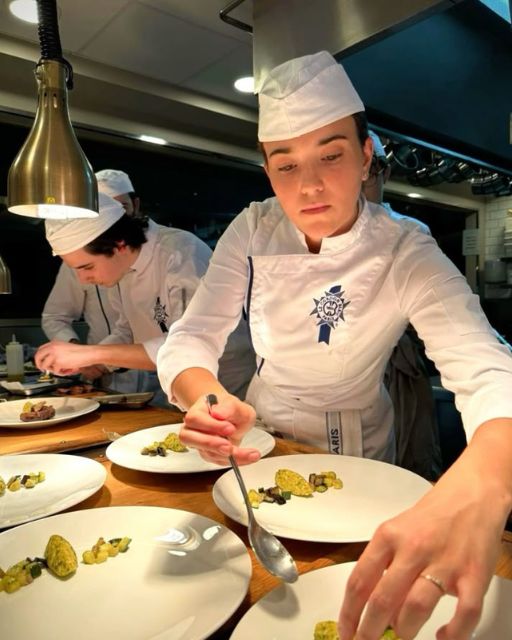
That’s Soraya plating her signature dish like her whole future depends on it—because it kinda does. Last exam of the semester. Michelin chef judging. Her fingers didn’t even shake.
She’d practiced that dish—zucchini mousse quenelles with burnt eggplant crumble—over fifty times in our aunt’s basement kitchen. Every time, she swore it came to her in a dream. “No one’s tasted this before,” she kept saying. “This is mine.”
And I believed her. Until the morning of the showcase, when I opened an old photo album she’d mailed from home. Tucked between two faded pictures of her and our grandma was a menu. Laminated. Yellowing. Dated 1998.
From a defunct restaurant in Tangier.
Same mousse. Same crumble. Even the plate layout was identical. And under the chef’s name? “Y. Idrissi.” Our grandmother.
I didn’t know whether to be proud or horrified. Soraya had sworn she’d come up with it alone.
So I said nothing. Watched her plate it. Watched the judges eat it. Then watched one of them pause, fork midair, brow furrowed like he was trying to place a song.
And then he smiled. “Is this…” he asked, looking at Soraya with a glint of recognition in his eyes. “…from Y. Idrissi?”
My heart dropped into my stomach. I had no idea what to say. My mind was racing. I didn’t even know if I wanted to be the one to break the news to her. But I had to. I couldn’t stand watching her take the credit for something that didn’t belong to her. I knew she loved our grandmother dearly—had always talked about how she wanted to carry on her legacy. But this? This felt different.
Soraya froze, her hand trembling for the first time. “I… I don’t know what you mean,” she stammered. Her voice was shaky, and for the first time since I met her, she looked unsure of herself.
The judge’s smile grew wider. “I remember that dish. Back in the 90s, I worked at a small place in Tangier. That was Y. Idrissi’s signature. She was the kind of chef who created magic from the simplest ingredients.”
Soraya swallowed, her face flushed. “That’s impossible. I created this myself. It’s… it’s my recipe.”
The judge didn’t look convinced, but he didn’t press further. Instead, he politely nodded and took another bite, this time savoring it slowly. I could see the wheels turning in his head as he probably tried to figure out the best way to handle this—whether it was a coincidence or something more.
My mind was spiraling. Was Soraya lying to everyone, or had she truly convinced herself that she was the creator? I didn’t know which one terrified me more.
The rest of the presentation went by in a blur. I kept my eyes on Soraya, who seemed to be getting more and more agitated with every minute that passed. She’d been so proud, so confident before, and now she looked like she might collapse at any second. When the exam ended, the judges gave polite applause, but there was no excitement, no real recognition for her dish.
The waiting game began. I watched Soraya retreat to a corner of the room, her hands tightly clasped together as if she were trying to hold everything in. She looked like she was bracing herself for something.
A few minutes later, the judges gathered and walked up to her. I couldn’t hear what they said, but the expressions on their faces told me everything. Soraya’s eyes widened with each word they spoke.
I stayed where I was, my heart beating out of my chest.
I knew what was coming.
“Miss Idrissi,” one of the judges finally said, “we need to speak with you privately.”
I couldn’t help myself. I had to follow.
Soraya’s face drained of color as she followed them to a side room, and I hesitated for a moment before slipping into the hallway, just enough to hear snippets of their conversation.
“I’ve seen this recipe before,” the judge said. “The question is, did you steal it, or is this all a coincidence?”
“I swear, I didn’t steal it!” Soraya’s voice cracked. “I’ve never even seen that menu before!”
The judge sighed, sounding disappointed. “We’ve already checked the records. Your grandmother’s restaurant in Tangier shut down after she passed away. The dish was famous, and we know it. You’ve presented the exact same recipe, the same plating. You’re going to have to explain how this came to be.”
Soraya went quiet, and I could hear the faintest sobs. I knew she wasn’t crying because she’d been caught. She was crying because she realized something that shook her to her core: she’d never truly created anything herself.
I felt a pang of guilt. How could I have let this go on? How could I have let her believe in her own lie? Was I just as complicit by staying silent? I could have told her the truth, I could have confronted her, but instead, I let her continue with this charade, and now it was all unraveling.
I knew it was too late to change anything now. The damage had been done.
The door to the room opened, and Soraya stepped out, her face red and blotchy. She was no longer the confident, poised woman she had been earlier. She was a mess. Her dream of becoming a celebrated chef had just crumbled to dust.
I approached her, hesitant, unsure of how to speak to her in this moment.
“Are you okay?” I asked softly, stepping closer.
She looked at me, her eyes hollow. “I thought I could do it,” she whispered. “I thought I could be someone like Grandma, someone who could make a name for herself with my own creations. But all I did was copy her. And now… now I’ve ruined everything.”
I wanted to reach out to her, to comfort her, but I didn’t know how. She’d made a mistake, but it wasn’t too late to fix it. I couldn’t let her spiral any further into despair.
“You haven’t ruined anything,” I said firmly. “You’ve just lost your way a little. But that’s okay. It’s never too late to learn. You just need to figure out who you really are as a chef.”
She looked at me, surprised. “What do you mean?”
“I mean, you’re not your grandmother. You don’t have to be. You can still create something that’s yours—something that makes you proud, something that comes from your heart, not from a recipe you found in an old album.”
Her lips trembled, and for a moment, I thought she might break down again. But then, she nodded, slowly, like she was considering what I said.
“Maybe I can still do that,” she whispered.
I smiled, relieved. I knew it wasn’t going to be easy for her, but she’d learned a hard lesson today. The journey to success wasn’t always about winning or proving something. Sometimes, it was about finding your own path, even when the road seemed impossible.
Later that day, Soraya walked up to the judges with a new dish—one she’d come up with in the last few hours. She looked uncertain, but determined. The judges tasted it, and this time, they didn’t hesitate to praise her. It wasn’t perfect, but it was hers.
In the end, she didn’t win that exam. But she found something more important: herself.
She didn’t need to steal a recipe. She didn’t need to live in anyone’s shadow. She was capable of so much more.
As the years passed, Soraya became a name in the culinary world, not because she copied someone else’s greatness, but because she found her own. She built a legacy not on secrets and stolen recipes, but on true talent, dedication, and passion for the art of cooking.
The lesson here? Sometimes the biggest mistakes lead us to the most important discoveries about who we are and what we’re capable of.
If you’ve ever felt like you’ve lost your way, remember: it’s never too late to find your own path. Even if it’s a little messy at first.