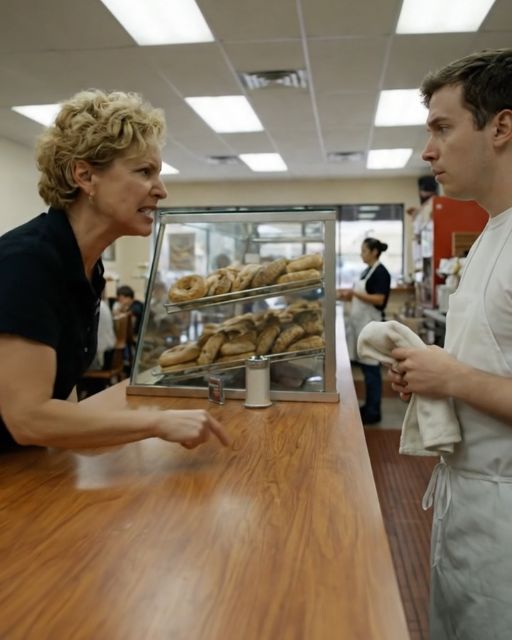
“You’re fired!” my manager, Brenda, shrieked, slamming her hand on the counter. “I saw you give that bum a bagel! That is theft!”
I looked at her in disbelief. “Brenda, it was stale. It was going in the trash.”
“I don’t care! It’s company property!” she yelled, causing customers to stare. “Hand over your apron. Get out.”
I didn’t argue. I took off the apron, tossed it on the floor, and walked out the door. The homeless man, an old veteran named Earl who sat on the corner, looked at me with tears in his eyes.
“I’m so sorry, son,” he rasped. “I cost you your job.”
“Don’t worry about it, Earl,” I said, patting his shoulder. “I have a feeling things are about to change.”
The next morning, I got a text from a coworker. Brenda was in a panic. The franchise owner – a man nobody had ever seen because he ran the business remotely – was coming for a surprise inspection.
I decided to stop by.
When I walked in, Brenda rushed over, her face pale. “What are you doing here? If the owner sees you…”
“I think he wants to see me,” I said calmly.
“You don’t work here!” she hissed.
Just then, a black sedan pulled up. The door opened, and a man in an immaculate suit stepped out. Brenda straightened her posture, put on a fake smile, and rushed to open the door for him.
“Welcome, sir!” she chirped. “I’m Brenda, the manager!”
The man didn’t look at her. He walked straight past her, right up to me, and held out his hand.
Brenda gasped. “Sir, don’t touch him! He’s a thief! I fired him yesterday for feeding a homeless man!”
The owner stopped. He turned to Brenda slowly, reaching into his pocket.
“I know,” he said, his voice ice cold. Brenda visibly relaxed, thinking he was on her side.
“Oh, thank goodness, sir. I was just upholding company policy. Protecting your assets.”
“I was sitting in my car across the street yesterday,” the owner continued, his eyes never leaving hers. “I saw the whole thing.”
Brenda’s knees buckled. But the real shock came when he pulled out a photo from his pocket and showed it to her.
“And the man you called a ‘bum’?” he pointed to the picture. “Take a close look at who he really is…”
Brenda squinted at the faded photograph. It showed two young men in crisp military uniforms, their arms around each other’s shoulders, smiling somewhere in a dusty, foreign land.
One of the men was clearly a younger version of the owner standing before her.
“That’s you,” she whispered, her voice trembling.
“Yes,” the owner said. He then tapped his finger on the face of the other soldier in the picture. The young man had a kind, hopeful face, a shadow of the weathered man who sat on the corner every day.
“And that,” he said, his voice thick with an emotion he could no longer hide, “is my father. Earl.”
The cafe fell silent. You could have heard a pin drop on the tile floor. Brenda stared at the photo, then at me, then back at the owner. Her carefully constructed world was shattering into a million pieces.
“Your… father?” she stammered, the words barely audible. “But… he’s a…”
“A what, Brenda?” the owner, whose name I would soon learn was Arthur, asked quietly. “A war hero? A man who sacrificed everything for his country? A human being deserving of dignity?”
He didn’t raise his voice. He didn’t have to. The weight of his words filled the entire room.
“I’ve been searching for him for five years,” Arthur explained, his gaze now distant, lost in a painful memory. “He came back from his last tour a different man. The war left scars on him that no one could see.”
He looked around the cafe, at the clean counters and the neatly stacked cups.
“He suffered from severe PTSD. One day, he just… left. He couldn’t handle being inside, couldn’t handle the memories. He wrote a note saying he felt like a burden and that we’d be better off without him.”
Arthur’s polished composure finally cracked, and a single tear traced a path down his cheek.
“He was wrong. My mother passed away from a broken heart two years later. I inherited this business, this whole chain of cafes, but none of it mattered. The only thing I wanted was to find my dad.”
He finally looked back at Brenda, his eyes now hard as steel.
“A few weeks ago, a private investigator finally found a lead. A man matching his description, a veteran named Earl, was living on the streets in this city. Right on this corner.”
He gestured toward the window, to the spot where Earl always sat.
“So I came here. I didn’t want to startle him. I didn’t know what state of mind he was in. So I just watched. From my car. For days.”
He took a deep breath.
“I watched him interact with people. Most ignored him. Some sneered at him. Some, like you, looked at him with disgust.”
Brenda flinched as if she’d been struck.
“And then,” Arthur said, turning his gaze to me, “I watched this young man. I watched him every single day.”
He was talking about me. I felt my face flush.
“I saw him bring Earl a coffee every morning, whether it was bought with his own money or was a ‘mistake’ order. I saw him sit and talk with my father when the cafe was slow, asking him about his day, treating him like a person.”
“I saw him give my father a warm pair of gloves when the weather turned cold. He never made a show of it. He just did it.”
The other employees who were working exchanged glances. They had all seen me do those things but had probably been too afraid of Brenda to say anything.
“Yesterday,” Arthur’s voice dropped, becoming a low growl. “Yesterday, I saw the culmination of it all. I saw this employee, on his own time, notice a bag of day-old bagels destined for the garbage. He took one. Just one. And he walked it outside to my father.”
He looked directly at Brenda.
“And I saw you, the manager of my store, a store I built on the principle of community, follow him out and humiliate him. You screamed at him for an act of basic human decency. You called my father a ‘bum’ and this employee a ‘thief’.”
Brenda started to sob, a pathetic, gulping sound. “I… I didn’t know. Sir, I am so sorry. If I had known who he was…”
“That’s the point, Brenda!” Arthur’s voice finally rose, echoing off the walls. “It shouldn’t matter who he is! He could have been any stranger, any person down on their luck. It doesn’t take a family connection to show compassion!”
He shook his head in disgust.
“You don’t get it. You never will. You’re not a manager. You’re a bully who gets a thrill from wielding a tiny bit of power over people you think are beneath you.”
He paused, letting the words hang in the air.
“This young man,” he said, putting a hand on my shoulder, “showed more leadership, more integrity, and more of what this company is supposed to stand for with one stale bagel than you have in your entire five years here.”
Brenda opened her mouth to plead, but Arthur held up a hand.
“I’ve been reviewing the security footage from the past week. I saw you docking pay for employees who were two minutes late. I saw you berating the new girl until she cried in the breakroom. I saw you throwing away perfectly good food at the end of the night while telling my staff they weren’t allowed to take any home to their families.”
He gestured around the cafe. “This isn’t just about my father. This is about everything. You created a toxic environment based on fear and cruelty.”
He looked her dead in the eye. “You are the one who is stealing. You’re stealing the morale of your staff. You’re stealing the dignity of the people in this community. And you are stealing the soul of my company.”
“Brenda,” he said, his voice returning to that ice-cold calm. “Hand over your keys. Get your personal belongings. Get out.”
She didn’t argue this time. With tears streaming down her face, she fumbled in her pocket, pulled out a set of keys, and placed them on the counter. She didn’t even look at me as she scurried to the back room.
Arthur turned to me, his expression softening completely. “I’m sorry you had to go through that. What’s your name, son?”
“It’s Thomas,” I said, my voice a little shaky.
“Thomas,” he repeated, a genuine smile spreading across his face. He extended his hand again, and this time I shook it. It was a firm, warm handshake.
“Thank you, Thomas. For what you did. You showed my father kindness when he needed it most. You saw him when the rest of the world, including his own son for a time, couldn’t.”
“He’s a good man,” I said simply. “He just… had a rough time.”
“I know,” Arthur said, his eyes misting over again. “Now, if you’ll excuse me, I have a reunion that’s been five years in the making.”
He walked toward the door, then stopped and turned back to me.
“Thomas, don’t go anywhere. When I get back, you and I are going to talk about your new position.”
He didn’t wait for a reply. He pushed the door open and walked outside. I, along with every customer and employee in the cafe, watched through the large front window.
We saw Arthur approach his father cautiously. Earl looked up, his eyes wary, used to being chased away or ignored.
Arthur knelt, so he was at eye level with his father. We couldn’t hear what they were saying, but we could see the emotion. We saw Arthur show him the photograph.
We saw Earl’s hands, weathered and trembling, reach out to take it. He stared at it for a long, long time. Then he looked up at Arthur’s face, really looked at him.
And we saw the moment of recognition.
It wasn’t a loud, dramatic movie moment. It was quiet, and all the more powerful for it. Earl’s face crumpled, the tough exterior he’d built for years melting away to reveal the heartbroken father underneath. Arthur wrapped his arms around him, and the two men just held each other on that cold patch of sidewalk.
Father and son, finally reunited.
There wasn’t a dry eye in the cafe.
Brenda emerged from the back room with a box of her things. She saw the scene outside, and a fresh wave of shame washed over her face. She scurried out the back door without another word.
About twenty minutes later, Arthur came back inside, this time with Earl beside him. Earl looked overwhelmed, but there was a light in his eyes I hadn’t seen before.
Arthur guided him to a comfortable booth. One of my coworkers, without being asked, brought over a hot cup of tea and a fresh, warm bagel with cream cheese. Earl looked at it, then at me, and gave a small, grateful nod.
Arthur sat down across from me.
“So, Thomas,” he said, his voice full of a new, lighter energy. “We have a management position open.”
I was stunned. “Manager? Me?”
“Who better?” he asked with a smile. “You’ve already proven you know what’s most important. It isn’t profit margins or inventory control. It’s people. You take care of the people—your staff and your customers—and the rest will follow.”
He leaned forward, his expression serious.
“I want to change the way this company does things. I want every one of my cafes to be a pillar of its community, not just a place that sells coffee. I want to start a new program, a ‘Pay It Forward’ initiative where customers can buy a meal for someone in need. And I want to partner with local veterans’ associations to help men and women like my father get back on their feet.”
He looked at me, his eyes full of hope.
“I can’t do that from a corporate office. I need people on the ground who believe in that mission. People like you. I want you to run this store, Thomas. I want you to make it a model for what all the others can become. I’ll pay for any training you need, and I’ll double what Brenda was making.”
I was speechless. Just yesterday, I was jobless, worried about how I was going to pay my rent. Now, I was being offered a career, a purpose.
“Yes,” I finally managed to say. “Absolutely, yes.”
The next few months were a blur of wonderful change. Earl got the medical attention and therapy he needed. He moved into a small apartment just a few blocks away that Arthur helped him secure. He wasn’t the same man, the war had changed him forever, but he was healing. He started volunteering at the local VA, helping others who were struggling. He would stop by the cafe every single day, not for a handout, but for a chat. He was part of our family.
I took to my new role with passion. We started the ‘Pay It Forward’ program, and it was a huge success. The wall behind the counter was soon covered in colored post-it notes, each one representing a meal or a coffee paid for in advance for someone who needed it. My staff was happier, the atmosphere in the store was warm and welcoming, and business had never been better.
Arthur became a regular presence, not as a distant owner, but as a friend. He saw in his father’s story and my small act of kindness a chance to redefine his own life and the legacy of his family’s business. He found a purpose beyond profit.
Sometimes, life pushes you out of a door you thought was your only option. It feels like the end of the world. But it’s almost always to open a new one, a better one you couldn’t have imagined. My moment came from a stale bagel and a simple choice: to see a human being instead of a problem. That choice cost me a job, but it gave me a future, and it gave a lost father back to his son. It taught me that the smallest act of kindness can ripple outward, changing not just one life, but many.