Basic training was brutal, but nothing like the laughs I got from the guys in my platoon. “Princess Lisa can’t even lift a rifle right,” Gary sneered, flexing for the crowd. I was the only woman, 5’4″ and 120 pounds soaking wet. They bet beers I’d tap out in ten seconds.
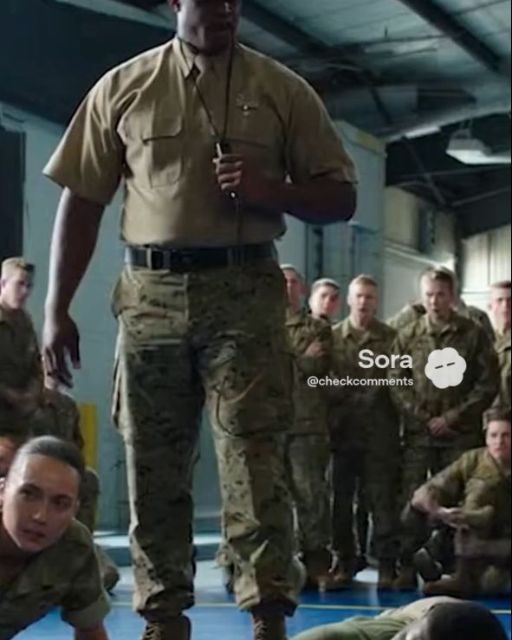
Drill Sergeant Dale paired me with Rick – their 6’3″, 220-pound beast who’d never lost a match. “Let’s see what the girlie’s got,” Rick grinned, circling the mat like a shark.
The whistle blew. He lunged, arms wide to crush me.
My heart pounded. I ducked low, hooked his ankle, twisted his momentum. Boom – he hit the mat face-first. I mounted, locked his arm, cranked till he slapped out.
The whole platoon froze. Jaws on the ground. Rick lay there gasping, eyes wide with shock.
Sergeant Dale grabbed the mic. “Private Lisa wins! But that’s not even the half of it. She’s not here by accident. Because before today, she was…”
I stepped off the mat, sweat dripping, and locked eyes with Rick. His face went ghost white when he saw the tattoo on my wrist.
It was a small, intricate phoenix, its wings curling around a faint, silvery scar that sliced across my skin.
“Before today,” Sergeant Dale’s voice boomed across the silent gym, “Private Lisa was a two-time NCAA national wrestling champion. Division One.”
A collective gasp went through the platoon.
“She was also a Pan-American Judo gold medalist.” Dale paused for effect, letting it sink in. “She is here because she wants to serve. Not because she has to prove anything to any of you.”
He let the microphone drop with a thud.
But Rick wasn’t looking at the Sergeant. He wasn’t hearing the murmurs of the other recruits. His eyes were glued to my wrist, to the scar beneath the ink.
His mouth opened, but no words came out. He scrambled backward off the mat, his confident swagger completely gone, replaced by something that looked a lot like fear.
He knew. He remembered.
The gym might have seen a wrestling champion, but Rick saw a ghost from his past. He saw the girl he and his friends used to call “Mouse” back in high school.
Back then, I wasn’t Lisa the champion. I was Lisa the library nerd, the girl with glasses too big for her face and clothes that were always a size too large.
I was an easy target.
Rick was the king of Northwood High. He was the star quarterback, the guy every girl wanted and every guy wanted to be. And his favorite pastime was making my life miserable.
It wasn’t just words. It was tripping me in the halls, knocking books from my hands. It culminated one afternoon behind the bleachers.
He and his buddies, Gary included, had cornered me. They were laughing, shoving me back and forth. I tried to run, but Rick grabbed my arm, twisting it.
“Where you going, Mouse?” he’d sneered. “The party’s just getting started.”
I slipped on the muddy grass and my wrist scraped hard against a jagged piece of metal sticking out from the bleacher supports. Pain shot up my arm, sharp and hot.
I cried out, and for a second, a flicker of something—maybe concern—crossed his face. But it was gone as quickly as it appeared, replaced by that arrogant smirk when his friends laughed.
They left me there, crying in the mud with a bleeding wrist.
That was my breaking point. That scar wasn’t just a mark on my skin; it was a brand of my weakness.
That night, I made a promise to myself. Never again. Never again would I be a victim.
I begged my dad to enroll me in a self-defense class. He found a local dojo run by a stern but kind old man who taught Judo.
I wasn’t a natural. I was clumsy and weak. But I was determined.
I trained every single day. Before school, after school. The anger and humiliation I felt fueled me. It turned into discipline.
Judo led to wrestling in college. The quiet, mousy girl disappeared, replaced by a focused, powerful athlete.
I had covered the scar with the phoenix tattoo. It was a reminder that I had risen from the ashes of the person I used to be.
Joining the army was the next step. It wasn’t about fighting. It was about belonging to something bigger, a team where strength and skill were all that mattered, not popularity or looks.
I never thought I’d see Rick or Gary again. But fate, it seems, has a twisted sense of humor.
Back in the barracks that evening, the atmosphere was completely different. The guys who had been mocking me were now avoiding my gaze or giving me respectful nods.
“Hey, Lisa,” one of them, a quiet guy named Sam, said. “That was… that was incredible.”
I just nodded, cleaning my rifle.
Gary, on the other hand, was fuming in the corner, muttering to anyone who would listen. “It’s a setup. She’s some kind of ringer. It ain’t fair.”
Later that night, as I was heading to my bunk, a figure blocked the aisle. It was Rick.
He looked smaller without his arrogance. He couldn’t meet my eyes.
“Lisa?” he said, his voice barely a whisper. “From Northwood?”
I didn’t answer. I just stared at him, my expression unreadable.
“I… I saw the scar,” he stammered. “Behind the bleachers. That was me.”
It wasn’t a question. It was a confession.
“I’m sorry,” he said, the words sounding hollow and small in the quiet barracks. “I was a stupid kid. An idiot. There’s no excuse for how I treated you.”
I looked at him for a long moment, the angry, hurt teenager inside me wanting to scream at him, to tell him how he’d made my life hell.
But I wasn’t that girl anymore.
“We were all kids, Rick,” I said, my voice even and calm. “Forget it. We’re soldiers now. We wear the same uniform. That’s all that matters.”
I walked past him and climbed into my bunk, leaving him standing there in the dark.
I thought that would be the end of it. I was wrong.
My skills on the mat earned me respect, but Gary’s resentment only grew. He saw my competence as a personal insult.
During drills, he’d try to sabotage me in small ways. He’d “accidentally” kick dirt in my direction during low crawls or make a loud noise when we were practicing stealth movements.
Rick, to his credit, seemed to be trying. He was quiet, withdrawn. He’d stopped being the platoon’s loudmouth leader and started being just another recruit.
He followed orders without question and kept his head down. Sometimes, I’d catch him looking at me with a complicated expression of guilt and awe.
The real test came during “The Forge,” the final, grueling 96-hour field exercise that would determine if we graduated.
We were exhausted, running on no sleep and a couple of MREs. Our fireteam—me, Rick, Gary, and Sam—was tasked with a night land navigation course.
The rain was relentless, turning the ground into a thick, sucking mud. We were already behind schedule.
“We’re lost,” Gary spat, throwing his compass on the ground. “This is her fault. Princess can’t read a map.”
“I can read the map, Gary,” I said calmly, pointing. “The landmark is just over that ridge. We’re on track.”
“No, we’re not! You’re trying to get us all washed out!” he shouted, getting in my face. His eyes were wild with exhaustion and frustration.
“Back off, Gary,” a low voice said. It was Rick.
He stepped between us, putting a hand on Gary’s chest. He wasn’t aggressive, but his presence was firm.
Gary was shocked. “What’s this? You defending her now? You used to be the one leading the charge against this… this mouse!”
The word hung in the air, a poison dart aimed right at my heart.
I flinched, but Rick didn’t. His jaw tightened.
“I was a punk,” Rick said, his voice filled with a self-disgust that sounded completely genuine. “She’s a better soldier than you’ll ever be. Now pick up your compass and move.”
Gary shoved Rick. “Don’t you tell me what to do!”
In that moment, everything happened at once. As Gary shoved him, Rick stumbled backward, his foot slipping on a patch of wet, slick clay near the edge of a steep, muddy embankment.
He lost his balance, his arms windmilling as he tried to regain his footing.
But the ground gave way. With a cry of surprise, he tumbled over the edge and slid down into the darkness.
We heard a sickening thud, followed by a groan of pain.
“Rick!” I screamed, scrambling to the edge. Sam was right behind me with a flashlight.
The beam cut through the rain, revealing Rick crumpled at the bottom of the twenty-foot drop. He was lying at an awkward angle, his leg clearly broken.
“My leg,” he moaned, his voice strained. “I think… I think it’s bad.”
Gary stood frozen, his face pale with horror. “I… I didn’t mean to.”
There was no time for blame. My training kicked in.
“Sam, radio for a medevac! Give them our coordinates,” I ordered. “Gary, get the first aid kit and find anything we can use as a splint.”
I took the rope from my pack and secured it to a thick tree root. Without a second thought, I rappelled down the slippery embankment to Rick’s side.
His face was contorted in pain. His shinbone was sticking out at a horrifying angle.
“Hey,” I said, my voice steady despite the adrenaline pumping through me. “Look at me. We’re going to get you out of here.”
He looked up at me, his eyes filled with rain and regret. “Lisa… why? After everything…”
“Because you’re my teammate, Rick,” I said, cutting a strip of cloth from his uniform to use as a pressure bandage. “That’s all that matters out here.”
Up top, Gary was snapping out of his shock, frantically breaking branches to use for a splint. Sam was on the radio, calmly relaying our position.
We worked together, the four of us, in the pouring rain. We splinted Rick’s leg as best we could and did our best to keep him from going into shock.
When the medevac chopper finally arrived, its searchlight cutting through the storm, it was the most beautiful thing I’d ever seen.
As they loaded Rick onto the stretcher, he grabbed my hand.
“Thank you, Lisa,” he whispered, his voice thick with emotion. “You saved me.”
“We saved you,” I corrected, nodding toward Sam and a very subdued-looking Gary. “The team saved you.”
Rick was flown out, and the three of us had to finish the course. We didn’t talk much, but we moved with a new unity. Gary was silent and obedient, his arrogance completely stripped away.
We completed the objective just as the sun was rising.
A few weeks later was graduation day. My parents were in the stands, beaming with pride.
Rick was there too, on crutches, his leg in a massive cast. He’d been medically discharged, his army career over before it had even begun.
After the ceremony, he hobbled over to me.
“I guess this is it,” he said, managing a weak smile.
“What will you do now?” I asked.
“Go to college, I think. Maybe become a physical therapist,” he said, looking down at his cast. “I’ve learned a lot about broken bones. And about being a broken person.”
He looked me straight in the eye. “What I did to you in high school… it was a sickness. I was so insecure, I had to tear others down to feel big. Seeing you again, seeing who you became… you didn’t just beat me on the mat, Lisa. You showed me what real strength is.”
He stuck out his hand. “I hope, one day, you can truly forgive me.”
I looked at his outstretched hand, then at his face. I didn’t see the school bully anymore. I saw a young man who had made a terrible mistake and was now paying a price for it.
I saw someone who had, in a moment of truth, chosen to do the right thing and defend me.
I took his hand and shook it. “I already have, Rick. Be good.”
He nodded, a single tear tracing a path down his cheek. He turned and hobbled away, leaving his past behind him.
Gary didn’t graduate. His actions during the field exercise were deemed a catastrophic failure of character. He was sent home.
As I stood there, a newly minted soldier, I looked down at the phoenix on my wrist. I finally understood its true meaning.
Strength isn’t about how hard you can hit or how much you can lift. It’s not about winning matches or proving people wrong.
True strength is about rising from the ashes of your own pain. It’s about having the courage to face your past, the grace to forgive others, and the character to build a better future.
Some battles are fought on a mat, and some are fought in the mud under a stormy sky. But the most important battles are the ones fought within our own hearts. And winning that one is the only victory that truly matters.