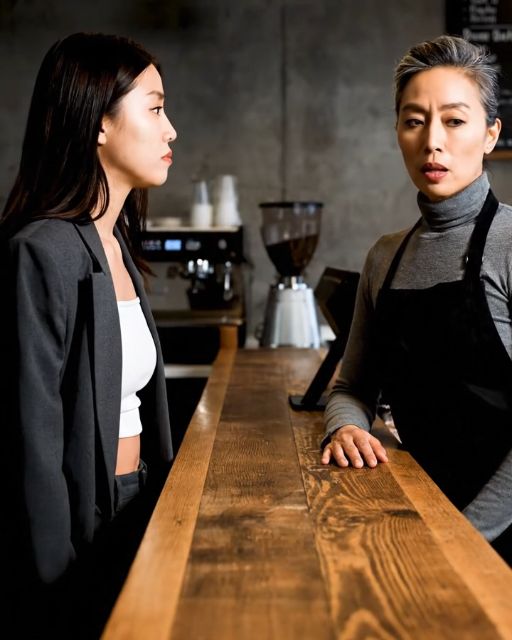
“Do you know who I am?” she snapped, flipping her hair as the café bustled around us. Leah, a local influencer with an attitude to match her followers, had just demanded a free meal in exchange for “exposure.”
The owner, a no-nonsense woman named Karen, wasn’t having it. “Everyone here pays, darling,” she replied, wiping her hands on her apron, eyes steady.
Leah frowned, haughtily pointing at her phone. “I can get you more customers.” The café was already at full capacity, but I watched as Karen calmly leaned closer.
“Then feel free to pay for the others too,” she said, nodding towards the packed tables. Leah gaped at her audacity, her face reddening.
That’s when Karen gestured to a small poster on the counter, declaring a ban on all attempts to exchange social media fame for food. “I’m here to serve meals, not deals,” Karen stated firmly.
Leah spluttered, desperately trying to regain control. But then Karen did something no one expected – she pulled out a list of restaurants Leah had visited before. And as she began reading aloud what those owners said about her under their breath…
“Let’s see,” Karen said, her voice clear and carrying over the sudden hush in the café. “Giovanni’s Trattoria: complained the complimentary bread wasn’t artisanal enough.”
A few customers exchanged glances, their forks paused mid-air.
“The Salty Siren Fish & Chips: sent back a perfectly good piece of cod, claiming it wasn’t ‘photogenic’.”
Leah’s face went from red to a pale, mottled white. “You can’t do this,” she whispered, her voice cracking.
Karen continued, her expression unreadable. “The Oak Barrel Pub: tried to get a discount after ‘finding’ one of her own blonde hairs in her shepherd’s pie.”
A collective gasp went through the room. The silence was now thick with judgment.
This wasn’t just a list; it was a character assassination delivered with the casual efficiency of a daily specials board. It was a compilation of petty tyrannies, of small abuses of power that business owners usually just had to swallow.
Leah looked around wildly, searching for a friendly face, for someone to join her in outrage. She found none.
All she saw were the eyes of regular people, people who worked hard for their money and paid for their lunch without a fuss.
She grabbed her designer bag, her hands shaking. “You’ll regret this,” she hissed, the threat lacking any of its earlier venom.
And with that, she fled, pushing past a couple coming in the door and disappearing onto the busy street.
For a moment, the café was completely still. Then, an elderly man in the corner started to clap, slowly at first, then with more enthusiasm.
Soon, the entire café erupted in applause.
Karen simply nodded, a faint, weary smile on her face. She tucked the list back under the counter and went back to wiping it down, as if she hadn’t just single-handedly dismantled a local celebrity’s ego.
I stayed behind after the lunch rush died down. My name is Alex, and I’m a writer. Karen’s place, “The Daily Grind,” is where I do my best work.
“That was something else, Karen,” I said, nursing my cold coffee.
She sighed, finally sitting down at my table. “I didn’t want to do it, Alex. I really didn’t.”
“But you were prepared,” I noted. “That list was very specific.”
Karen looked out the window, her gaze distant. “I had a friend, Martha. She ran a little bakery a few towns over.”
“Her cakes were legendary,” Karen continued, her voice softer now. “She poured her entire life savings into that place. It was her dream.”
“One day, an influencer came in. Not Leah, someone else, but the same type. Demanded free pastries for a month in exchange for a few posts.”
“Martha, being the kind soul she was, politely declined. Said she couldn’t afford it.”
A shadow crossed Karen’s face. “The girl launched a smear campaign. Said the bakery was dirty, that she got sick. All lies.”
“Martha’s business was destroyed in a week. The online mob was relentless. She had to sell everything, and she lost her dream.”
I finally understood. This wasn’t just about a free sandwich. It was a matter of principle, forged in the painful memory of a friend’s loss.
“I decided then and there,” Karen said, her eyes meeting mine, full of fire, “that I would never let that happen here. I started talking to other owners. We shared stories. That list… it’s been growing for months.”
The next morning, the digital storm broke. Leah posted a video. It was a masterclass in manipulation, filmed in soft lighting with tears glistening in her eyes.
“I was just trying to support a small, local business,” she sniffled into the camera. “And I was met with such cruelty. The owner publicly shamed me and bullied me.”
She never mentioned her demands or the list of her past behaviors. She painted herself as the victim, a benevolent patron scorned by a bitter, angry woman.
The comments section exploded. Her followers, her “Leah’s Legion,” descended like a digital army.
The Daily Grind’s online review pages became a war zone. One-star reviews poured in from people in different states, different countries, none of whom had ever stepped foot in the café.
They called Karen a bully. They called her jealous. They plastered her business with hateful, false accusations.
The café phone began to ring incessantly with prank calls and threats.
By the end of the day, the café’s five-star rating had plummeted to a dismal one and a half.
I went in the next afternoon. The place was nearly empty. Two of her staff had called in sick, too scared to face the potential harassment.
Karen was standing by the counter, looking exhausted but resolute. She was polishing glasses, her movements slow but deliberate.
“It’s bad, isn’t it?” I asked quietly.
She nodded. “Bookings are cancelled. Our suppliers are getting nervous. This is how it starts.”
It felt like watching Martha’s story play out all over again. It felt like hate was winning.
But then, something small happened. An older woman came in, a regular I recognized.
“One black coffee, Karen,” she said loudly. “And I’ve just left you a five-star review. Told them your scones are the best in the county, and your integrity is even better.”
Karen looked up, a genuine, surprised smile gracing her lips for the first time that day.
A few minutes later, a young couple came in. “We saw the news,” the man said. “Frankly, we’re tired of people like her. Two lattes and two of your biggest cinnamon rolls, please.”
Throughout the day, a slow but steady trickle of people came in. Not the usual lunch rush, but something more meaningful. These were people making a conscious choice to stand against the online mob.
That evening, I saw a post from Giovanni’s Trattoria. It was a picture of him and his staff, holding up steaming plates of pasta.
The caption didn’t mention Leah by name. It was more clever than that.
“At Giovanni’s, we believe in honest food and honest work. We applaud business owners who stand up for the value of their craft. Community is built on mutual respect, not demands. #StandWithSmallBiz.”
The post got hundreds of likes. Then, The Oak Barrel Pub posted a picture of a pint. “A toast to those who serve with pride and refuse to be bullied. Cheers.”
A movement was starting. It wasn’t loud and aggressive like Leah’s. It was quiet, firm, and built on shared values.
The real turning point, however, came from a source no one could have predicted.
A young woman named Sarah contacted a local independent news blogger. She said she had a story to tell. She was Leah’s former assistant.
The blog post went live the following night. It was an exposé, complete with screenshots of text messages and emails.
Sarah described a world of calculated cruelty behind the perfect Instagram filters.
She revealed how Leah would instruct her to scout for “easy marks” – new businesses that might be desperate for promotion.
There were texts from Leah: “Find me a place that looks like it’s struggling. They’ll be more grateful.”
Another read: “Make sure you get a pic of me looking ‘disappointed’ with the food before we ask for the manager. Sets the mood.”
The most damning piece of evidence was a short, unedited video clip Sarah had saved. It showed Leah, in her car after leaving a restaurant, laughing with a friend.
“I can’t believe they fell for the hair trick again!” Leah cackled in the video. “Free steak dinner. Easiest money I ever made.”
Sarah’s blog post explained her motives. “I needed the job,” she wrote. “But I couldn’t be part of the deception anymore. Watching people’s hard work and dreams be used as props for a fake lifestyle… it broke my heart. What the owner of The Daily Grind did was brave. She did what I was too scared to do.”
And then came the biggest twist. Sarah revealed it was she who had anonymously compiled and sent the list to Karen weeks ago. She had been sending it to multiple businesses Leah targeted, hoping one day, someone would have the courage to use it.
The story was no longer about a local spat. It became a national conversation about influencer culture, entitlement, and the power of a community standing together.
The backlash against Leah was swift and brutal.
Her carefully curated world shattered overnight. Sponsors dropped her. Her follower count, once her source of power, began to hemorrhage by the thousands every hour.
Her tearful apology video was ratioed into oblivion, with commenters quoting her own words back at her from the exposé.
Her brand was authenticity, and she had been exposed as the ultimate fake.
Back at The Daily Grind, things were different. Very different.
The next day, there was a line out the door and down the block. People came from neighboring towns, even states, not just for coffee, but to support Karen.
News vans were parked across the street. Karen, flustered but gracious, gave a simple statement.
“I’m just a small business owner who believes in hard work,” she said. “The real story here is the community that stood up with me. This victory isn’t mine; it’s ours.”
The café was buzzing with a renewed energy. It became a symbol. People left messages of support on napkins, tucking them into the sugar bowls. Giovanni and the owner of The Oak Barrel Pub came by and hugged her.
A few months passed. The buzz died down, but the loyalty remained. The Daily Grind was more successful than ever.
Karen used her new platform for good. She and a group of other owners, including Giovanni, started the “Small Business Alliance,” a support network to help local entrepreneurs navigate the pressures of the modern world, including online marketing and smear campaigns.
They created a charter of mutual support, a modern-day guild.
Leah vanished from the internet. Her accounts went dormant, a digital graveyard of a life that was never really real.
I was sitting in my usual corner booth one afternoon, writing, just like I always had. The café was warm and filled with the comforting sounds of clinking cups and quiet conversation.
Karen brought my coffee over, her apron still stained with a bit of flour. She looked tired, but happy. Truly happy.
“Look at this place, Alex,” she said, her voice filled with a quiet sense of wonder. “It’s more than just a café now.”
I looked around at the faces. The regulars, the new supporters, the small business owners meeting at a back table. She was right.
It had become a community center, a testament to what can happen when one person decides to stand for something, and others find the courage to stand with them.
The world often tells us that fame is power, that followers equal value. But the truth, the real, lasting truth, is much simpler. True influence isn’t about the noise you can make online; it’s about the quiet integrity you live by every day. It’s found in the respect you earn from your neighbors, the community you build, and the courage to say “no” to what is wrong, even when it’s easier to just give in.
Karen didn’t defeat Leah with a bigger platform or a flashier video. She won with the simple, undeniable power of the truth, and a community that remembered what truly matters.