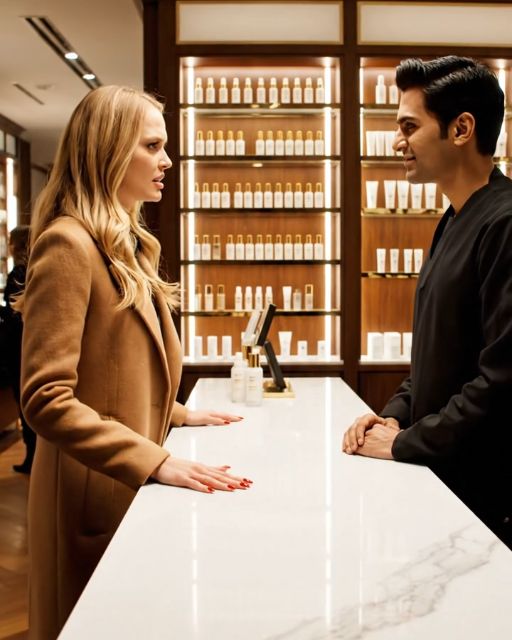
“Listen, I don’t care what your policy says,” the woman hissed, tapping her manicured nails aggressively on the counter. “I want my money back, and I want it now. This soap gave me a rash!”
As a new cashier, I nervously fumbled for the store’s return policy leaflet. “I’m really sorry, ma’am, but without a receipt, it’s against store policy,” I started to explain, but she cut me off with a loud scoff.
“Do you know who I am?” she demanded, eyebrows shooting up to her hairline. The whole line of customers turned their attention to the unfolding drama.
Trying to appease her, I replied, “If you could just show me the receipt…”
With a glare that could melt steel, she rummaged through her oversized designer purse, finally producing a crumpled piece of paper and thrusting it into my face. “Here!”
Relieved to have a potential solution, I took the receipt, flattening it out. But my relief quickly turned to confusion. “Ma’am, this is from a different store,” I said, pointing to the store name printed at the top.
Her face went from red to pale in seconds. “That’s impossible,” she snapped, snatching it back and squinting at it. “But this still doesn’t – “
She stopped cold, her eyes widening in shock as she read the tiny print at the bottom. It wasn’t just a regular receipt. Attached was a note addressed to her, revealing…
A message, written in a familiar, slightly slanted handwriting.
The note was small, printed from a kiosk at the other store, but the words filled her entire world. “For my Eleanor. Just a little something for our anniversary. I love you more than words. Forever yours, Arthur.”
The name hit her like a physical blow. Arthur. Her husband.
He had been gone for six weeks. Six weeks, four days, and about three hours.
The anger drained out of her face, replaced by a deep, hollow confusion. The fancy soap, the supposed rash, the public confrontation – it all evaporated.
The receipt was from a little jewelry shop downtown. It was dated the day before he died.
She hadn’t even remembered their anniversary was next week. How could she have forgotten thirty-two years?
Her hands started to tremble, the crumpled paper shaking like a leaf in a storm. The haughty, demanding woman from moments ago was gone.
In her place stood someone lost, someone fragile. Her composure shattered into a million invisible pieces right there in the checkout aisle.
A tear escaped her eye, then another, tracing a path through her carefully applied foundation. She tried to stifle a sob, but it came out as a choked gasp.
The entire line of customers fell silent. The collective annoyance they’d felt just a minute ago was replaced by an awkward, palpable sympathy.
She fumbled to shove the receipt back into her purse, her movements clumsy and uncoordinated. In her haste, the large bag slipped from her grasp.
It hit the linoleum floor with a loud clatter, its contents spilling everywhere. Lipstick tubes rolled under the candy display, a wallet flopped open, and loose change skittered across the floor.
It was the final humiliation. She bent down, her face burning with shame, trying desperately to gather her scattered belongings.
I didn’t even think. I just came out from behind my register. “Ma’am, let me help you,” I said softly, crouching down beside her.
An older gentleman from the back of the line came forward and started picking up the coins. A young mother with a toddler in her cart handed Eleanor her compact mirror.
No one said a word about the delay. The tension in the air had transformed into a quiet, shared moment of humanity.
Eleanor kept her head down, whispering, “I’m so sorry, I’m so sorry,” over and over again. Her voice was thick with unshed tears.
Once everything was back in her purse, I helped her to her feet. “Why don’t you come sit in the break room for a minute?” I offered. “You can have a glass of water.”
My manager, David, was watching from his office. He gave me a slight, almost imperceptible nod of approval.
Eleanor just nodded, unable to speak, and let me guide her through the swinging doors marked “Employees Only.”
The break room was small and smelled faintly of burnt coffee and disinfectant. I sat her down in one of the wobbly plastic chairs and got her a cup of water.
She took it with a shaking hand. “Thank you,” she whispered, looking up at me for the first time without a trace of animosity. Her eyes were red-rimmed and full of a pain so profound I felt it in my own chest.
“My name is Sam,” I said gently. “You don’t have to explain anything.”
But she seemed to need to. “The note,” she started, her voice cracking. “It was from my husband. He passed away.”
She told me about Arthur. About his goofy laugh and the way he always made her coffee in the morning, exactly how she liked it.
She explained that the last few weeks had been a blur of grief and anger. She was mad at the world, mad at him for leaving, mad at herself for not being able to fix it.
“I found that soap in his medicine cabinet,” she said, looking down at her hands. “It wasn’t his brand. I just… I needed something to be angry about today. Something small I could control.”
The rash wasn’t even real. It was just an excuse, a focal point for the formless, overwhelming sorrow that consumed her.
She smoothed out the receipt on the small table, her fingers tracing the name of the jewelry store. “He bought me an anniversary present. I completely forgot.”
A fresh wave of grief washed over her, and I just sat there, silently offering the only thing I could: my presence.
After a few more minutes, she collected herself, taking a deep, shuddering breath. The mask of the formidable, difficult customer was gone for good.
“Thank you, Sam,” she said, her voice stronger now. “You have no idea what your kindness means to me.”
She stood up, her shoulders a little less slumped than before. “I think I know where I need to go.”
I walked her back out to the main floor. The line was gone, and the store had returned to its normal hum.
She paused before leaving. “I am truly sorry for how I behaved,” she said, making eye contact. It was a genuine, heartfelt apology.
“Everyone has bad days,” I replied. It was the best I could come up with.
She gave me a small, sad smile and walked out the automatic doors, clutching her purse like a lifeline.
I went back to my register, my mind replaying the entire encounter. It was a stark reminder that you never truly know the story behind a person’s anger.
The next few days were a blur of beeping scanners and polite customer service. But I couldn’t stop thinking about Eleanor.
I wondered if she went to the jewelry store. I hoped she found whatever it was Arthur had left for her.
Then, about a week later, she walked into the store again.
She looked different. She wore less makeup, and her hair was styled more softly. The hard, defensive edge she’d carried before was gone.
She came directly to my checkout lane, even though it was the longest, and waited patiently.
When it was her turn, she placed a small basket on the counter. It contained only a single bar of lavender soap – the same kind she had tried to return.
“Hello, Sam,” she said, her voice warm.
“Hi, Eleanor,” I replied, a smile spreading across my face. I was so glad to see her looking more at peace.
“I wanted to thank you again,” she began, her eyes clear and sincere. “You were the first person to show me any kindness in a very long time. It… it changed things for me.”
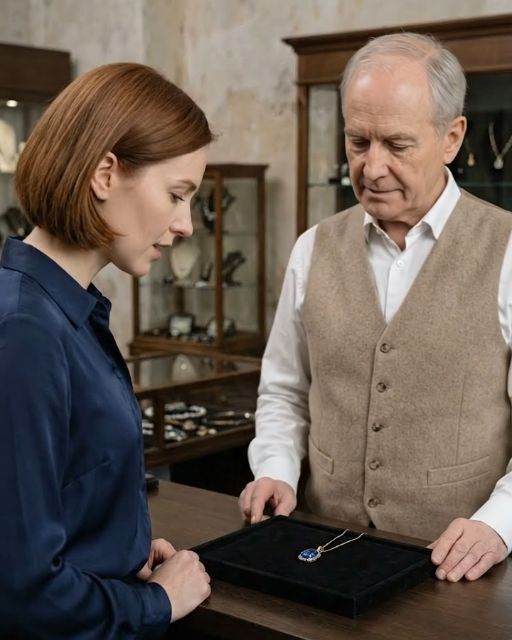
She told me she had gone to the jewelry shop that afternoon. The owner, an old man named Mr. Gable, had remembered Arthur perfectly.
He’d said Arthur was practically glowing with excitement, talking about his “Ellie” and how he couldn’t wait to see her face when she opened her gift.
Mr. Gable retrieved a small, velvet-wrapped box from his safe. It was the gift Arthur had paid for in full, left there for safekeeping until their anniversary.
Eleanor had taken the box to a nearby park, her heart pounding. She sat on a bench overlooking a duck pond, the same one where Arthur had proposed to her thirty-two years ago.
With trembling fingers, she opened the box.
Inside was a beautiful, simple silver locket. It was elegant and timeless, just her style.
She clicked it open, expecting to see a tiny photo of them, or perhaps an engraving. But it was empty, save for a minuscule, tightly folded piece of paper.
Curious, she carefully unfolded it. It wasn’t a love note.
It was a lottery ticket.
Tucked in with it was another tiny note in Arthur’s writing. “For my lucky charm. One last wish for our future. Win or lose, I already hit the jackpot with you.”
It was their little ritual. Every Friday, Arthur would buy a lottery ticket using a combination of their special dates: their birthdays, their wedding day, the day their son was born.
It was never about the money. It was a small tradition, a shared dream of what they would do “when they won.”
Eleanor had the ticket in her purse for two days before she even thought to check the numbers. She expected nothing. It was the gesture that mattered, the final, loving “what if” from her husband.
She finally checked the numbers online, more out of a sense of duty to him than anything else.
She scanned the first number. It matched. Then the second. It matched too.
One by one, she went down the line. All of them matched. Not the Powerball, but all the main numbers.
It wasn’t the hundred-million-dollar jackpot. But it was the second prize. It was enough.
Enough to pay off the house. Enough to set up a college fund for their grandkids. Enough to live comfortably and grieve without the crushing weight of financial anxiety.
It was Arthur’s final act of taking care of her. A piece of luck sent from beyond.
As Eleanor finished her story, my jaw was on the floor. I was speechless.
“The money is a blessing,” she said, her eyes welling up with happy tears. “But the real prize was being reminded of his love. And your kindness, Sam, is what led me there.”
She pushed a thick envelope across the counter toward me. “This is for you. Please, don’t say no.”
I opened it hesitantly. Inside was a cashier’s check made out to me. The amount was staggering. It was enough to pay for my entire college education, with plenty left over.
“I can’t accept this,” I stammered, trying to push it back.
“Yes, you can,” she insisted gently. “Arthur and I always believed in paying kindness forward. He would want this. Think of it as a scholarship from him.”
She also handed me a gift card for the store. “And this is for your manager, David. For hiring such a compassionate young man.”
I didn’t know what to say. I just stood there, completely overwhelmed.
Eleanor paid for her bar of soap, the one she now associated not with anger, but with a final, beautiful gift from her husband.
“I’m going to put his picture in the locket,” she said as I handed her the bag. “And I’m going to be okay.”
She smiled, a genuine, radiant smile that reached her eyes. And then she was gone.
Life is funny. You can stand in the same spot every day, thinking you’re just scanning groceries and counting change.
You don’t realize you’re actually standing at a crossroads in someone else’s story.
That day, I learned that anger is often just grief in disguise. It’s a shield people use to protect a heart that is hurting too much.
And a small act of compassion, a simple offer of a glass of water, can be enough to lower that shield and let the light in.
Eleanor’s gift changed my life, allowing me to graduate debt-free. But her story changed my soul. It taught me to always look past the surface, to treat every person with the assumption that they are fighting a hard battle you know nothing about. Because sometimes, the most important thing you can offer someone isn’t a refund, but a little bit of grace.