I was at my boyfriend’s parents’ house for dinner, and the nerves were eating me alive. This was the first time I was meeting the people who raised Oliver, a man I’d been dating for nearly a year. They lived in a beautiful, sprawling home in a leafy suburb of Manchester, the kind of place where the gravel in the driveway sounds expensive. His mom, Sandra, greeted me at the door with a hug that felt genuine, and the house smelled like slow-roasted lamb and rosemary.
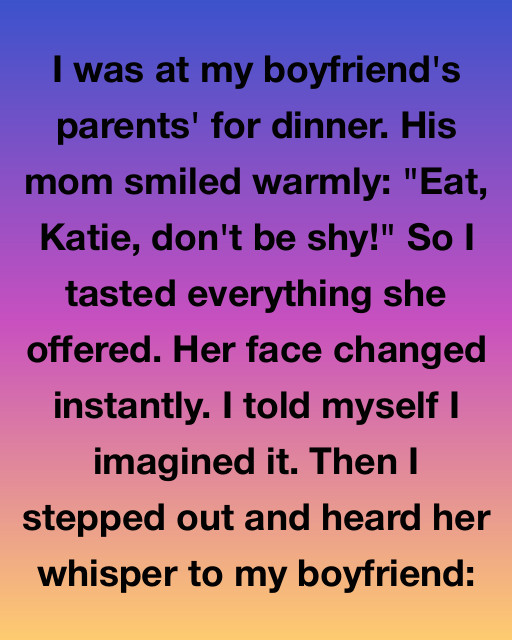
His mom smiled warmly as she set a massive platter of food in the center of the table. “Eat, Katie, don’t be shy! I made all of Oliver’s favorites, and I hope they’re yours too,” she said. I felt a wave of relief wash over me, thinking the horror stories I’d heard about overbearing mothers-in-law were just myths. Oliver squeezed my hand under the table, giving me a reassuring look that suggested I was already part of the family.
So I tasted everything she offered, from the mint-crusted lamb to the rich, buttery mashed potatoes and the honey-glazed carrots. I made sure to compliment every dish, truly enjoying the home-cooked meal after months of takeaway in my tiny flat. But as I reached for a second helping of the roasted potatoes, I noticed something strange. Her face changed instantly, the warm smile replaced by a sharp, clinical look that lasted only a second before she masked it with another polite grin.
I told myself I imagined it, chalking it up to my own social anxiety and the pressure of the evening. We moved on to dessert, a heavy apple crumble that was delicious but left me feeling incredibly full. After dinner, I felt the need to stretch my legs and find the restroom, so I excused myself from the table. The hallway was dimly lit and lined with old family photographs of Oliver and his younger brother, Simon.
As I made my way back toward the dining room, I stopped near the partially open kitchen door. I heard the clatter of silverware being loaded into the dishwasher and the low murmur of voices. Then I stepped out and heard her whisper to my boyfriend, “She has the same appetite as the others, Oliver. Are you sure you can handle another one like her? She’s already at the threshold.”
I froze, my breath catching in my throat as I tried to process what “the threshold” could possibly mean. It sounded like they were talking about a medical condition or some kind of bizarre physical requirement for being in their family. I stood there, hidden by the shadows of the hallway, feeling a sudden and intense sense of intruders’ guilt. Oliver’s response was even more confusing: “She’s different, Mom. She doesn’t know the history yet, so just give her a chance to prove she’s strong enough.”
I retreated to the bathroom, my heart hammering against my ribs like a trapped bird. I looked at myself in the mirror, wondering if I looked “weak” or if I had some visible flaw I hadn’t noticed before. I splashed some cold water on my face, trying to shake off the feeling that I was being judged on some invisible scale. When I finally walked back into the room, I caught Oliver and Sandra sharing a look that felt heavy with a secret I wasn’t part of.
The rest of the evening was a blur of polite conversation and forced smiles. I couldn’t stop thinking about the “others” Sandra had mentioned—who were they, and what had happened to them? Was Oliver some kind of serial dater who brought women home just to have his mother evaluate their eating habits? It felt absurd, but in that big, quiet house, even the most ridiculous theories started to feel plausible.
As we were leaving, Sandra handed me a small, beautifully wrapped box of homemade shortbread. “For your breakfast tomorrow, Katie,” she said, her smile back in place but her eyes remaining oddly watchful. Oliver thanked them, kissed his mom on the cheek, and we walked out into the cool night air. The drive back to my apartment was quiet until I finally couldn’t take the silence anymore.
“Oliver, I heard what your mom said in the kitchen,” I blurted out, watching his profile in the glow of the dashboard lights. He didn’t look surprised; instead, he looked weary, his hands tightening slightly on the steering wheel. “I knew you might hear something,” he sighed, pulling the car over to the side of a quiet road. “My family is… complicated, Katie. It’s not about how much you eat, not really.”
He explained that for generations, the women in his family—his grandmother, his mother, and even his aunts—had suffered from a very rare, hereditary metabolic disorder. It wasn’t life-threatening, but it required a very specific, high-calorie diet to keep their energy levels stable during times of stress. His mother had been testing me to see if I showed any signs of the same “weakness” she saw in herself and the women who had come before her. She wasn’t judging my weight; she was looking for a genetic compatibility that she feared would make my life difficult if I joined their family.
But then, Oliver looked at me, his eyes full of a strange mix of guilt and relief. “The thing is, Katie, I don’t have the disorder, but I am a carrier. My mom is obsessed with finding someone ‘strong’ because she blames herself for my brother, Simon.” He told me that Simon’s wife had the condition too, and their child was struggling because of the double-hit of genes. Sandra wasn’t being a “monster-in-law”; she was a terrified grandmother who didn’t want to see another generation suffer.
I felt a wave of empathy wash over me, replacing the anger I’d been nursing all evening. I realized that her “face changing” wasn’t disgust; it was fear. She was watching me eat, hoping I was healthy, while simultaneously dreading that my appetite meant I was like her. Oliver reached into the glove box and pulled out a small medical report that he had been hiding.
“I went for testing a month ago,” he whispered. “I’m not just a carrier, Katie. I actually have a mild version of it myself, which is why I’m always so tired and why I eat so much more than you do.” He had been hiding his own struggle from me, afraid that I would leave him if I knew he came with a “medical expiration date.” Sandra hadn’t been warning him about me; she had been warning him about himself and the burden he might be placing on me.
The “threshold” she mentioned wasn’t about me being too much; it was about whether I was strong enough to support a man who might eventually need a lot of care. I looked at Oliver, and for the first time, I didn’t see the perfect, athletic guy I’d fallen for. I saw a man who was scared of his own shadow and a mother who was trying to protect her son’s future in the only clumsy way she knew how.
We sat in the car for a long time, the rain starting to tap against the roof. I realized that every family has its ghosts, its hidden debts, and its silent fears. I told him that I wasn’t looking for a perfect person, just a real one. If we were going to be together, we’d handle whatever “thresholds” came our way, whether they were medical, emotional, or anything in between.
The next weekend, I went back to Sandra’s house, but this time I didn’t wait for her to offer me food. I walked into the kitchen, picked up a towel, and started helping her dry the dishes. I told her I knew about the history and that I wasn’t afraid. The wall between us didn’t just crumble; it vanished. She sat me down and really talked to me—not as a judge, but as a woman who had spent forty years carrying a secret.
We spent the afternoon looking through old cookbooks that were filled with high-energy recipes, the “survival guides” of the women in her family. I realized that what I had mistaken for a bizarre dinner test was actually a ritual of survival. The rewarding conclusion wasn’t that the medical issue went away, but that the secrecy did. Oliver started his treatment, Sandra stopped being a watchdog, and I became the person who helped them navigate the truth.
I learned that we often judge people most harshly when we don’t understand their trauma. We see a “mean” comment or a “weird” look and we assume it’s about us, when usually it’s about a battle they’ve been fighting since before we were born. Families are like puzzles with pieces missing; you can’t see the whole picture until you’re willing to look at the parts that don’t fit.
Trust your partner enough to share the “ugly” parts of your history, because the right person won’t run away—they’ll just bring a bigger umbrella for the rain. Don’t let a whispered secret define your relationship; let it be the conversation that finally makes you a team. Life is too short to eat alone, and it’s definitely too short to hide the truth from the people who love you.
If this story reminded you that everyone is fighting a hidden battle, please share and like this post. You never know who might need a reminder to be a little kinder to the “difficult” people in their lives. Would you like me to help you find a way to talk to your partner or their family about a difficult secret you’ve been carrying?