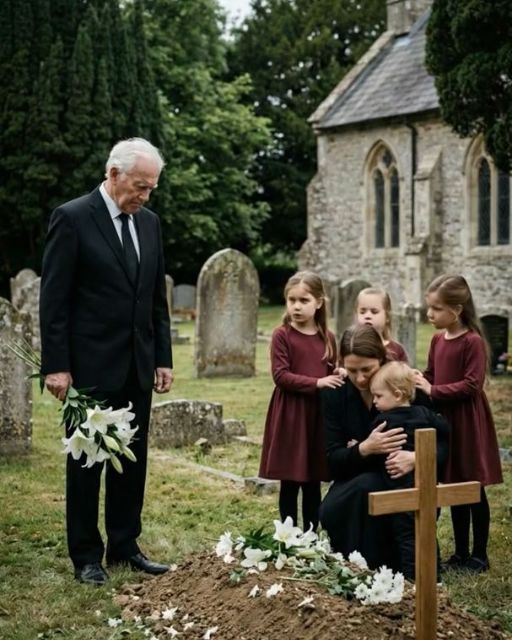
For six months, I did the same thing. Every Sunday morning, my driver would drop me at the gate of the cemetery, and I would walk the rest of the way alone. I carried flowers for my son, Ethan. He died in a car crash. A drunk driver, the police said. He was my only child.
We weren’t on good terms when he passed. He hated my business, my money, everything I’d built. He wanted to save the world. I wanted him to take over the company. The last words we had were angry ones. Now I’d give anything to take them back.
Yesterday was different. As I stood at his headstone, I saw a woman a few rows over. She was trying to wrangle four little kids. They were being loud, and I was about to say something when one of them, a boy of about six, looked right at me.
My heart stopped.
He had Ethan’s eyes. The same deep blue, the same serious look. I walked over, my legs feeling like stone.
“Excuse me,” I said. My voice was rough. “That boy… he looks familiar.”
The woman, Sarah, went pale. She pulled the kids behind her. “We’re just leaving,” she said, her voice tight.
“My son is buried over there,” I said, pointing. “His name was Ethan Caldwell.”
Her face crumbled. “Oh, God,” she whispered. She looked from me to the headstone, then back. The kids were staring. I could see it in all of them now. A piece of my son’s face in each of theirs.
“They’re his, aren’t they?” I asked. It wasn’t a question.
She nodded, tears running down her cheeks. “I’m so sorry. He made me promise I’d never…”
I felt a surge of something that wasn’t grief. It was hope. “I’m their grandfather,” I said, my voice thick. “I can help you. Whatever you need, it’s yours.”
Sarah shook her head, backing away. “No. You don’t understand. You can’t.”
“Why not?” I demanded. “My son is gone. But his children… they’re my bloodline.”
She took a shaky breath and looked me dead in the eye. “Mr. Caldwell,” she said, her voice barely a whisper. “Ethan didn’t die in a car crash. There’s nothing in that box. He took money from very bad people to stage the whole thing. He did it to get away from…”
Her voice trailed off, but her eyes never left mine. She didn’t have to finish the sentence. The way she looked at me, at my expensive suit, at the glint of my watch, said it all.
“…from you,” I finished for her, the words tasting like ash.
She flinched but didn’t deny it. She just gathered her children, herding them towards the cemetery gate like a frightened mother hen. The little boy with Ethan’s eyes gave me one last look over his shoulder. It was a look of pure, childish curiosity, and it broke my heart into a million new pieces.
I stood there, rooted to the spot, long after they were gone. The flowers I’d brought for Ethan felt heavy and useless in my hand. I was staring at a block of granite that marked an empty box. My grief for my son was suddenly replaced by a confusing, raging storm of betrayal, anger, and a desperate, aching hope.
He was alive.
My son was alive.
The drive home was silent. I didn’t see the city blurring past the window. I saw Ethan’s face as a boy, then as a teenager, then as the angry young man he’d become. I replayed our last argument in my head, the one where I called his dream of starting a non-profit “a waste of a good mind.” He’d told me my money was poison. I’d told him he was ungrateful.
Had I driven him to this? To fake his own death just to escape me?
The moment I walked into my penthouse, I called Arthur, my head of security and the closest thing I had to a friend. He was at my side in twenty minutes, his face calm and professional.
“Find them,” I said, my voice flat. “The woman, Sarah, and the four children. Find out everything. And Arthur… be discreet. No one can know.”
He simply nodded. Arthur didn’t ask questions.
The next two days were the longest of my life. I went to the office and stared at spreadsheets, the numbers meaningless. I sat in board meetings, the voices of my executives a dull drone. All I could think about was an empty coffin and a little boy with my son’s eyes.
Arthur called on Tuesday night. “I’ve found her, sir. She lives in a small apartment complex in the east end. Two bedrooms. She works as a waitress. It’s not an easy life.”
He sent me the address. I told my driver I wouldn’t need him. I drove myself for the first time in years, my expensive car feeling alien and obscene as I pulled into the crumbling parking lot of her building.
I sat there for an hour, just watching the lighted window on the third floor. What was I going to do? Barge in and demand my rights as a grandfather? Throw money at her until she let me in? That was the old me. That was the man Ethan ran from.
I had to be different.
I went back the next day in the afternoon. I knocked on her door, my heart pounding like a drum.
She opened it a crack, her face immediately hardening when she saw me. “You need to leave,” she said, trying to close the door.
I put my hand on it, gently. “Please, Sarah. I’m not here to cause trouble. I just want to understand.”
The little boy with Ethan’s eyes peeked out from behind her legs. “Is that the sad man from the flower place, Mommy?” he asked.
Sarah’s resolve seemed to melt at his words. She sighed and opened the door wider. “You have five minutes.”
Her apartment was small but clean. Toys were neatly stacked in a corner. Drawings were taped to the refrigerator. It was a home filled with a love that my vast, empty penthouse had never known.
“Ethan and I met in college,” she began, not bothering to offer me a seat. “We fell in love. He had these huge dreams. He wanted to build shelters, start food banks. He didn’t want your name or your money.”
She told me how Ethan had tried to get funding for his projects, but doors were always closed. He started taking odd jobs, but with four kids on the way, it was never enough. He got desperate.
“That’s when he met them,” she said, her voice dropping. “A private investment group. They promised him the world. They gave him the seed money for his first project, a community kitchen.”
“The ‘bad people’,” I said.
She nodded. “It all went wrong so fast. The kitchen was a success, but they wanted more. They weren’t investors, they were sharks. The interest rates were impossible. They started threatening him. Then they started threatening me, and the kids.”
I felt a cold dread creep up my spine. This was my fault. If I had just listened, if I had supported his dream instead of trying to force him into mine, he never would have been in that position.
“He was too proud to come to you,” she said, as if reading my mind. “He said you’d just say ‘I told you so’ and take over, make it yours. He wanted to fix it himself.”
But he couldn’t. The debt grew. The threats became more real.
“One night, he came home, his face ashen,” Sarah continued, her eyes distant. “He said there was only one way out. He’d found a way to make it look like he died. The investors would write off the debt, and we could disappear. Start over.”
“So he took their money to fake his death?” I asked, trying to piece it together.
“No,” she said, shaking her head. “That’s the part you don’t understand. It was worse than that.”
Before she could explain, the door to the apartment opened and a tall man walked in, carrying a bag of groceries. He froze when he saw me.
It was Ethan.
He looked older, thinner. There were lines of worry etched around his eyes that hadn’t been there before. But it was him. My son. Alive.
“Dad?” he whispered, his voice cracking. The bag of groceries slipped from his hand, oranges and apples rolling across the worn linoleum floor.
For a moment, nobody moved. The only sound was a cartoon playing on the small television in the corner. I couldn’t breathe. I couldn’t think. All the anger, all the hurt, it just vanished. All I could see was my boy.
“Ethan,” I managed to say.
He looked at Sarah, a panicked expression on his face. “How? I told you…”
“He found us at the cemetery,” she said softly.
I took a step towards him. “Ethan, I don’t understand any of this. But we can fix it. Whatever it is, I can pay them off. I can make them go away.”
A bitter laugh escaped his lips. “You still think money fixes everything, don’t you? You have no idea what you’re dealing with.”
“Then tell me!” I pleaded, my voice raw. “Tell me what happened.”
And so he did. He sat me down at their small kitchen table while the children played in the other room. He told me the name of the man he was indebted to: Marcus Thorne. The name was familiar. Thorne was a ruthless real estate developer, a man I’d competed against on a few deals. He was known for his shady, borderline illegal tactics.
“His ‘investment group’ was a front,” Ethan explained. “He was laundering money through these small, feel-good charity projects. He’d give me ten thousand for the kitchen, but the books would show fifty thousand. He was washing his dirty money and using my dream to do it.”
My blood ran cold.
“I found out,” Ethan said, his voice low and intense. “I found the real ledgers. I saw the scope of it. It wasn’t just my kitchen. It was dozens of small charities. He was a parasite, feeding off good intentions.”
This was the twist. My son wasn’t just a debtor on the run.
“I couldn’t go to the police,” he went on. “Thorne has people everywhere. They would have buried me, and he would have come after Sarah and the kids. So I made a plan. I copied all his files. I took every last dime he’d given me, and a lot more that he’d laundered through my accounts.”
“You stole from him?” I asked, stunned.
“I took it back,” he corrected me, a fire in his eyes I hadn’t seen since he was a teenager. “And I gave it away. Every penny. I found the other charities he was bleeding dry and made anonymous donations to all of them. Then, I staged the crash. I paid off a coroner, got a death certificate. I disappeared so Thorne would think the trail went cold with me.”
I stared at my son, truly seeing him for the first time. He hadn’t run from a problem he’d created. He’d run into a fire to save others, and then orchestrated an impossible escape to protect his family. He wasn’t a failure. He was a hero.
And he did it all without me.
“Now he’s looking for the money,” Ethan finished. “He doesn’t believe I’m dead. He thinks I’m out there somewhere, living on his fortune. His people are everywhere. That’s why we move every few months. That’s why we live like this. We can never be safe as long as he thinks I have his money.”
I finally understood the depth of his fear. It wasn’t just about debt. It was about survival.
I stood up. “No more,” I said, my voice filled with a new kind of certainty. “This ends now.”
Ethan looked at me with suspicion. “What are you going to do? Write him a check?”
“No,” I said. “I’m going to fight him. But I’m going to do it my way. On my battlefield.”
For the next week, I became the man Ethan had always hated. I unleashed the full power of Caldwell Industries. My corporate intelligence team, the best in the world, started digging into every aspect of Marcus Thorne’s life. My lawyers, a pack of sharks in thousand-dollar suits, began looking for any legal weakness.
We found it. Thorne was clever about his money laundering, but he was sloppy with his taxes. He was arrogant. He thought he was untouchable.
I arranged a meeting. Just the two of us. He agreed, likely thinking I was coming to pay my son’s debt. We met in a private room at a downtown restaurant, a place where deals were made and fortunes were won and lost.
Thorne was smug, confident. “Mr. Caldwell,” he said with a thin smile. “To what do I owe the pleasure? Come to clean up your boy’s mess?”
I didn’t say a word. I just slid a thick, leather-bound folder across the table.
He opened it. His smile slowly faded as he flipped through the pages. They were copies of his offshore bank statements, evidence of his tax evasion, sworn affidavits from disgruntled former employees. It was his entire criminal enterprise, laid bare on paper.
“This is all a fabrication,” he hissed, but the sweat on his brow told a different story.
“My sources are impeccable,” I said calmly. “One copy of that folder is with my lawyer. Another is in a bank vault. A third is addressed to the IRS. If anything happens to me, to my son, or to his family… if I so much as get a flat tire… all of them get sent.”
I leaned forward, my voice dropping to a whisper. “You’re going to forget Ethan Caldwell ever existed. You will call off your men. You will erase his name from your memory. You are going to disappear from my family’s life. In return, I will let you keep your freedom. Do we have an understanding?”
He stared at the folder, then at me. The smugness was gone, replaced by the cold, hard look of a cornered animal. He knew he’d lost. He slowly nodded.
I stood up and walked out without another word.
That night, I went back to Ethan’s apartment. I told him it was over. He and Sarah just looked at me, not quite believing it.
“He’s gone,” I said. “He won’t bother you again. You’re free.”
Tears streamed down Ethan’s face. He didn’t say thank you. He just stood up and hugged me. He wrapped his arms around me, and for the first time in over a decade, I hugged my son back. All the years of anger and misunderstanding melted away in that one moment.
We didn’t fix everything overnight. The wounds were deep. But we started to talk. I didn’t try to offer him a job or a trust fund. Instead, I offered him my time.
I started spending weekends with them. I taught my grandson, little Daniel with the serious blue eyes, how to build model airplanes. I read stories to his sisters. I watched Sarah and Ethan, and saw the deep, resilient love that had gotten them through it all.
I sold my penthouse and bought a large house with a big backyard, not far from them. One day, Ethan came to me with a business plan. It was for a new non-profit, a real one, designed to help families get back on their feet.
“I can’t do this on my own,” he said, looking me in the eye. “I need a partner.”
My heart swelled with a pride so fierce it almost hurt. This was all I had ever wanted. Not for him to be like me, but for him to let me be a part of his world.
We built the foundation together, side-by-side. My business acumen and his passion. It was a perfect match. I finally understood that my son’s desire to save the world wasn’t a childish fantasy. It was his strength. It was his legacy.
I still visit the cemetery sometimes. But I don’t go to Ethan’s headstone. I walk past it, to a small, simple grave I purchased for a man who died alone many years ago, a man who had no one to bring him flowers.
I stand there and I think about how close I came to being that man. Rich, powerful, and utterly alone. My son faking his death was the most painful thing that ever happened to me, but it was also the thing that woke me up. It forced me to see that the greatest fortune I could ever build wasn’t made of money or skyscrapers, but of forgiveness, second chances, and the simple, priceless gift of family. It’s a lesson I was almost too late to learn: the most important things in life aren’t the things you own, but the people you hold.