I went to my son’s grave every single week. Same time, same flowers. It was my routine. It was the only thing I could control since I lost him. I am a CEO. I am used to being in charge of everything. In my world, there are no surprises.
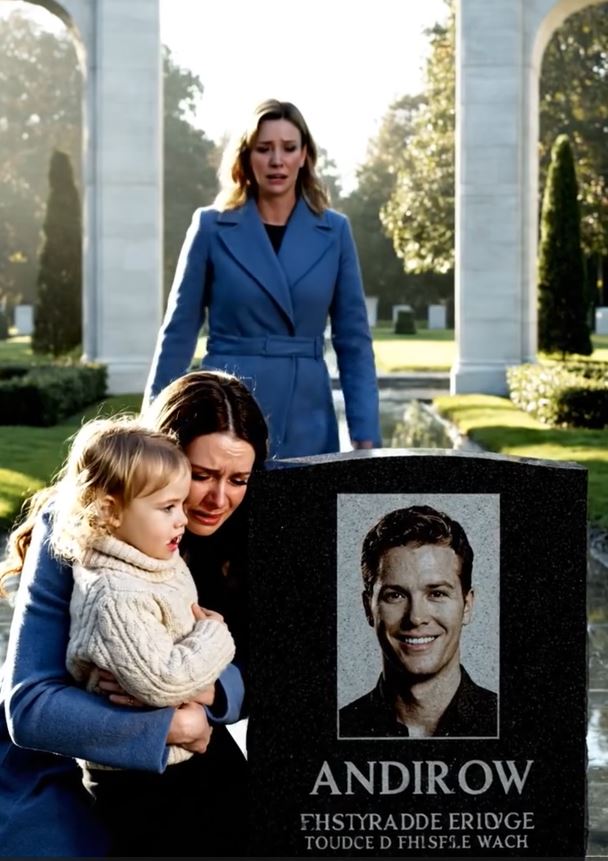
But that morning, there was a surprise. Someone was already there. A young woman, kneeling in the grass. She was holding a baby and crying softly. She had a small bunch of cheap daisies next to the headstone. They looked so sad next to my big, expensive roses. I felt a flash of anger. This was my place. My grief.
My voice was cold and sharp. “Who are you?” I demanded. “Why are you at my son’s grave?”
The woman jumped, startled. Her eyes were red and puffy. She looked poor, tired, and scared. She clutched the baby closer to her chest. The little girl in her arms looked up at me with big, blue eyes. My son had those same eyes. My heart skipped a beat, but I pushed the feeling down. I was about to call security.
That’s when the young woman finally spoke. She took a shaky breath, looked right at me, and her quiet words hit me like a train.
“He was the father.”
The world seemed to tilt on its axis. The manicured grass, the cold marble, the clear blue sky—it all blurred into an incomprehensible mess. My mind, usually a fortress of logic and order, was suddenly a chaotic storm.
“That’s impossible,” I managed to say, the words feeling like stones in my mouth.
My son, Daniel, had a girlfriend. A suitable girl from a good family, someone my wife, Eleanor, and I approved of. They were on a path we had carefully helped pave. This young woman, with her worn-out clothes and exhausted eyes, did not fit into that picture. She was a disruption. A problem.
“I have his pictures,” she whispered, her voice trembling. “I have his letters.”
I shook my head, a sharp, decisive gesture I used in boardrooms to shut down bad ideas. “I don’t know what kind of scam you’re trying to pull, but it won’t work.”
The baby in her arms made a soft gurgling sound. Those eyes. They were Daniel’s. It was an undeniable, gut-wrenching truth staring right at me.
“I don’t want anything,” the woman said, tears now streaming freely down her face. “I just wanted her to… to meet her dad.”
My corporate instincts took over. This was a situation to be managed, a potential liability to be contained. I took out my wallet and pulled out a business card. My hand was shaking.
“My name is Arthur Vance,” I said, my voice all business now. “We will conduct a paternity test. If what you say is true, you will be compensated. You will sign a non-disclosure agreement, and you will disappear.”
She stared at the card as if it were a venomous snake. She didn’t take it.
“My name is Sarah,” she said softly. “And the baby’s name is Lily.”
She looked back down at the headstone, her shoulders slumped in defeat. “I’m sorry to have bothered you.”
She turned to leave, and a strange panic seized me. It wasn’t about the money or the potential scandal. It was the sight of those blue eyes—my son’s eyes—being carried away from me forever.
“Wait,” I called out, the word rough and unfamiliar.
She stopped but didn’t turn around.
“The test,” I said, trying to regain my composure. “It’s the only way to be sure. My lawyer will be in touch.”
She finally turned, a flicker of defiance in her tired gaze. “Fine. But not for your money. For Lily. So she knows who her father was. And who her family is.”
The next few days were a blur of phone calls and sterile clinics. I didn’t tell Eleanor. How could I? She was fragile, shattered by Daniel’s death in the car accident six months ago. This news would destroy the perfect memory she clung to so desperately.
I met Sarah at the clinic. She was holding Lily, who was wrapped in a simple, hand-knitted blanket. Lily was quiet, just looking around with that unnerving, familiar gaze. I kept my distance, observing them as I would a business negotiation.
The nurse called us back. The procedure was quick, a simple swab from my cheek and one from Lily’s. As I stood there, watching the nurse gently handle the baby, a feeling I couldn’t name washed over me. It was a terrifying, unwelcome warmth.
The results would take a week. A week of living with a secret that felt like a ticking time bomb.
During that week, I found myself doing things I never did. I looked through old photo albums of Daniel as a baby. The resemblance to Lily was uncanny. It was there in the shape of his chin, the way his hair curled at the nape of his neck.
I drove past the diner where Sarah said she worked as a waitress. It was a small, unassuming place on the other side of town, a world away from the five-star restaurants Daniel was accustomed to. I tried to picture my son, in his designer clothes, sitting in one of those worn vinyl booths. It didn’t make sense.
The call came on a Friday afternoon. I was in the middle of a quarterly review, my voice sharp as I dissected profit margins. My personal assistant buzzed me. It was the lab.
I took the call in my private office, the city skyline stretching out behind me. The voice on the other end was clinical, detached.
“Mr. Vance, the results are in. There is a 99.99 percent probability that you are the paternal grandfather.”
I hung up the phone. I didn’t move. I just stared at the skyline, a view that had always made me feel powerful, in control. For the first time, it made me feel small.
My son had a daughter. And I had tried to pay her to go away.
The shame was a physical weight. I canceled the rest of my meetings and drove. I didn’t know where I was going until I found myself in a rundown part of the city, parked in front of a small, dilapidated apartment building. It was the address Sarah had given the lab.
I sat in my car for a long time, the leather seats a stark contrast to the poverty around me. What was I even doing here? Was I going to offer her a check? Demand to see the child? My granddaughter?
I finally got out of the car. The hallway of the building smelled of dust and boiled cabbage. I found her apartment, Number 3B, and knocked.
Sarah opened the door, her eyes widening in surprise. She was wearing an old t-shirt and sweatpants. Lily was in a bouncer on the floor behind her, happily kicking her feet. The apartment was tiny, but it was clean and tidy.
“Mr. Vance,” she stammered.
“The test was positive,” I said bluntly. There was no other way to say it.
She nodded slowly, a single tear tracing a path down her cheek. It wasn’t a tear of victory. It was a tear of sorrow, of validation.
“I know,” she said. “I never doubted it.”
I stepped inside, feeling like a giant in the small room. My eyes landed on a framed photo on the little side table. It was Daniel. But it wasn’t the polished, smiling Daniel from our family portraits. He was laughing, his arm slung around Sarah’s shoulders. He looked genuinely, uncomplicatedly happy. He was wearing a simple t-shirt, the same kind he wore in the photo on her nightstand.
“He loved this place,” Sarah said, following my gaze. “He said it was real.”
She told me their story. They met at the diner. He kept coming back, sitting in her section, leaving huge tips she tried to refuse. He never told her who he was, just that his family had high expectations. He was just “Dan.”
He’d spend evenings at her tiny apartment, helping her put together cheap furniture, eating takeout on the floor, watching old movies. He told her he felt suffocated by his life, by the pressure to be the perfect son, the future CEO. With her, he could just be himself.
“He loved you,” I said, the words feeling foreign. I had always equated love with provision, with creating a legacy.
“And I loved him,” she said. “When I found out I was pregnant, we were scared. But he was so happy, Arthur. He was going to tell you. He was building up the courage.”
She went to a small wooden box on a shelf and took out a letter. The envelope simply said, “Mom and Dad.” Daniel’s handwriting was unmistakable.
“He wrote this the night before the accident,” she said, her voice thick with emotion. “He was going to give it to you the next day.”
She handed it to me. My hands trembled as I took it. I couldn’t open it. Not yet.
“Why didn’t you come to us sooner?” I asked, my voice hoarse. “After he died?”
“I was scared,” she admitted. “I read about you online. I saw your perfect family. I felt like I would ruin his memory. I didn’t want his daughter to be seen as a mistake, a dirty secret. So I waited. I just wanted to introduce her to him, at his grave, where it was just us.”
I looked at Lily, now dozing in her bouncer. She wasn’t a liability. She wasn’t a problem. She was a piece of my son. The last piece.
I knew I couldn’t keep this from Eleanor any longer. It was a betrayal to her, and to Daniel’s memory.
That night, I sat with my wife in our silent, cavernous living room. I told her everything. The woman at the grave. The test. The story Sarah told me. Eleanor listened without expression, her face a mask of grief.
When I finished, she was still. “I don’t believe it,” she said, her voice dangerously quiet. “It’s a lie. That woman is a fortune hunter, preying on our grief.”
“Eleanor, I saw the test results,” I pleaded. “I saw the baby. She has his eyes.”
“So do a lot of babies!” she snapped, her composure finally breaking. “Daniel would never have hidden something like this from us! He wouldn’t have associated with someone like… like her.”
The contempt in her voice was chilling.
“I have a letter,” I said, my voice low. “From Daniel. He wrote it for us.”
I pulled the letter from my jacket pocket. Eleanor stared at it, her denial warring with the sight of her son’s handwriting.
“Read it,” she whispered.
I opened the letter.
“Mom, Dad,” I read aloud, my voice cracking. “If you’re reading this, it means I’ve finally found the courage to tell you the most wonderful news. I’ve met someone. Her name is Sarah. She isn’t the kind of girl you would have picked for me, and that’s probably why I love her so much. She sees me, not my last name. And we’re going to have a baby.”
Eleanor let out a choked sob.
“I know you’re probably angry,” I continued reading Daniel’s words. “I know you think I’ve thrown away the future you planned. But Dad, you always taught me to build something real. And this is the realest thing in my life. I’m going to be a father. I hope, one day, you can forgive me and love my child as much as I already do. Your son, Daniel.”
The room was filled with the sound of my wife’s weeping. The wall she had built around her heart had crumbled. The perfect son she had mourned was replaced by a real man, a man who had been happy, and in love, and on the verge of a new life.
The next day was the hardest of my life. I called Sarah and asked her to come to our house. To bring Lily.
When they arrived, our housekeeper showed them into the formal living room. Sarah stood awkwardly by the door, holding Lily, looking small and out of place amidst our expensive furniture and art.
Eleanor came down the stairs. She walked slowly, her eyes fixed on the baby in Sarah’s arms. She stopped a few feet away, her face a canvas of pain and longing.
“May I?” Eleanor asked, her voice barely a whisper, her hands outstretched.
Sarah nodded, and gently passed Lily into my wife’s arms.
Eleanor looked down at the baby’s face. She traced the curve of Lily’s cheek with her finger. And then she began to cry, not with anger, but with a profound, heartbreaking love.
“Oh, Daniel,” she wept, clutching the baby to her chest. “She’s beautiful.”
That was the beginning. It wasn’t easy. There were moments of tension, of two different worlds colliding. But Lily was our bridge.
We insisted Sarah and Lily move in with us. Sarah refused. She didn’t want to be a charity case. So, I did something I never thought I would. I used my resources not to control, but to help. I bought her a small, comfortable house in a good neighborhood, not far from us. I set up a trust fund for Lily, ensuring her future. Sarah, fiercely independent, enrolled in night classes to finish her degree.
I learned more about my son in the months that followed than I had in his entire life. Sarah would tell me stories. Daniel hated fancy galas. He loved old rock music. His favorite food was the greasy cheeseburger from the diner.
She told me about the daisies.
“He always brought me daisies,” she said one afternoon as we watched Lily take her first steps in our backyard. “He said your roses were beautiful, but they felt like an obligation. He said daisies were happy flowers. They just are what they are, no pretense.”
That was the twist that truly undid me. I had spent a fortune on roses every week, a grand gesture for a son I thought I knew. All along, his heart was with the simple daisies. My anger at the cemetery, at her cheap flowers, was completely misplaced. She knew my son better than I ever did.
My life changed. I stepped back from the company, promoting a talented vice president to take my place. My days were no longer filled with board meetings, but with building block towers and pushing a swing set. I discovered the simple joy of a baby’s laugh, the warmth of a tiny hand in mine.
Eleanor found a new purpose, too. She showered Lily with the love she could no longer give her son. She and Sarah formed an unlikely, powerful bond, united by their shared love for Daniel and his daughter.
One year after I first met Sarah, we all went to the cemetery together. I carried a bouquet of expensive, long-stemmed roses. Sarah carried a small, bright bunch of daisies.
We stood before the headstone. Eleanor held Lily’s hand.
We placed the flowers side-by-side, the elegant roses and the cheerful daisies. They no longer looked like they were in competition. They looked like they belonged together.
I spent my life building an empire of things I could control, of assets and outcomes I could predict. I thought grief was just another project to be managed, a routine to be followed. I was wrong. I lost my son, but in the chaotic, unexpected arrival of his daughter, I found him again. I learned that the greatest legacies are not etched in stone or listed on the stock exchange. They are written in the love we pass on, in the connections we make, and in the happy, unpretentious joy of a simple daisy. My life isn’t in my control anymore. And for the first time, it feels truly, completely full.