My son Thomas and I don’t talk much anymore. So for my 69th birthday, I was shocked when a fancy box showed up. Inside were the most beautiful chocolates I had ever seen. They were covered in real gold dust.
They looked too nice for an old lady like me to eat all by myself. I knew who would love them: my grandkids. I drove over to his house and gave the box to my daughter-in-law, Laura. Seeing the kids’ faces light up made my whole week.
The next morning, my phone rang. It was Thomas. “Mom,” he said, and his voice sounded weird. “Did you like the chocolates?”
I smiled. “Oh, honey, they were too pretty for me. I gave them to Laura and the kids.”
The line went dead silent. I could just hear him breathing, fast and hard. Then he screamed. A real scream, like he was watching a car crash. “YOU DID WHAT?”
He was yelling so loud I had to pull the phone away from my ear. “Did they eat them? Tell me they didn’t eat them!” Before I could even answer, he hung up. I just stood there, my heart pounding. It finally hit me. He wasn’t mad I gave away his gift. He was scared. He was terrified of what was INSIDE of it.
Just then, the phone rang again. It was Laura. She was crying so hard she couldn’t breathe. “The children…” she sobbed. “What they found inside the last one…”
My mind went to the darkest places imaginable. Poison. Shards of glass. Things I’d only seen in movies.
My hand was shaking so badly I almost dropped the phone. “Laura, breathe. Talk to me. Are the children okay?”
“They’re fine,” she choked out, which only confused me more. “They’re just scared. We’re all scared.”
“What did they find, Laura? What was in the chocolate?”
There was a pause, and then her voice came back, barely a whisper. “Little rocks. Tiny, clear, shiny rocks.”
Rocks? I didn’t understand. Why would Thomas scream like that over rocks?
“I’m coming over,” I said, my voice firmer than I felt. I grabbed my car keys, my mind a swirling mess of confusion and dread.
The drive to their house, usually a pleasant ten-minute trip, felt like an eternity. Every red light was a personal insult. Every slow driver a monster.
When I got there, the front door was ajar. I pushed it open and walked into a scene of strange, quiet chaos.
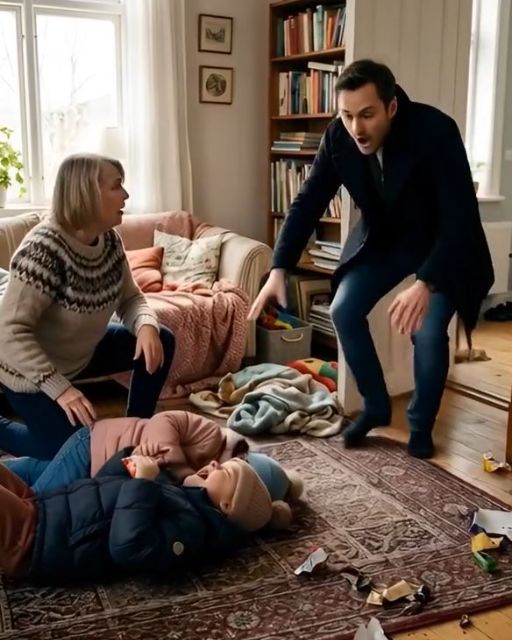
Laura was sitting on the sofa, her face pale and tear-streaked. My grandkids, seven-year-old Sarah and five-year-old Ben, were huddled next to her, looking at me with wide, frightened eyes.
On the coffee table, laid out on a napkin, were the “rocks.”
They weren’t rocks. They were diamonds.
Dozens of them. Small, perfectly cut, and glittering under the living room light like a constellation of captured stars. They were impossibly beautiful and terrifyingly out of place.
“Ben bit into the last one,” Laura explained, her voice trembling. “He thought it was a hard piece of candy. He spit it out, and all these… fell out.”
I stared at the tiny gems. They were worth a fortune. I knew enough about jewelry from my late husband, Robert, to know that much. This was life-changing money.
And my son had screamed in terror because his children had found it.
Suddenly, the front door flew open and Thomas stumbled in. He looked like he hadn’t slept in a week. His hair was a mess, his eyes were bloodshot, and his nice work shirt was wrinkled and untucked.
He didn’t even look at me or Laura. His eyes were fixed on the diamonds on the table.
He let out a sound that was half a sob, half a sigh of relief. He sank into an armchair and buried his face in his hands.
“I thought they swallowed them,” he mumbled into his palms. “Oh, god. I thought they swallowed them.”
I walked over and stood in front of him. “Thomas, you need to tell us what is going on. Right now.”
He looked up at me, and for the first time in years, I saw the little boy he used to be. The one who would come to me when he was scared, not the distant, prideful man he had become.
“I’m in trouble, Mom,” he said, his voice cracking. “I’m in real trouble.”
He explained everything, the words tumbling out of him in a desperate rush. His business, a small contracting company he’d built from the ground up, was failing. He had taken out loans, remortgaged the house, but it wasn’t enough.
He got in deep with a man, a private lender who preyed on desperate people. The interest rates were criminal. Soon, the debt was a mountain he could never hope to climb.
This man, he called him Mr. Sterling, didn’t accept failure. He told Thomas there was a way to clear his debt. All he had to do was act as a courier.
A package would be delivered to a “safe” address. Thomas was supposed to pick it up and deliver it to another location. He thought a “safe” address meant one that wasn’t connected to him. He used mine.
He never, ever imagined I would open it. He certainly never imagined I’d give it away.
“The chocolates were a decoy, Mom. A fancy, expensive box that no one would suspect,” he said, shaking his head in disbelief. “I was supposed to pick it up from you this afternoon, pretend I was just visiting for my birthday.”
Laura was staring at him, her expression a mixture of anger and fear. “You put us in danger, Thomas. You put your own children in danger.”
“I know,” he whispered, his eyes filling with tears. “I was trying to save us. I thought I could fix it before you ever found out.”
My heart ached for him, for the desperation that had led him to this. But fear was a cold knot in my stomach. This Mr. Sterling wasn’t going to be happy.
“Who is this man, Thomas?” I asked quietly. “This Mr. Sterling.”
“You don’t want to know him, Mom. He’s not a good person.” Thomas’s face was grim. “He’ll be expecting his package. When I don’t deliver…” He didn’t have to finish the sentence.
We all knew what it meant.
We sat in silence for a long time, the only sound in the room the ticking of the grandfather clock in the hall. The beautiful, terrifying diamonds on the table seemed to mock us.
Then, a name clicked in my memory. Sterling.
It was a common enough name, but it felt familiar in a way I couldn’t quite place. It was tied to my husband, Robert.
“Stay here,” I said, standing up with a sudden sense of purpose. “Don’t touch those. Don’t call anyone. I’ll be back.”
I drove home in a daze, the name Sterling echoing in my mind. Robert had been a jeweler, a good one. He had a small shop downtown that he ran for forty years.
When he passed away, I packed up most of his work things into boxes and stored them in the attic. I hadn’t looked at them since.
The attic was dusty and smelled of old paper and cedar. I found the box labeled “Ledgers & Correspondence.” My hands trembled as I sliced through the old tape.
Inside were dusty books filled with my husband’s neat, slanted handwriting. I pulled out a thick ledger from the early eighties. I flipped through the pages, scanning the names of clients and suppliers.
And then I found it. Sterling. Arthur Sterling.
It wasn’t a client. He was listed as a partner. My breath caught in my throat. I remembered Arthur. A kind, quiet man with a brilliant eye for design. He and Robert had started the business together.
I kept digging. I found a folder of old, yellowed letters. The last one was from Arthur. It was dated 1985. His handwriting was shaky, desperate. He was begging Robert for a loan, for a buyout, for anything.
His wife was sick, he wrote. The medical bills were burying them. He needed to sell his half of the business.
I then found Robert’s reply, a carbon copy on thin, onion-skin paper. He’d refused. The business wasn’t doing well, he’d written. He couldn’t afford to buy Arthur out. He wished him the best.
But I knew that wasn’t the whole truth. The business was struggling, yes, but it wasn’t failing. Robert was just scared. He was always so cautious with money, a trait he’d inherited from his own father who had lived through the Depression. He was scared of losing everything.
So he cut his partner loose.
A few months later, Arthur Sterling lost his home. A year after that, his wife passed away. Arthur himself died of a heart attack not long after. He had lost everything.
Robert had carried that guilt with him for the rest of his life. He never spoke of Arthur, but sometimes I’d find him staring at an old photograph of the two of them, their arms around each other, smiling in front of their new shop.
In the bottom of the box, I found one last thing. A small, velvet pouch. Inside was a silver pocket watch. Engraved on the back were the initials A.S. Arthur Sterling.
Robert had kept it all these years.
I sat there in the dusty attic, the story of two families laid out before me. This wasn’t just about a loan shark and a bad debt. This was about a ghost. A debt of a different kind, passed down from one generation to the next.
This Mr. Sterling, the man terrorizing my son, had to be Arthur’s son.
My fear began to recede, replaced by a strange, cold clarity. I knew what I had to do.
I went back downstairs and found Thomas’s phone. I scrolled through his recent calls and found the number. My finger hovered over it. This was insane. I was a 69-year-old woman about to call a dangerous criminal.
But I wasn’t just any woman. I was Robert’s wife. And I was Thomas’s mother.
I took a deep breath and pressed the call button.
A cold, clipped voice answered on the second ring. “Yes?”
“Is this Mr. Sterling?” I asked, my voice surprisingly steady.
“Who is asking?”
“My name is Margaret. I believe you are expecting something from my son, Thomas.”
The line was silent for a moment. “Your son is a very foolish man. He has something that belongs to me.”
“I have it,” I said. “And I want to give it back to you.”
Another pause. “This is a strange conversation. Why are you calling me, Margaret?”
“Because I believe this is about more than just money,” I said, my heart pounding. “This is about Arthur Sterling.”
Dead silence. For a full ten seconds, I thought he had hung up.
Then, his voice came back, and all the cold professionalism was gone. It was replaced by something raw, something full of pain. “What do you know about my father?”
I had him.
We agreed to meet. I chose the place: a small, quiet park downtown, right across from where my husband’s old jewelry shop used to be. It was a long shot, but I was banking on sentiment, on memory.
Thomas begged me not to go. “Mom, you don’t know what he’s like. He’s dangerous.”
“He’s a man who lost his father,” I replied, tucking the velvet pouch with the watch into my purse alongside the napkin full of diamonds. “I need to do this.”
I sat on a park bench, the afternoon sun warm on my face. The old shop was a trendy coffee place now, but I could still see the ghost of the sign: “Robert & Sterling Fine Jewelers.”
A man approached. He was younger than I expected, probably in his early forties, with sharp eyes and a suit that was too expensive for a man who worked with his hands. He looked nothing like the kind, gentle Arthur I remembered, but he had his father’s weary eyes.
He sat on the other end of the bench, leaving a careful distance between us.
“You’re brave, Margaret. Or you’re stupid,” he said, not looking at me. “I haven’t decided which.”
“I’m a mother,” I said simply.
I opened my purse and took out the napkin, unfolding it carefully on the bench between us. The diamonds glittered, seeming small and insignificant in the open air.
He glanced at them, his expression unreadable. “My property.”
“Yes,” I agreed. “And this is too.”
I took out the velvet pouch and handed it to him. He opened it slowly, his brow furrowed in confusion. When he saw the watch, he froze. He turned it over and over in his hands, his thumb tracing the engraved initials.
“My husband, Robert, never forgave himself for what happened to your father,” I said softly. “He was a good man, but he was a frightened man. He made a terrible mistake, and he lived with it every single day.”
Mr. Sterling, or perhaps I should call him Arthur Junior, didn’t speak. He just stared at the watch, his jaw tight.
“He kept this watch to remember him. To remember the friend he failed,” I continued. “What you’re doing to my son… you’re becoming the thing that broke your father’s heart. You’re using fear to hurt people, just as fear made my husband hurt him.”
He finally looked at me, and his sharp, cold eyes were glistening with unshed tears. “My father was the best man I ever knew. He built that business with his own hands. And your husband threw him away like he was nothing. We lost everything.”
“I know,” I said. “And I am so, so sorry for that. No amount of money can fix it. But this cycle of pain, this legacy of debt, it can end right here. With us.”
I pushed the napkin of diamonds towards him. “Take these. They’re yours. But let my son go. Let this be the end of it. For Arthur. And for Robert.”
He sat there for what felt like an hour, staring from the watch in his hand to the diamonds on the bench. The fate of my family rested in this one, broken man’s decision.
Finally, he closed his hand around the watch, clutching it tightly. He stood up, leaving the diamonds on the bench.
“The debt is cleared,” he said, his voice thick with emotion. He turned and walked away without another word, without a backward glance.
I sat there, watching him go, my body trembling with relief. I gathered the diamonds, folded the napkin, and walked back to my car.
When I got back to Thomas’s house, the atmosphere was thick with dread. They all looked at me as I walked in, their faces full of questions.
I placed the napkin of diamonds back on the coffee table.
“It’s over,” I said, my voice shaking slightly. “You’re free.”
Thomas just stared at me, his eyes wide. Then he broke down. He didn’t just cry; he sobbed. He sobbed for his failure, for his fear, and for the relief of a second chance he never thought he’d get.
That night, for the first time in a very long time, we were a family again. We talked. Really talked. Thomas told me about the pressures he was under, the shame he felt for failing, the pride that kept him from asking for help.
I told him about Robert and Arthur, about the secret guilt our family had been carrying for decades.
We decided to sell the diamonds. Not to pay a debt, but to build a future. We used the money to save Thomas’s business, to set up college funds for the kids, and to put a down payment on a small condo for me, closer to them.
The rest, we donated to a charity that helps families dealing with medical debt. It felt right. It felt like we were finally settling a debt that had been left unpaid for far too long.
It’s funny how things work. My son sent me a box of what he thought was just a tool for his crime, a container for his secret shame. But it ended up being a gift after all.
It wasn’t the chocolates, and it certainly wasn’t the diamonds. The gift was the truth. It was a chance to finally heal the old wounds that had been festering in our family for generations.
We learned that day that the most valuable things in life aren’t the ones you can hide in a piece of candy. They’re the things you share openly: your fears, your mistakes, and your love. Pride can cost you everything, but honesty, even when it’s terrifying, can buy you back your entire world.