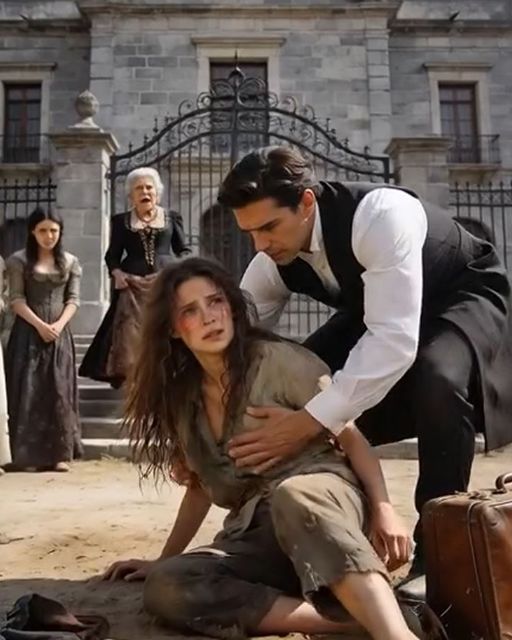
They gave me a room in the east wing of the Ordóñez estate. A real bed. Sheets that smelled like soap, not mildew. For three weeks, I woke up at dawn out of habit, confused by the silence. No one was yelling for me to start the fires.
Don Antonio kept his distance, but he watched me. At dinner, he asked about my mother. I told him what little I knew: she died when I was two, a fever, no grave I’d ever visited. My aunt Rita never spoke of her.
“And your father?” he asked.
I shrugged. “She said he was nobody. A drunk who abandoned us.”
Don Antonio set down his fork. He looked at his son. Matthew looked at his plate.
“Curious,” the old man said. “Curious indeed.”
The lawyer arrived on a Tuesday. A small man named Guerrero with ink-stained fingers and a leather case stuffed with yellowed papers. He’d been digging through parish records in Puebla for two weeks on Don Antonio’s orders.
I wasn’t supposed to be in the study. I was fetching a shawl I’d left on the chair. But when I heard my mother’s name – Elena Montes de Oca – I froze behind the door.
“The birth was registered,” Guerrero said. “But the father’s name was scratched out. Someone paid the priest to remove it.”
“Can you recover it?”
“I already have.” Papers shuffled. “The original ledger had a copy. The father was Don Alejandro Valdivia.”
My legs went numb. Alejandro Valdivia. My aunt’s dead husband. The Marques.
“The dates are clear,” Guerrero continued. “Elena Montes de Oca gave birth eleven months before Rita married Alejandro. The child was legitimate if he’d married Elena first, but he didn’t. He married Rita for her family’s land. Elena died two years later. Fever, they claimed.”
Don Antonio’s voice dropped. “And the child’s inheritance?”
“Everything. Under the old laws, a firstborn – even from an earlier union—takes precedence. The girl sleeping in your east wing is the rightful heir to the Valdivia estate. Rita has been living on stolen property for twelve years.”
I pushed open the door. All three men turned.
“Sara—” Matthew started.
“My aunt knew,” I said. My voice didn’t sound like mine. “She knew who I was. She knew whose daughter I was. And she still made me sleep by the kitchen. She still made me call her ‘ma’am.’”
Guerrero opened his case and pulled out one more document. His face had gone pale.
“There’s something else,” he said. “I found the physician’s original report on your mother’s death. It wasn’t a fever.”
He handed me the paper. The handwriting was cramped, faded, but one word was circled in fresh ink.
The word was “arsenic.”
And below it, a witness signature I recognized. The name written in my aunt’s own elegant, cruel script: Rita Valdivia.
The paper slipped from my fingers. It floated to the floor like a dead leaf. The study, with its rich mahogany and smell of old books, seemed to tilt on its side.
Matthew was there in an instant, his hand on my arm to steady me. “Sara, breathe.”
I couldn’t. The air was thick with the truth I’d just swallowed. Twelve years of it. Twelve years of cold scraps and threadbare blankets. Twelve years of being told I was nothing, from the woman who had taken everything.
“She killed my mother,” I whispered. The words felt foreign, like a line from a play.
Don Antonio’s face was stone. He looked older than he had a minute ago. “Guerrero, are you certain of this?”
“The document is authentic,” the lawyer said, his voice quiet but firm. “The physician who signed it, a Dr. Morales, fled to the city shortly after. He was known to be a man of conscience. He likely feared for his life.”
I sank into the chair I had come for, my shawl forgotten. My mind raced back through the years, replaying every harsh word, every back-breaking chore, every look of disdain from my aunt. It all made a new, horrific kind of sense.
She wasn’t just cruel. She was a murderer hiding in plain sight. And I was her ghost, the living proof of her crime, scrubbing the floors of the very house that should have been mine.
Don Antonio finally spoke, his voice a low rumble of command. “Matthew, call Sheriff Brody. Tell him I need to see him. Immediately.”
He then knelt before me, his old knees cracking. It was a gesture so unexpected it broke through my shock. He took my hand, his skin warm and dry against my cold one.
“Sara,” he said, looking me directly in the eye. “I knew your mother. Elena was… she was like sunshine. Kind to everyone, even when she had little herself. She worked for my wife for a time, helping in the gardens.”
A memory, faint as a watercolor, surfaced. A woman’s laughter. The smell of jasmine. Was that her?
“I promised her I would look out for you,” Don Antonio continued, his voice thick with regret. “When she died, Rita claimed you as her niece, a distant relation. She said she would raise you. I believed her. I failed your mother, and I failed you. That is a sin I will carry to my grave.”
Tears I didn’t know I had in me began to fall. Not for myself, but for the mother I never knew, and for this old man’s long-held guilt.
He had been watching me not out of suspicion, but out of a duty he felt he’d abandoned.
The next few hours were a blur. Sheriff Brody arrived, a tall man with a kind, tired face. He listened patiently, examined the papers, and asked me gentle questions.
We planned the confrontation for the next morning. It felt wrong to call it a plan. It felt like preparing for an earthquake.
I didn’t sleep that night. I sat by the window in my new room, looking out at the moonlit grounds of the Ordóñez estate. Beyond the trees, I could just make out the dark silhouette of the Valdivia house. My house. A place of nightmares.
Matthew brought me a cup of tea. He didn’t say much, just sat in the chair across from me, a quiet, steady presence in the dark.
“You don’t have to do this,” he said after a long silence. “We can just let the sheriff handle it.”
“I have to,” I replied, my voice hoarse. “I have to look her in the eye.”
The drive over the next morning felt like a funeral procession. Don Antonio drove, with me in the passenger seat. Matthew and Sheriff Brody followed in the sheriff’s car.
When we pulled up the long, gravel driveway, the house looked the same. Imposing, cold, unwelcoming. For a moment, I was a little girl again, terrified of tracking mud on the polished floors.
Rita opened the door herself. She was dressed impeccably, as always. When she saw me standing with Don Antonio, her face tightened into a mask of polite inquiry.
“Antonio,” she said, her voice like chilled wine. “And Sara. To what do I owe this… unexpected visit?”
“We need to talk, Rita,” Don Antonio said, his tone leaving no room for argument.
She led us into the formal drawing-room, the one I was only ever allowed to clean. She didn’t offer us a seat.
I didn’t wait for anyone else to speak. I walked to the center of the room and faced her. “You lied to me my whole life.”
A flicker of annoyance crossed her face. “I took you in when you had nothing. You should be grateful.”
“Grateful?” The word caught in my throat. “You made me a servant in my own home.”
Sheriff Brody stepped forward then, holding a file. “Mrs. Valdivia, we have a copy of a birth certificate. It names Sara Montes de Oca as the daughter of Elena Montes de Oca and Don Alejandro Valdivia.”
Rita’s smile was thin and brittle. “A forgery, no doubt. The girl is delusional.”
“We also have this,” Brody said, pulling out the physician’s report. He didn’t hand it to her. He held it up. “A report on Elena’s death. The cause listed is not fever.”
The color drained from my aunt’s face. For the first time, I saw real fear in her eyes. Her carefully constructed world was crumbling.
“Lies,” she hissed, her composure cracking. “All of it, lies spread by a jealous old man!”
“Then explain your signature, Rita,” I said, my voice shaking but clear. “Explain why your name is on a document that says my mother was poisoned.”
The silence in the room was absolute. It was as if the house itself was holding its breath.
Then, Rita did something I never expected. She laughed. It wasn’t a sound of amusement. It was a terrible, broken sound, full of fury and despair.
“You think you’re so clever,” she spat, her eyes locking onto mine. “You think you’ve figured it all out. The poor, mistreated orphan who was secretly a princess.”
She took a step closer, her voice dropping to a venomous whisper. “You want to know the truth? The real truth?”
I stood my ground, my heart hammering against my ribs.
“Your mother wasn’t some innocent saint,” Rita sneered. “She was a common servant who thought she could trap a rich man. And your father… Alejandro… he was weak. Pathetic.”
This was the part of the story I had never known. The part about the man who was my father.
“He came to me in a panic,” she went on, her eyes wild. “He told me Elena was pregnant. He was terrified. A scandal like that would have ruined him. The Valdivia name meant everything. He couldn’t have it tainted by a child born to a nobody.”
I felt sick. My father wasn’t just a drunk who had abandoned us. He was a coward.
“So we made a plan,” Rita said, a strange pride in her tone. “I had the land he needed, the connections. We would be a power couple. He would marry me, and the problem of Elena would simply… disappear.”
A gasp escaped my lips. “He knew? My father knew you were going to kill her?”
Rita’s smile was a slash of red against her pale skin. “Knew? My dear, sweet, stupid girl. It was his idea.”
That was the twist. The final, brutal turn of the knife. My inheritance wasn’t just stolen by a wicked aunt. It was built on a conspiracy between the two people who gave me life. My father wasn’t just absent; he was a monster. He had chosen land and a title over his child and the woman who carried her.
“He paid the doctor to sign the false death certificate,” Rita continued, her confession pouring out like poison. “He paid the priest to scratch his name from the ledger. He wanted every trace of you and your mother gone. But then he died in that riding accident before we could send you away. I was stuck with you.”
She looked at me, and all the years of her hatred were plain on her face. “Every day, I had to look at your face. Your mother’s face. A constant reminder of the secret I had to keep. You think scrubbing floors was a punishment? It was a mercy. I could have left you on the steps of an orphanage. Or worse.”
Sheriff Brody stepped between us. “Rita Valdivia, you’re under arrest for the murder of Elena Montes de Oca.”
As he led her away, she never took her eyes off me. There was no remorse. No apology. Only pure, unadulterated hate.
The house was silent again. But this time, it was a different kind of silence. It was the silence of a tomb that had finally given up its dead.
In the weeks that followed, the legalities were sorted out. The Valdivia estate, the house, the money, it was all mine. But it felt like ashes in my mouth. The entire legacy was built on a foundation of murder and betrayal.
I couldn’t stay in that house. I walked through its empty, opulent rooms, and all I could see were ghosts.
Don Antonio and Matthew were my anchors. Don Antonio would sit with me for hours, telling me stories about my mother. He told me how she loved to grow things, how she could make even the most stubborn rosebush bloom. He said she had a laugh that could make you forget your troubles.
He gave me back the pieces of my mother that Rita and Alejandro had tried to erase.
One day, Matthew took me for a walk to the far edge of the Valdivia property. There, hidden behind a crumbling stone wall and overgrown with weeds, was a small, neglected garden.
“My father said this used to be your mother’s special place,” he said softly. “When she worked here, Alejandro gave her this little patch of land to tend as her own.”
I pushed through the thorny vines. In the center, almost choked by weeds, was a single, hardy jasmine vine, still clinging to life. I touched one of its leaves, and for the first time, I felt a connection. Not to the Valdivia name, but to Elena Montes de Oca. My mother.
That was when I knew what I had to do.
It took years. I sold off some of the excess land to fund the project. I hired architects and builders. I worked alongside them, my hands learning the feel of soil and stone instead of soapy water and scrub brushes.
The grand Valdivia mansion was transformed. We turned it into the “Elena’s House,” a safe haven and school for orphaned children. The east wing, where Don Antonio had first given me a room, became the nursery for the youngest ones.
The cold, formal drawing-room where Rita had confessed her sins was now a library, filled with sunlight and the sound of children learning to read.
My personal home was a small, new cottage we built on the edge of the property, right next to my mother’s restored garden. The jasmine vine now covered an entire trellis, its scent filling the air every evening.
Matthew was there through it all. Our friendship grew into something deeper, a quiet, steady love built on shared purpose and mutual respect. We ran the foundation together.
One afternoon, I was sitting on the porch of our cottage, watching a group of children playing tag on the lawn that I used to have to mow. Matthew came and sat beside me, handing me a glass of lemonade.
He looked out at the mansion, now vibrant and full of life. “You did it, Sara,” he said. “You turned a place of sorrow into a place of hope.”
I thought of my aunt, spending the rest of her days in a prison cell, consumed by her own bitterness. I thought of the father I never knew, a man who chose greed over love. They had tried to build an empire on darkness, and it had crumbled to dust.
They thought inheritance was about a name, about property and power. They were wrong.
True inheritance is the love you cultivate and the good you grow from the poisoned soil of the past. It’s about taking the broken pieces you are given and building something that will shelter others, something that will last. My mother didn’t leave me a fortune; she left me her resilience, her love for growing things. And that was a legacy worth more than any title.