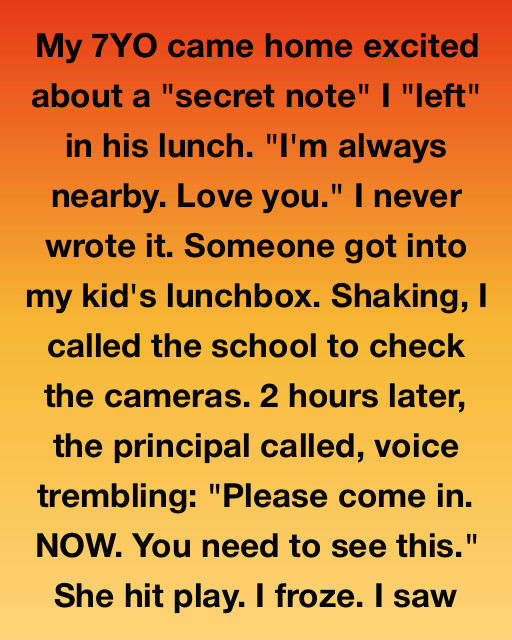
My 7YO came home excited about a “secret note” I “left” in his lunch. “I’m always nearby. Love you.” I never wrote it. Someone got into my kid’s lunchbox. Shaking, I called the school to check the cameras. 2 hours later, the principal called, voice trembling: “Please come in. NOW. You need to see this.” She hit play. I froze. I saw a man I hadn’t seen in over twenty years, a ghost from a life I thought I’d buried a thousand miles away.
The footage was grainy, the kind of choppy surveillance video you see in movies, but the way he moved was unmistakable. He was dressed in a worn-out janitor’s uniform, blending perfectly into the background of the bustling elementary school cafeteria. He didn’t look like a predator; he looked like a shadow, someone who had mastered the art of being invisible while standing in plain sight. He approached my son’s cubby with a practiced ease, slipped a small, folded piece of yellow paper into the side pocket of the blue nylon lunchbox, and vanished back into the hallway.
My son, Freddie, was only seven, and the thought of a stranger touching his belongings sent a cold, sharp spike of adrenaline through my veins. I lived in a quiet suburb of Bristol, a place where people didn’t lock their doors during the day and the biggest news was usually a lost cat. But seeing that man, those slouched shoulders, and that specific way he tucked his chin toward his chest, made the room spin. It was my father—a man who was supposed to be serving a life sentence in a high-security prison for a crime that had torn our family apart when I was just a teenager.
“Do you know him, Arthur?” the principal, Mrs. Gable, asked, her eyes searching mine for any sign of recognition. I couldn’t breathe, let alone speak. I just nodded slowly, my hands gripping the edge of her mahogany desk until my knuckles turned white. I told her his name was Silas, and I told her that he wasn’t supposed to be anywhere near a school, or a city, or me.
The police were called immediately, and the school went into a soft lockdown while they searched the grounds. I sat in that small, brightly lit office, surrounded by posters of motivational quotes and children’s drawings, feeling like a little boy again. My father had been a violent, unpredictable man, and the day he was taken away was the day I finally started to breathe. I had changed my name, moved across the country, and built a life based on the absolute absence of his influence.
But as the officers arrived and started questioning the staff, a different story began to emerge. The head of maintenance, an older man named George, looked confused when they showed him the photo of Silas. “That’s not a janitor,” George said, scratching his head. “That’s the guy who’s been volunteering with the local food bank to deliver the surplus meals to the kids who don’t have enough.”
It turned out that Silas hadn’t broken into the school; he had been vetted and cleared as a volunteer under a different name. He had been working in the shadows of the community for months, doing the dirty work that no one else wanted to do. He spent his mornings loading heavy crates of fruit and his afternoons cleaning up the spills in the hallway after the kids went home. He was a ghost, but he was a ghost who was helping people.
I felt a confusing mix of rage and bewillary. Why was he here? Why was he leaving notes in Freddie’s lunch instead of knocking on my door? The police tracked him down to a tiny, one-room flat above a dry cleaner’s a few streets away. They didn’t find a lair or a plan; they found a room filled with books on child psychology and a stack of letters addressed to me that had never been mailed.
When they brought him into the station, I insisted on seeing him. I needed to look into his eyes and see if the monster was still there. He was sitting in the interrogation room, looking frail and diminished, nothing like the towering figure of my nightmares. His hair was stark white, and his hands, once so heavy and dangerous, were now thin and covered in the spots of old age.
“Why are you doing this, Silas?” I asked, my voice cracking with the effort to stay calm. He didn’t look up at first; he just stared at his own reflection in the table. “I’m dying, Arthur,” he said, his voice a low, gravelly rasp. “I got out on compassionate release six months ago. The doctors said I have a year, maybe less, if the cancer keeps spreading.”
He told me he didn’t want my forgiveness and he didn’t want to be part of my life. He knew he had forfeited that right the moment he chose the life he led. But he couldn’t stand the thought of leaving this world without knowing that I was okay, and that his grandson was growing up in a world of love. He had found us through a private investigator, and he had spent his final bits of energy trying to be “nearby” without causing any more damage.
The “secret notes” weren’t threats; they were the words he had never been able to say to me. One of the notes in his pocket read, “You are brave, you are kind, and you are loved.” They were affirmations, the kind of things a father is supposed to tell a son. He was trying to give Freddie the childhood I never had, even if it was just through a few words on a piece of paper tucked next to an apple and a sandwich.
I sat there for a long time, watching him breathe, the rhythmic hiss of his lungs the only sound in the room. I realized that the man I had hated for twenty years was gone, replaced by this shell of a human who was trying to atone for a lifetime of sin with a handful of sticky notes. It didn’t make what he did okay, and it didn’t heal the scars on my back or the ones in my mind, but it did something else. It took away his power over me.
I didn’t let him meet Freddie properly. I wasn’t ready to explain the complex, dark history of our family to a seven-year-old who still believed in magic. But I did something I thought I would never do. I told the police not to press charges for the trespassing, and I arranged for him to be moved to a hospice facility that was much more comfortable than his dingy flat. I paid for it using the small inheritance my mother had left me, the one she had specifically earmarked for “emergencies.”
For the next four months, I visited him once a week. We didn’t talk about the past; we talked about the weather, the books he was reading, and sometimes, I’d tell him a little bit about Freddie. I’d tell him about the way Freddie loved to build Lego towers or how he was the fastest runner in his class. Silas would just listen, his eyes closed, a small, sad smile on his face. He was a man who had finally realized that the greatest things in life aren’t the things you take, but the things you leave behind.
When he finally passed away on a rainy Tuesday in November, I was the only one there. I held his hand, and for the first time in my life, I didn’t feel afraid. I realized that people are capable of profound change, even if it comes too late to fix the things they broke. He had spent his last months as a janitor and a volunteer, trying to clean up the world he had once made so dirty. It wasn’t a perfect redemption, but it was a real one.
I took the box of letters he had written and I kept them in the back of my closet. I’m not sure if I’ll ever show them to Freddie, or if I’ll just keep them as a reminder of the complexity of the human heart. I want Freddie to know that his grandfather wasn’t just a monster, but a man who was lost and eventually found a tiny bit of light. I want him to know that love can find a way into even the most guarded places, like a side pocket of a lunchbox.
The life lesson I took away from all of this is that we spend so much of our lives running from our shadows, forgetting that shadows only exist because there is a light somewhere nearby. We are more than our worst mistakes, and we are more than the damage done to us. Sometimes, the most important work you can do is the work of forgiveness—not for the person who hurt you, but for yourself, so you don’t have to carry their burden anymore.
Freddie still talks about the “secret notes” from time to time, and I’ve started leaving them in his lunchbox myself. “You are brave, you are kind, and you are loved,” I wrote this morning. I watched him run toward the school bus, his backpack bouncing against his small shoulders, and I felt a sense of peace that I hadn’t known in decades. The past is a heavy thing, but it doesn’t have to be an anchor. It can be a foundation if you’re willing to do the hard work of building on top of it.
If this story reminded you that it’s never too late to try and make things right, or that forgiveness is a gift you give yourself, please share and like this post. We all have ghosts in our past, and sometimes they just need a little bit of grace to finally find their rest. Would you like me to help you find a way to start a difficult conversation with someone you’ve been avoiding?