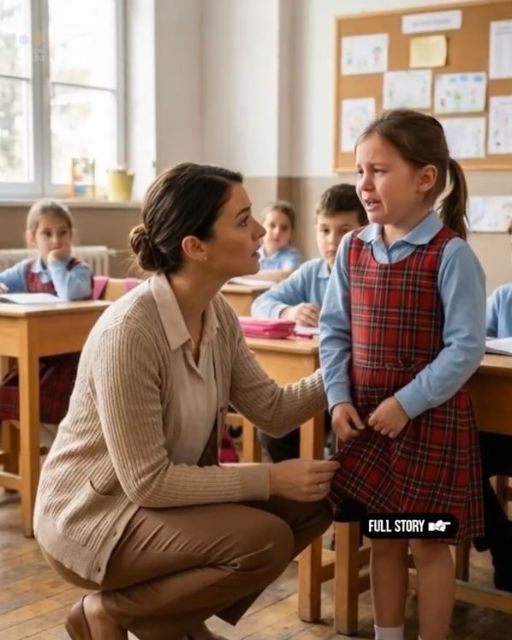
For a week, little Kate stood at her desk.
She wouldn’t sit, not for class, not for lunch.
We all thought it was a weird phase.
Then she fell on the playground.
When I ran over, she wasn’t crying from the scrape on her knee.
She was terrified.
“Don’t lift my shirt,” she begged, grabbing my arm.
I did it anyway.
Her whole back was a grid of deep, circular bruises, layered over old yellow ones.
It was a pattern.
“What happened to you?” I whispered.
She flinched.
“The listening chair,” she said.
“It has teeth.”
My hands shook as I dialed 911 from the office.
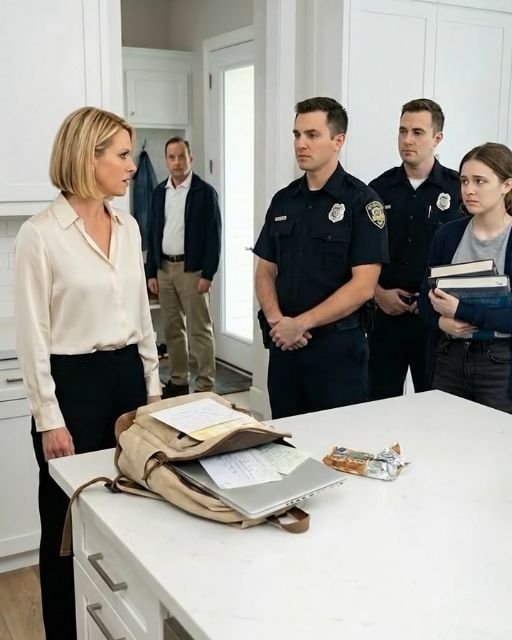
A police officer arrived in minutes.
He was calm, professional.
I felt the air go out of my lungs with relief.
He knelt by Kate.
“Let’s see what’s wrong here,” he said, his voice kind.
He gently lifted the back of her shirt.
He was quiet for a long time.
Then he looked right at her and said, “I told you what happens when you don’t listen.”
My breath caught in my throat.
I looked from his cold eyes down to the polished black name tag on his uniform.
It read ‘Officer Reed.’
And I suddenly remembered what Kate had told me her last name was.
The world narrowed to a single, roaring point in my ears.
It was Kate Reed.
This man, this protector, was her father.
He was the monster.
His gaze lifted from Kate and met mine.
There was no kindness in it now, only ice.
It was a look of ownership, a look that said, “This is my property, and you have interfered.”
My mind raced, trying to form a sentence, any sentence, that would not get us both killed right here in the principal’s office.
My relief curdled into pure, liquid terror.
“Oh,” I managed, my voice a squeak.
“Officer Reed, I… I didn’t realize you were her father.”
I forced a wobbly, pathetic smile.
“What a coincidence that you were the one on call.”
He stood up slowly, the leather of his duty belt creaking like a coffin lid.
He let the back of Kate’s shirt fall, hiding the evidence.
“No coincidence, Ms. Albright,” he said, his voice smooth as glass.
“I monitor the calls that come from this address.”
The implication hung in the air, thick and suffocating.
He had been waiting for this.
He wanted to see who would dare to report him.
Little Kate hadn’t moved a muscle.
She was frozen, a statue of fear, her eyes fixed on the scuffed floor tiles.
“She’s clumsy,” Officer Reed said, the explanation a clear threat.
“Falls a lot.”
He put a heavy hand on Kate’s shoulder, and I saw her wince.
“I’ll take her home,” he stated.
It wasn’t a suggestion.
My heart hammered against my ribs like a trapped bird.
I couldn’t let him take her.
But what could I do?
He was the law.
And I was a first-grade teacher with a shaking voice and sweat beading on my forehead.
The school principal, Mr. Harris, chose that moment to bustle back into the office, holding a folder.
“Everything all right here, Officer?” he asked, oblivious.
“Just a family matter,” Reed said, his grip on Kate tightening.
“Ms. Albright was just a bit overzealous.”
Mr. Harris gave me a slightly annoyed look, as if I’d wasted everyone’s time.
“Right,” he said. “Well, thank you for your quick response, Officer.”
It was happening.
They were going to let him walk out of here with her.
My brain screamed, but my mouth was full of sand.
“Wait,” I said, the word barely a whisper.
Officer Reed turned his head slowly, an eyebrow raised.
“We still need to fill out an incident report,” I blurted out, the lie coming from a place of pure panic.
“For the school’s insurance.”
It was the stupidest thing I could have possibly said, but it was all I had.
Mr. Harris looked confused.
“Insurance? For a scraped knee?”
“And the… back,” I said, forcing myself to look at Reed.
“The policy is very strict on any injury, no matter how minor it seems.”
I was gambling, praying on the fear of paperwork and bureaucracy that everyone shares.
Officer Reed stared at me for a long, torturous moment.
I could see the gears turning behind his eyes, weighing his options.
Making a scene here would draw attention.
He was a man who operated in the shadows of his own home.
“Fine,” he clipped out.
“I’ll send her mother to come pick her up and fill out your forms.”
He turned to Kate.
“You wait here with your teacher,” he said, and the menace in his tone was unmistakable.
“Mom will be here soon. We’ll talk about this at home.”
Kate gave a tiny, almost imperceptible nod.
He turned and walked out of the office.
The moment the door clicked shut, I crumpled into a chair, the adrenaline leaving my body in a great, shuddering rush.
Kate remained standing.
Mr. Harris cleared his throat.
“Well, Ms. Albright, perhaps next time we can avoid calling 911 for a simple tumble on the playground.”
I just stared at him, speechless.
I knew then I was completely on my own.
When Kate’s mother arrived twenty minutes later, she was a ghost.
Her name was Maria, and her eyes were as haunted as her daughter’s.
She was pale, thin, and her long-sleeved cardigan seemed designed to make her disappear.
I pulled her into my empty classroom, away from the front office.
Kate stood by the window, her back to us.
“I need to talk to you about Kate’s injuries,” I started, keeping my voice low.
Maria wouldn’t meet my eyes.
“She’s a clumsy child,” she recited, the words flat and rehearsed.
“It’s the chair,” I said gently.
“Kate told me about the listening chair.”
For the first time, Maria looked at me.
Her eyes filled with a terrifying mixture of fear and something else.
Was it hope?
“You don’t understand,” she whispered, twisting the strap of her purse.
“He’ll know we talked.”
“He already knows I saw the bruises,” I countered.
“He knows I’m the one who called. We have to do something.”
Tears began to slide down her pale cheeks.
“There’s nothing to do,” she choked out.
“He’s a police officer. Who would they believe? Him, or me?”
She was right.
It was his word against ours.
My word, the “overzealous teacher,” and hers, the “hysterical wife.”
“I believe you,” I said, my voice firm.
“And I will help you.”
I wrote my personal cell number on a slip of paper and pressed it into her hand.
“Call me tonight, when he’s asleep or out,” I urged.
“Please.”
She stared at the number, then folded the paper into a tiny square and hid it in her fist.
She nodded once, a quick, jerky motion, before collecting Kate and leaving without another word.
I went home that night and felt a new kind of fear.
Every passing car on my street made me jump.
Was it him?
Did he follow me?
He knew my name.
He knew where I worked.
Finding my address wouldn’t be hard for a man like him.
I barely slept.
My phone remained silent all night.
The next day at school, Kate’s desk was empty.
My blood ran cold.
I called the main office, my heart pounding.
The secretary told me Mrs. Reed had called in.
Kate had the flu.
It was a lie. I knew it was a lie.
He was punishing her for what happened.
I spent the day in a fog of anxiety, unable to focus on my other students.
That night, my phone finally rang.
It was an unknown number.
“Hello?” I answered, my hand trembling.
“He’s on the late shift tonight,” Maria’s voice whispered, so faint I could barely hear it.
“He won’t be back until two in the morning.”
“Are you and Kate okay?” I asked, a hundred terrible images flashing through my mind.
There was a pause, and then a choked sob.
“No,” she said.
“He… he was angry that you called the school. He used the chair again.”
I squeezed my eyes shut, a wave of nausea washing over me.
This was my fault.
“It’s not your fault,” Maria said, as if reading my mind.
“You gave me… you made me think. Maybe…”
Her voice trailed off.
“Maybe what, Maria?” I pressed.
“I can’t do this anymore,” she whispered.
“I can’t watch him do this to her. I can’t.”
“We need proof,” I said, my mind suddenly clear.
“We need something more than just bruises that he can explain away.”
“The chair,” she said instantly.
“What is it? What does it look like?”
“It’s in the basement,” she said, her voice shaking.
“He made it himself. It’s a metal stool. But on the seat… he welded short, rounded bolts onto it, pointing up.”
My stomach turned.
“They’re spaced out. They press into her back when he makes her sit on it for hours. He says it teaches her to listen without leaving marks that look like a belt or a hand.”
Circular bruises.
A grid.
It was monstrous. It was calculated.
“Can you take a picture of it?” I asked.
“Send it to me.”
“He’d find it on my phone,” she said, panicked.
“He checks it.”
We needed a different plan.
We needed to get the proof to someone who would listen.
I thought about going to his precinct, but who would I trust?
His friends? His partner?
The thought sent a shiver down my spine.
I needed to go over his head.
I spent the next morning calling every helpline and government agency I could think of.
I was passed from department to department, put on hold, and asked to fill out forms online.
Finally, I was connected to a detective in the state’s Internal Affairs division, a man named Miller.
His voice was tired and skeptical, but he listened.
I told him everything.
The bruises, the father being a cop, the “listening chair.”
“That’s a very serious accusation against an officer, ma’am,” he said when I was finished.
“I know,” I said, “but the child isn’t in school today. I’m afraid for her life.”
There was a long silence on the other end of the line.
“Can you get me a picture of this… device?” he finally asked.
“I think so,” I said, my new, terrifying plan forming in my mind.
“But I’ll need your help.”
I called Maria back and told her my idea.
It was insane. It was dangerous.
But it was the only thing I could think of.
She agreed without hesitation.
She was done being afraid.
The plan was for the following night when Reed was on his late shift again.
Maria would leave the back door unlocked for me.
I would sneak in, go to the basement, and take the pictures myself.
Then I would send them directly to Detective Miller from a prepaid burner phone I’d bought that afternoon.
I drove to their house that night, my headlights off as I rounded the corner.
It was a neat little suburban home, with a perfectly manicured lawn and a cheerful-looking wreath on the door.
It looked so normal.
I parked a block away and walked, my heart a drum against my ribs.
The back door was unlocked, just as she’d said.
I slipped inside.
The house was dark and silent.
Maria met me in the kitchen, her face a pale oval in the gloom.
Kate was asleep upstairs.
“The basement door is over there,” she whispered, pointing.
“Be careful. The third step creaks.”
I nodded, my throat too dry to speak.
I pulled out the burner phone and turned on its small flashlight.
The basement stairs were steep and old.
I avoided the third step, my feet silent on the worn wood.
The air down there was cold and smelled of damp earth and laundry detergent.
And there it was.
In the center of the concrete floor, under a single, bare lightbulb, was the chair.
It was exactly as Maria had described.
A simple metal stool, but the seat was an instrument of torture.
A dozen polished, round-headed bolts were welded to the surface, a cruel grid of steel teeth.
It was more horrifying than I could have imagined.
My hands shook so badly I could barely hold the phone steady.
I took pictures from every angle.
Close-ups of the bolts, a wide shot of the chair in the bleak room.
I had the proof.
I turned to go back up the stairs.
And then I heard it.
The sound of a car door slamming shut in the driveway.
A key turning in the front door lock.
He was home early.
Maria’s eyes met mine from the top of the stairs, wide with panic.
There was no time to run.
“Hide!” she mouthed silently, her expression frantic.
I ducked behind an old furnace in the corner of the basement, my body pressed into the dusty shadows.
I held my breath, praying he wouldn’t come down.
I heard his heavy footsteps on the floor above me.
“Maria?” he called out. “Why are you still up?”
“I couldn’t sleep,” I heard her say, her voice impressively steady.
“I was getting a glass of water.”
“You seem nervous,” he said, his voice closer now.
He was in the kitchen.
Right above my head.
“Long day,” she replied.
I stayed completely still, my muscles screaming in protest.
My phone was still in my hand.
I had the pictures.
But what good were they if he found me here?
“I’m going to head down to the workshop for a bit,” he announced.
“Need to fix that loose leg on the coffee table.”
No.
No, no, no.
His workshop was down here.
In the basement.
I heard his footsteps approaching the basement door.
This was it.
He was going to find me.
Just as the door at the top of the stairs creaked open, I did the only thing I could.
I hit send.
I sent every single photo to Detective Miller’s number, along with the address and a simple message: “He’s home.”
Light flooded the stairwell.
I squeezed myself tighter into the shadows, making myself as small as possible.
His boots clomped down the stairs, one step at a time.
He reached the bottom and flicked on the main basement light.
The room was bathed in a harsh, yellow glare.
I could see his shadow moving across the floor.
He stopped.
He was looking at the chair.
I realized my mistake.
In my panic, I had left the single bare bulb directly over the chair switched on.
It was the one light I had used to take the pictures.
A light he knew was never, ever left on.
He was silent for a full minute.
Then he spoke, his voice low and deadly.
“Who’s down here, Maria?” he called up the stairs.
I heard her gasp.
He didn’t wait for an answer.
He began to walk slowly around the basement, his shadow falling over my hiding spot.
I closed my eyes.
Then his shadow stopped.
He had found me.
I opened my eyes and looked up into the face of pure evil.
He didn’t shout. He didn’t yell.
He smiled.
“Well, look what we have here,” he said softly.
“The overzealous teacher.”
Suddenly, there were frantic footsteps on the stairs.
Maria ran down, her face streaked with tears.
“Robert, no!” she cried, putting herself between us.
“Leave her alone!”
For the first time, she wasn’t the timid ghost I had met.
She was a mother protecting her child, and by extension, me.
“Get out of my way, Maria,” he snarled, his mask of calm slipping away.
“No,” she said, her voice shaking but firm.
“It’s over.”
He laughed, a harsh, ugly sound.
“It’s over when I say it’s over.”
He reached out to shove her aside.
At that exact moment, flashing red and blue lights filled the small basement windows.
The sound of sirens, suddenly cut off, was followed by the thunder of feet on the porch upstairs and a heavy, pounding on the front door.
“State Police! Open the door!” a voice boomed.
Officer Reed froze, his face a mask of disbelief and fury.
He looked from the flashing lights, to me, to his wife.
The smile was gone.
He knew he was trapped.
Detective Miller had gotten my message.
And he had come. Fast.
The next few hours were a blur of uniforms, official voices, and flashing cameras.
I saw Miller in person for the first time.
He was a big man with a kind, tired face.
He simply nodded at me, a look of profound respect in his eyes.
They led Reed out in handcuffs, his face pale and slack with shock.
His own colleagues from the local precinct were there, looking on with stunned disbelief as the state police took one of their own into custody.
The listening chair was carefully bagged and taken as evidence.
It was finally over.
Six months later, I was sitting at my desk after school, grading papers.
A small drawing was placed on my blotter.
It was a picture of me and a little girl with brown hair, both of us smiling under a big yellow sun.
The little girl in the picture was sitting in a bright red chair.
I looked up.
Kate was standing there, a wide, genuine smile on her face.
She was no longer the haunted, silent child who stood at her desk.
She was bright, she was chatty, and she was thriving.
“That’s for you,” she said.
“Thank you, sweetie,” I said, my throat thick with emotion. “It’s beautiful.”
Maria was waiting for her at the classroom door.
She looked like a different person.
The fear was gone from her eyes, replaced by a quiet strength.
She had a new job and a new apartment, just for her and Kate.
She mouthed “thank you” to me over her daughter’s head.
I just smiled back.
Robert Reed was convicted on multiple felony counts.
The physical evidence of the chair was undeniable.
His badge didn’t protect him.
His uniform didn’t hide him.
The truth, once it has a voice, is a powerful thing.
Sometimes, all it takes is one person who is willing to listen, truly listen, to the whisper of a child.
It taught me that courage isn’t the absence of fear.
It’s being terrified and doing the right thing anyway.
And that the most important lessons aren’t taught from a textbook, but are learned when we stand up for those who have no voice, no matter the cost.