The car was a blur of rust and exhaust. The man was just a gray hoodie.
He didn’t look. He just heaved the wooden crate over the guardrail.
I heard the splash a second before my foot slammed the brake.
The sedan was already gone.
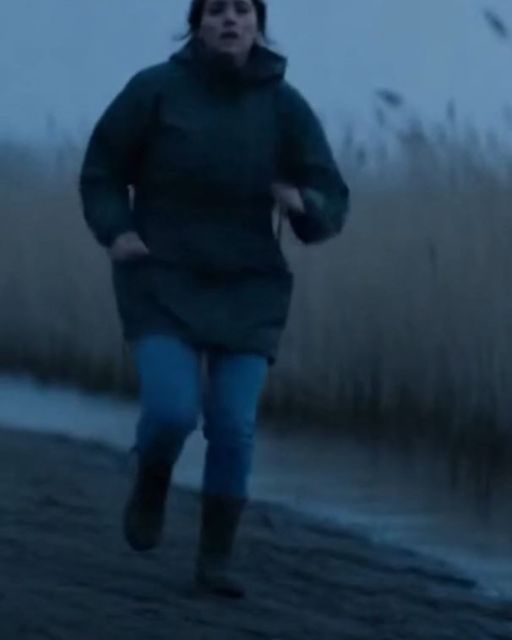
But I was out of my car, scrambling down the muddy embankment without thinking. The river was a shock of ice, instantly soaking my jeans to the bone.
It was right there. A dark shape snagged in the reeds, bobbing gently.
I dragged it to the bank, my arms screaming from the weight of the waterlogged wood.
And then I heard it.
A sound so small I thought I imagined it. A faint, weak whimper from inside the box.
A cold dread washed through me. My fingers fumbled at the lid, numb and clumsy.
Please be a puppy. Please just be an animal.
The wood splintered under my desperate hands. The lid groaned, then gave way.
I looked inside and my world stopped.
It wasn’t an animal.
It was a face. Tiny, wrinkled, and terrifyingly still. A tiny chest rose, then fell. Once. Barely.
My phone felt alien in my hand. The dispatcher’s voice sounded a thousand miles away.
“I… I found a baby.” The words felt like sandpaper in my throat. “In a crate. In the river.”
At the hospital, the fluorescent lights hummed. A nurse with calm eyes took the bundle from my arms. I just stood there, dripping water onto the polished floor, my heart a frantic drum against my ribs.
I told my story to an officer. A blur of questions and answers.
Then the nurse returned.
“He’s stable,” she said, and I could breathe again. “Vitals are good. Less than a day old, the doctor thinks.”
The relief was so strong my knees almost buckled.
But then she frowned.
“It’s strange,” she added, looking back toward the room. “He’s so quiet. Almost too quiet.”
And the ice water came back, flooding my veins.
She was right. Through the entire ordeal—the cold river, my frantic hands, the harsh hospital lights—he never cried.
Not a single sound.
It was as if he already understood. As if he had learned, in his first few hours of life, that making noise was the most dangerous thing he could do.
The next day, I called the hospital. I gave them my name, Daniel, and asked about the baby they were calling John Doe.
He was still stable. Still silent.
I couldn’t get it out of my head. I’d been driving on that road for no reason, just to clear my mind after a week that had felt like a year of setbacks. I felt adrift, purposeless.
Then, a crate in the water.
Two days later, I went back to the hospital. I brought a small, soft blue blanket. It felt like a foolish gesture.
The same nurse, Sarah, was at the station. She recognized me immediately.
“You’re the man from the river,” she said, her smile gentle.
I nodded, holding up the blanket. “I just… I wanted to see if he was okay.”
She led me to the nursery. Through the glass, I saw him in a small, clear bassinet. He was so small, a tiny island in a sea of white sheets.
He wasn’t crying. He wasn’t even fussing. He just stared at the ceiling with wide, dark eyes that seemed to hold the secrets of the universe.
“The detective was here again,” Sarah said softly. “Detective Miller. He said they have no leads. The car was a ghost.”
A monster in a gray hoodie. The image was seared into my brain.
I started visiting every day. It became the one solid point in my drifting life.
I would stand by the glass, and sometimes, he would turn his head and his eyes would meet mine. There was no recognition, of course.
But I felt a pull. A responsibility that went beyond just pulling him from the water.
Detective Miller found me there on the fifth day. He was a tall man with a tired face, the kind of tired that comes from seeing too much of the world’s ugly side.
“Mr. Stephens,” he said, his voice a low rumble. “Daniel, right?”
“Yes.”
He looked through the glass at the baby. “Still can’t shake it, huh?”
“Can you?” I asked, my voice sharper than I intended.
He gave a dry, humorless chuckle. “No. In twenty years, I’ve never seen anything like it. The crate was homemade. Crude. Like it was put together in a hurry.”
My stomach tightened.
“We’re running out of time,” Miller continued. “He’ll be a ward of the state soon. Lost in the system.”
The thought was unbearable. This silent, watchful baby, passed from stranger to stranger.
“There has to be something,” I insisted. “Something we missed.”
Miller sighed, rubbing the back of his neck. “We have the crate, the blanket he was wrapped in. Nothing. No labels, no hair, no fingerprints that aren’t yours or the hospital staff’s.”
Something clicked in my mind. The blanket. Not the one I brought, the one he was found in.
“Can I see it?” I asked. “The things he was found with?”
Miller looked at me, a flicker of something in his tired eyes. Maybe it was pity. Maybe it was a long-shot hope.
He made a call. An hour later, I was in an evidence room, looking at the rough-hewn wooden crate on a metal table.
Next to it was the blanket. It was a simple, gray wool thing, still faintly damp.
I picked it up. It was heavy, coarse. And tucked into one of the folds, almost invisible, was a small object.
My fingers closed around it. I held it out on my palm.
It was a bird. A tiny wooden bird, no bigger than my thumb, carved from a single piece of light-colored wood. It was smooth and detailed, its wings swept back as if in flight.
It wasn’t a toy you’d buy in a store. It was personal. It was a clue.
Miller leaned in, his eyes narrowed. “Well, I’ll be,” he breathed.
That little bird changed everything.
It gave the ghost in the gray hoodie a potential face. This wasn’t just a monster. A monster doesn’t tuck a hand-carved bird into a baby’s blanket.
This was something else. Something more complicated.
Miller sent photos of the carving to experts. For weeks, the trail was cold.
During that time, I became the baby’s official visitor. The nurses knew me. They let me sit by his bassinet.
I talked to him. I told him about my boring job, about the weather, about the little bird.
I told him he was safe. I told him he was a fighter.
And one afternoon, as I was humming a half-forgotten tune, his tiny hand uncurled and his fingers wrapped around my pinky.
His grip was surprisingly strong. My breath caught in my throat.
His dark eyes were locked on mine. And for the first time, I saw something other than quiet observation. I saw a flicker of connection.
It was then I knew. I couldn’t let him go into the system.
I started the paperwork to become a foster parent. My life was a mess, I had no business raising a child, but none of that mattered.
The universe had thrown this child at me, and I was going to catch him.
Then Miller called.
“We got a hit,” he said, and I could hear the excitement in his voice. “The carving style. It’s distinctive. It’s from a specific tradition, usually passed down through families. And we found a family known for it, a reclusive bunch. The Prestons.”
The Prestons were old money. They lived in a sprawling estate about an hour out of the city, surrounded by walls and secrets.
“They have a daughter,” Miller said. “Eleanor. Twenty-one years old. Hasn’t been seen in public for the better part of a year. The family says she’s been traveling. Ill.”
My heart hammered against my ribs.
“There’s more,” he said. “For about a year, before she vanished from the social scene, she was seeing someone the family hated. A local carpenter. A woodworker named Thomas Bell.”
The pieces were falling into place, but they were forming a picture I didn’t understand.
If this was Eleanor’s baby, and Thomas was the father, why was he in a crate in the river? Why would a father do that to his own son?
Miller and I drove out to the Preston estate. It was less a house and more a fortress.
A severe-looking man who introduced himself as Mr. Preston, Eleanor’s father, met us at the door. His eyes were like chips of granite.
He denied everything. His daughter was abroad. There was no baby. The carpenter was a regrettable phase she had grown out of.
His story was too neat, too polished. He was lying. I could feel it.
As we were leaving, I saw a flicker of movement in an upstairs window. A pale face, there and then gone.
“Did you see that?” I asked Miller as we got back in the car.
“I saw it,” he said, his jaw tight. “She’s not abroad. She’s a prisoner in her own home.”
The search for Thomas Bell intensified. But he had disappeared. His workshop was empty, his apartment cleared out. He was a ghost, just like the rusty sedan.
I felt a growing desperation. The foster care hearing was in a week. I was going to get the baby, who I had started calling Arthur in my head, but I wanted to give him more.
I wanted to give him his story.
I couldn’t stop thinking about the river. The place where it all started.
On a hunch, I drove back out there. The muddy bank was still scarred from where I’d scrambled down.
I just stood there, listening to the water, trying to put myself in the place of the man in the hoodie.
Why here? Was it random? Or was it chosen?
I looked around. It was a desolate spot, but just a few hundred yards down the road was a small, rundown motel. The kind of place people go when they don’t want to be found.
It was a wild guess. A shot in the dark.
I showed the night clerk a photo of Thomas Bell from his driver’s license. The man’s eyes flickered with recognition.
“Room 7,” he grunted. “Paid in cash for two weeks. Hasn’t left the room in days.”
My blood ran cold.
Miller arrived in twenty minutes. We stood outside the door to Room 7. I could hear nothing from inside.
Miller knocked. “Thomas Bell? This is the police. We need to talk to you.”
Silence.
Then, a small click as the lock turned. The door creaked open.
The man standing there was not a monster. He was a boy. He looked no older than twenty, with hollowed-out eyes and a face gaunt with terror and grief. He was wearing a gray hoodie.
He didn’t fight. He didn’t even speak. He just collapsed onto the small, sagging bed and started to sob, his body shaking with a pain so deep it was hard to watch.
The story came out in pieces, in that sterile interrogation room.
He loved Eleanor. And she loved him.
Her father, Mr. Preston, was a tyrant. He controlled every aspect of her life. When he found out she was pregnant, he exploded.
He forbade her from seeing Thomas. He locked her away in the house, telling the world she was ill.
His plan was simple and horrifying. When the baby was born, his private doctor would sign a death certificate for a stillbirth. And then the baby would… disappear.
Preston had made it clear. He would not have his family name tarnished by this child.
Thomas and Eleanor were terrified. They had no one to turn to. The family’s power and influence were absolute.
So they made their own plan. A desperate, insane, last-chance plan.
Thomas built the crate. He designed it to be water-resistant for a short time, to float. He knew this stretch of road. He knew people used it.
He knew it was a terrible risk. But it was the only risk they had.
The night Arthur was born, a sympathetic maid helped smuggle him out of the house. Thomas was waiting.
He wrapped his son in the blanket. He tucked the small bird, the first gift he had ever carved for Eleanor, into the folds. It was a message. A sign for her, if she ever got free, that their son was out there.
He drove to the river, his heart shattering with every mile.
“I wasn’t trying to kill him,” he whispered, his voice cracking. “I was trying to save him. I put him in the current, just enough so it would snag on the reeds. I was praying someone would see. Someone good.”
He waited, hidden in the trees, his whole world narrowed to that bobbing crate. He saw my car. He saw me stop.
He watched me pull his son from the water. And only then, when he knew his son was safe, did he run.
The silence, he explained, was a part of their plan too. They were so scared of the baby crying and alerting Mr. Preston’s staff. So for the few hours Thomas had with him, he held him constantly, murmuring to him, keeping him calm. He created a bubble of peace around him.
The baby learned that silence meant safety. That noise was a danger he couldn’t yet understand.
It wasn’t a sign of trauma. It was a sign of his father’s desperate, protective love.
With Thomas’s testimony, the Preston empire of secrets came crashing down.
Eleanor was freed. The story hit the news, and her father’s reputation was destroyed. He was a monster, but not the one I had first imagined.
I saw the reunion. I stood in the back of a hospital room as Eleanor, frail but with fire in her eyes, held her son for the first time since his birth.
Thomas stood beside her, his hand on her shoulder.
And Arthur, their son, looked from his mother’s face to his father’s. And he let out a small noise. A gurgle. A happy, contented sound.
His silence was finally broken. He was home.
Six months later, I sat in their small, sunlit apartment. It was filled with the smell of sawdust and baby powder.
Thomas was carving another small animal at a workbench in the corner. Eleanor was on the floor, laughing as a chubby, happy baby reached for her hair.
Arthur. He was cooing and babbling, a symphony of happy noises.
They had asked me to be his godfather. I was no longer just the man from the river. I was Uncle Daniel.
I watched them, a family forged in terror and saved by a desperate gamble. A family that should never have been.
Before that day, my life was like that crate in the water. Adrift, directionless, waiting for something to happen.
I thought I was saving a baby. I had pulled a box from a river.
But as I looked at the life and love that filled that room, I realized the truth.
That day on the river, by pulling him out, I was really pulling myself in. In to a purpose, in to a connection, in to a life that had meaning.
Sometimes you find what you’re looking for when you stop and help someone who is lost. And sometimes, the most monstrous act you can imagine is just a disguise for the most powerful love.