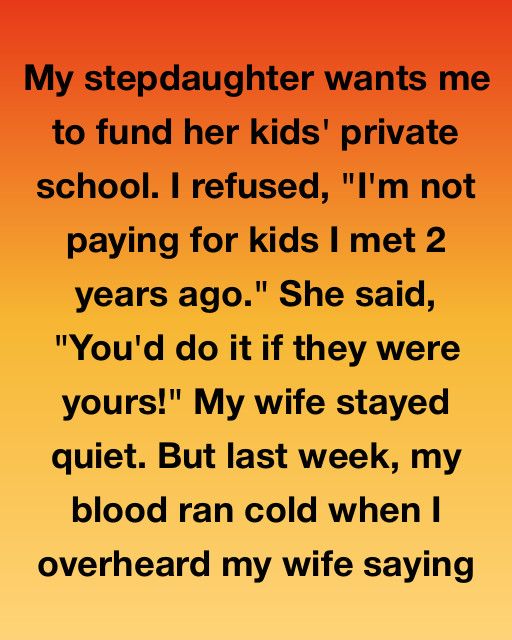
My stepdaughter wants me to fund her kids’ private school. I refused, telling her flat out, “I’m not paying for kids I met two years ago.” It sounds harsh when I say it like that, but you have to understand the timeline of my life. I married Nora late in life, about three years ago, after spending decades building a successful architectural firm in the heart of Chicago. I worked seventy-hour weeks and skipped vacations to ensure I could retire comfortably, and I wasn’t about to drain my savings for a whim.
Nora’s daughter, Sabrina, is in her thirties and has two kids from a previous marriage. She’s always lived a bit beyond her means, chasing a lifestyle that her mid-level marketing job doesn’t quite support. When she sat me down in our living room and laid out the tuition costs for the local private academy, I felt my jaw tighten. It wasn’t just a request; it was an expectation, as if my bank account was a community chest she had finally found the key to.
“You’d do it if they were yours!” Sabrina snapped when I gave her my final answer. She stood up, her face flushed with a mix of anger and entitlement, looking toward her mother for backup. Nora stayed quiet, fiddling with the hem of her cardigan and staring intently at the pattern on our Persian rug. I looked at my wife, hoping for a shred of support, but she just looked tired, her eyes avoiding mine as the silence stretched thin.
After Sabrina stormed out, the house felt heavy and cold, despite the late afternoon sun streaming through the windows. Nora didn’t argue with me, which almost made it worse; she just went about her evening in a sort of robotic trance. I tried to explain that it wasn’t about the money itself, but about the principle of financial independence. I had worked for everything I had, and I believed the best gift I could give those kids was the example of a grandfather who valued hard work over handouts.
For the next week, the tension in our home was thick enough to cut with a knife. Nora was polite, but distant, answering my questions in one-word sentences and going to bed earlier than usual. I started to wonder if I was being the “evil stepdad” everyone warns you about in the movies. But then I’d look at the tuition bill—nearly forty thousand dollars a year—and remind myself that I wasn’t a charity.
But last week, my blood ran cold when I overheard my wife saying something into her phone while she thought I was out in the garage. I had forgotten my glasses on the kitchen counter and slipped back into the house through the side door, moving quietly so I wouldn’t disturb her. She was in the sunroom, her voice low and frantic, and the words she spoke felt like a physical blow to my chest. “Sabrina, stop pressuring him,” Nora whispered. “If he looks too closely at the trust documents, he’ll realize the money you’re asking for is actually his own.”
I stood frozen in the hallway, my hand gripping the doorframe so hard my knuckles turned white. What on earth did she mean, “his own money”? I had complete control over my accounts, or so I thought, and I had never set up a trust for Sabrina or her children. I waited until I heard her end the call, then I retreated back to the garage, my mind spinning with a thousand different scenarios. I needed to see my financial advisor, a man named Sterling who had been managing my portfolio for twenty years.
The next morning, I sat in Sterling’s office, a sleek space overlooking the lake. I asked him to pull every record associated with my accounts, looking for anything that didn’t have my direct signature on it. Sterling looked confused at first, but as he dug into the archives, his expression shifted from professional calm to genuine concern. He found a secondary account, a “slush fund” of sorts, that had been siphoning small amounts from my dividends for nearly five years.
“Arthur, this account was authorized by a Power of Attorney document filed shortly after you and Nora were married,” Sterling said, pushing a piece of paper across the desk. I looked at the signature, and my heart sank. It was my signature, but I had no memory of signing a Power of Attorney for Nora. Then I remembered a week after our honeymoon when I was recovering from a minor surgery and on heavy pain medication. She had brought me a stack of “routine insurance papers” to sign while I was barely conscious.
It wasn’t just that she was stealing; it was the amount. Nora hadn’t just been taking enough for groceries or a new dress. She had diverted over two hundred thousand dollars into a private trust for Sabrina. But as I kept looking at the records, I realised the money wasn’t being used for Sabrina’s lifestyle or the kids’ school; the account had barely been touched in months.
I went home, the weight of the betrayal sitting in my stomach like lead. I found Nora in the garden, pruning the roses she loved so much. I didn’t yell; I just laid the bank records on the garden table and waited. She looked at them, her face going pale, and then she sat down on the stone bench, her shoulders sagging as if a great weight had finally been placed on her.
“I didn’t do it for her, Arthur,” Nora said, her voice barely a whisper. She explained that Sabrina had been in deep trouble with some predatory lenders years before I even entered the picture. Sabrina had made some terrible mistakes, and she was being blackmailed by people who were threatening to take her children away. Nora had married me, yes, out of love—but she had used my wealth as a shield to buy her daughter’s safety and pay off the debts in secret.
The private school request was a ruse. Sabrina didn’t want the kids in a better school; she needed forty thousand dollars to pay off the final “exit fee” to the people who were harassing her. Nora had been diverting my money to build a safety net so that one day, Sabrina could finally be free of the past without me ever knowing the mess I had married into. Nora had been living a double life, playing the role of the perfect, quiet wife while fighting a war in the shadows to protect her only child.
I realized then that Nora hadn’t stayed quiet because she was submissive; she stayed quiet because she was terrified. She thought that if I knew the truth about her daughter’s past, I would leave her and the kids would be at the mercy of the streets. She had gambled our marriage on the hope that she could fix her family’s brokenness with my money before I ever noticed it was gone. It was a desperate, misguided act of motherhood that had turned our life into a lie.
We sat in that garden for a long time, the sun beginning to set behind the trees. I thought about the decades I’d spent building my firm, the pride I took in my self-reliance, and the wall I’d built around my heart and my wallet. I realized that while Nora was wrong to steal from me, I had been wrong to keep myself so separate from her life. I had treated our marriage like a business merger where I was the majority shareholder, rather than a partnership of souls.
The rewarding conclusion didn’t come from a courtroom or a divorce lawyer. It came from a choice. I decided to pay the forty thousand dollars, but I did it my way. I sat down with Sabrina and the lenders, with a legal team behind me, and ensured that the debt was settled once and for all with no further contact. I closed the secret accounts and brought Nora into the light, giving her a seat at the table in our financial planning for the first time.
I learned that when you marry someone, you don’t just marry the person they are today; you marry their history, their burdens, and their mistakes. Trust isn’t just about showing someone your bank balance; it’s about creating a space where they don’t feel they have to steal to be safe. Nora made a terrible choice, but she made it out of a love that was as fierce as it was flawed. By forgiving her, I found a deeper connection than I ever thought possible.
Today, Sabrina is working a steady job, and the kids are in a good public school, thriving without the shadow of debt hanging over their heads. Nora and I are still together, and while it took a long time to rebuild the trust, our conversations are no longer whispers in the sunroom. We talk about everything now, the good and the bad, and I realized that my “rich” life was actually quite poor until I learned how to share it.
Money is just a tool, but love is the architect. You can build a fortress with your wealth, but if you don’t leave the door open for honesty, you’ll just end up living in a very expensive prison. Don’t let your “principles” blind you to the pain of the people sitting right across from you. Sometimes, the most valuable thing you can spend is your pride.
If this story reminded you that there is always more than one side to a family secret, please share and like this post. We all have moments where we have to choose between being right and being compassionate. I’d love to hear your thoughts—have you ever had to forgive someone for doing something wrong for the right reasons? Would you like me to help you navigate a tough family conversation about boundaries and trust?