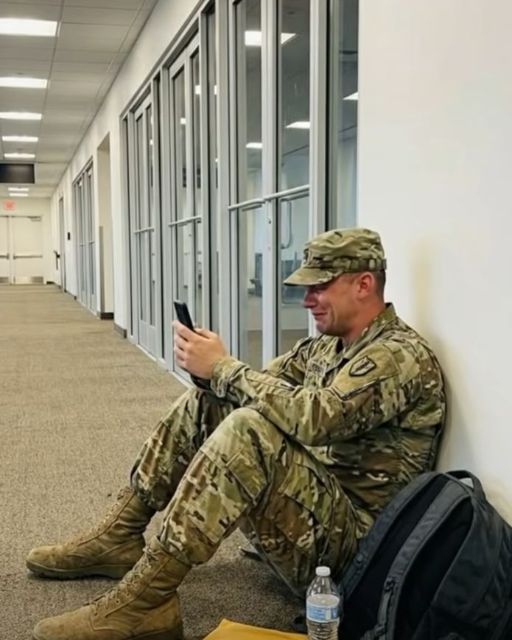
The flight was cancelled. My son was being born 800 miles away.
I was on the floor of the terminal, watching my wife scream on a tiny screen. I couldn’t do anything. Just watch. The world was gray floors and muffled announcements. I put my head in my hands.
A shadow fell over me. I looked up. The pilot. He pointed at my phone. “Your wife?”
I just nodded. My throat was too tight to speak. He looked at my uniform, then back at the phone. He pulled out his own phone and made a call. I could only hear bits of it.
“Yeah, it’s me… I don’t care about the storm… I need a private runway cleared… The destination isn’t the airport. It’s Saint Mary’s Hospital. Tell them we’re bringing home a…”
He paused, looking at me, then finished his sentence. “…a soldier.”
My head snapped up. I didn’t understand what was happening. It felt like a dream.
The pilot knelt down, his face etched with a seriousness I’d only seen in my commanding officers. “My name is Arthur Harris. What’s yours, son?”
“Marcus,” I managed to choke out.
“Alright, Marcus. My flight was cancelled too. But I have a friend with a six-seater jet at the private airfield a mile from here.”
He stood up and offered me a hand. “We’re not going to let a little thunder stop you from meeting your kid.”
I just stared at his outstretched hand. It didn’t feel real. People don’t do things like this.
He must have seen the doubt in my eyes. “Look, the storm is moving east. We can fly around the worst of it. It won’t be smooth, but it’ll get you there.”
I took his hand and he pulled me to my feet. My legs felt like jelly.
“Grab your bag,” he said, his voice firm and commanding. “We’re leaving. Now.”
We moved through the crowded terminal like ghosts. People were slumped in chairs, staring at the departure boards filled with red CANCELLED signs. Nobody paid us any mind.
We exited into a wall of rain and wind. Arthur led me to a shuttle bus meant for airport crew. The driver seemed to know him, giving a simple nod as we boarded.
The ride to the private airfield was a blur of slick roads and flashing lights. I fumbled with my phone, trying to text my wife, Eleanor. My hands were shaking too much.
‘They’re taking me to the hospital,’ I typed. ‘A pilot is flying me.’ It sounded insane even as I wrote it.
A reply came back almost instantly, not from her, but from her brother, David. ‘Who is? What are you talking about?’
Before I could reply, we were there. The airfield was small, just a few hangars and a runway lit by faint, misty lights. A sleek white jet sat waiting, its engines already whining softly.
A young man in a co-pilot’s uniform met us at the steps. “Captain Harris, she’s all fueled and ready. Air traffic control gave us a narrow window through the weather system.”
Arthur clapped him on the shoulder. “Good work, Ben. This is Marcus. He’s our passenger.”
Ben gave me a quick, professional smile. “Welcome aboard, sir. Let’s get you out of this rain.”
Inside, the jet was small and smelled of leather. I strapped myself into a seat as Arthur and Ben went through their pre-flight checks in the cockpit. The rain hammered against the tiny window.
I could feel the engines roar to life. My heart was a drum against my ribs. This was actually happening.
The takeoff was rough. The little plane shuddered and groaned as it climbed through the storm clouds. For a few minutes, all I could see out the window was a thick, angry gray.
Then, we broke through. Above the storm, the sky was a canvas of deep indigo, littered with a billion stars. The moon was a perfect, silver disc.
The turbulence settled into a gentle hum. I could finally breathe.
Arthur came back and sat in the seat across from me. He unbuckled his seatbelt. “How’s your wife doing?”
I showed him the string of texts from David. ‘Contractions are two minutes apart. Doctor says it’s time.’
My stomach twisted into a knot. “I’m not going to make it.”
Arthur looked at the phone, then at me. His eyes were kind, but held a deep, old sadness. “You’ll make it for the important part. You’ll be there to hold him. To hold her.”
“Why are you doing this?” I asked, the words spilling out. “For a complete stranger?”
He was quiet for a long moment, watching the stars. “Twenty-five years ago, I was a young pilot, just like Ben up there. I was on a long-haul flight from Tokyo to Chicago.”
He paused, and his voice grew softer. “My wife went into labor six weeks early. There were no cell phones, no way to reach me. By the time I landed and got the message, my daughter was already twelve hours old.”
He looked at me, and I could see the ghost of that memory in his eyes. “I’ve flown for thirty years. I’ve landed on icy runways and in sandstorms. But I’ve never outrun that regret. Missing that moment… it stays with you.”
I didn’t know what to say. “I’m sorry,” was all I could manage.
He shook his head. “Don’t be. Just don’t make the same mistake. When I saw you on that floor, looking at your phone… I saw myself. I just figured, maybe this time, I could get the pilot home.”
We sat in a comfortable silence for a while. Ben, the co-pilot, brought me a bottle of water. He gave me a reassuring smile.
The flight felt like an eternity. I watched the map on a small screen as our little plane icon crawled across the country. Every mile felt like a victory.
David kept sending updates. ‘She’s asking for you.’ ‘She’s so strong, Marcus.’ ‘The doctor is here. It’s happening.’
Each message was a fresh stab of guilt and helplessness. I was a soldier. I was trained to run toward the problem, to take action. But here, suspended 30,000 feet in the air, I was just a passenger.
I must have drifted off, because I was woken by Arthur gently shaking my shoulder. “We’re starting our descent, Marcus. We got clearance to land on the hospital’s helipad. An ambulance team will meet us there to get you to the maternity ward.”
My eyes snapped open. The helipad? I hadn’t even considered that.
“How did you arrange that?” I asked, my voice hoarse with sleep.
Arthur just smiled a little. “I have a few friends in high places. And everyone loves a good story.”
The landing was even rougher than the takeoff. The storm was still raging below. The wind tossed the small jet around like a leaf. I gripped the armrests, my knuckles white.
Through the cockpit window, I could see the lights of the city, blurred by the rain. Then, a single, brightly lit ‘H’ on top of a tall building. Saint Mary’s Hospital.
The jet didn’t land like a plane. It hovered, its engines screaming against the wind, then settled onto the helipad with a firm jolt. The doors opened immediately.
Two paramedics were waiting. The wind and rain were deafening. One of them shouted over the noise. “Marcus? Let’s go! Third floor!”
I turned to Arthur. “How can I ever thank you?”
He put a hand on my shoulder, his grip firm. “Go meet your son, soldier. That’s all the thanks I need.”
I scrambled out of the jet and ran with the paramedics toward a set of double doors. The world became a whirlwind of sterile hallways and the squeak of shoes on linoleum.
We got to the maternity ward. A nurse saw my uniform and pointed down the hall. “Room 304! You’re just in time!”
But as I ran, I heard it. A sound I’d never heard before, but recognized instantly. The first, sharp cry of a newborn baby.
My heart sank. I was too late.
I skidded to a stop at the door of Room 304. I pushed it open slowly.
The room was quiet, except for that tiny, hiccupping cry. Eleanor was lying in the bed, her hair damp with sweat, looking more beautiful and exhausted than I had ever seen her.
And in her arms, wrapped in a blue blanket, was the tiniest person I had ever seen.
Her eyes found mine. They were filled with tears. “You’re here,” she whispered.
I walked to the bed, my legs unsteady. I looked down at my son. He had a full head of dark hair and his tiny fists were clenched. He was perfect.
I missed his birth by about three minutes. But looking at him, looking at my wife, I knew Arthur was right. I was here for the important part.
“He looks just like you,” Eleanor said, her voice trembling with emotion.
I reached out a finger and he wrapped his whole hand around it. The strength in that tiny grip sent a shockwave through me. In that moment, everything changed. The world wasn’t gray floors and muffled announcements anymore. It was this room. It was my family.
We spent the next few hours in a blissful haze. David came in, clapped me on the back, and told me I was the luckiest man alive. The nurses cooed over the baby.
We didn’t have a name picked out. We had a list, but nothing felt right.
Later that evening, there was a soft knock on the door. Arthur Harris stepped in, holding a small, slightly crumpled paper cup of coffee. He looked out of place in his crisp pilot’s uniform.
“I just wanted to make sure you got here okay,” he said quietly. “And to meet the new recruit.”
Eleanor smiled at him, a genuine, grateful smile. “You’re the pilot? I don’t know what to say. Thank you isn’t enough.”
“No thanks necessary, ma’am,” he said, his eyes on the baby. “He’s a beautiful boy. Does he have a name yet?”
Marcus shook his head. “We can’t seem to agree on one.”
Arthur came closer to the bed. He looked at my son with that same deep sadness I’d seen on the plane. It was more than just regret about his own daughter’s birth. It was something deeper.
He reached into his breast pocket and pulled out a worn leather wallet. From it, he carefully extracted a faded photograph. It was of a young man, barely out of his teens, in an army uniform. He had a wide, goofy grin.
“I told you I missed my daughter’s birth,” Arthur said, his voice thick with emotion. “I didn’t tell you that I have a son, too.”
He handed me the picture. “His name was Samuel.”
I looked at the photo, and my blood ran cold. I knew that face. I knew that grin.
My voice was barely a whisper. “Private Samuel Harris. First Battalion. He was in my unit.”
Arthur’s eyes filled with tears, and he nodded slowly. “He was my boy.”
The world tilted on its axis. Samuel Harris. He was a good kid. Always joking, always willing to take point. He’d been killed by an IED six months before my tour ended. I was the one who had written the letter to his family. The standard, sterile letter of condolence that never felt like enough.
“I carried him,” I said, the memory hitting me like a physical blow. “I was with him.”
“I know,” Arthur said, his voice cracking. “Your letter… you wrote about how he was always talking about fixing up his dad’s old Mustang when he got home. You said he was brave. That he didn’t die alone.”
He took a deep breath, trying to compose himself. “When you get that letter, you read it a thousand times. You memorize the name at the bottom. Sergeant Marcus Thorne.”
He looked from me to my son. “So when I saw your name on the flight manifest this morning, I knew I had to be on that plane. When I saw your uniform, and your wife on that screen… it felt like Sam was giving me a chance to do something. To make sure another soldier got to have the moment my son never will.”
The room was silent, save for the soft breathing of my own son. We were two strangers, a pilot and a soldier, bound together by the memory of another young man who never made it home.
His act of kindness wasn’t random. It was a debt he felt he owed, not to me, but to the memory of his son. It was a way of channeling his grief into grace.
Eleanor was weeping silently. I looked at her, and she looked at me. No words were needed. We knew.
I looked at Arthur, this man who had crossed a stormy sky for me, who had moved heaven and earth for a stranger who wasn’t a stranger at all.
“We have a name,” I said, my own voice breaking.
I looked down at my perfect, tiny, sleeping son.
“His name is Samuel.”
Life has a funny way of creating circles. It takes our deepest pains and turns them into our greatest strengths. It connects us in ways we could never predict, weaving the threads of loss and love into a tapestry we can only understand in hindsight. That day, I didn’t just become a father. I learned that the best way to honor those we’ve lost is to live with more love and kindness for those who are still here. A single act of goodness can be a ripple from the past, a gift from a ghost, proving that no one is ever truly gone as long as we choose to remember them, not with sorrow, but with action.