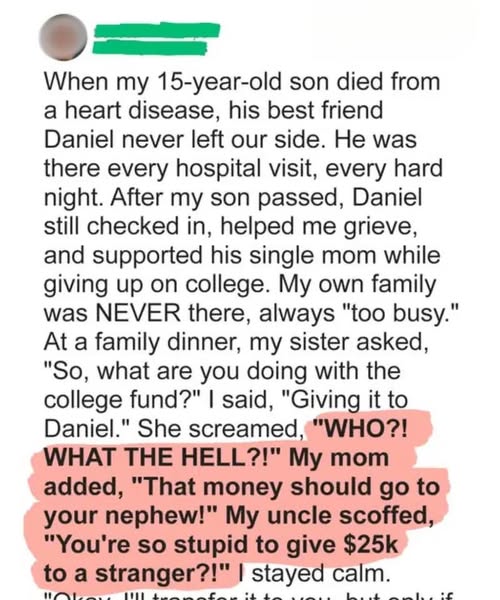
When my 15-year-old son died from a heart disease, his best friend Daniel never left our side. He was there every hospital visit, every hard night. After my son passed, Daniel still checked in, helped me grieve, and supported his single mom while giving up on college. My own family was NEVER there, always “too busy.”
At a family dinner, my sister asked, “So, what are you doing with the college fund?” I said, “Giving it to Daniel.” She screamed, “WHO?! WHAT THE HELL?!” My mom added, “That money should go to your nephew!” My uncle scoffed, “You’re so stupid to give $25k to a stranger?!” I stayed calm.
I’d been quiet for a long time, especially since losing Tomas. But I wasn’t going to let them steamroll me again. They had barely known him. They showed up to the funeral for optics, took selfies in their black suits, left after 40 minutes.
Daniel? Daniel stayed. He stayed long after the casseroles were gone and the sympathy cards stopped coming.
I remember finding him sitting in Tomas’s room one morning, crying softly into a hoodie they used to share. He stood when he saw me, awkward and red-eyed, and said, “I hope that’s okay. I just miss him.”
I hugged him and said, “You always have a place here.”
Over the next few months, he did chores around the house, helped me fix a leaky faucet, and even taught me how to reset the Wi-Fi. I don’t know how I would’ve made it through the first year without him.
Meanwhile, my sister Lyra only texted to remind me of birthdays or ask for a ride for her son, Nevan. My mother called once in January to ask if I was “over it yet.” No one from my family had spent more than two hours in my home since the funeral.
But Daniel showed up, every weekend, like clockwork.
He had planned to study mechanical engineering after high school. He and Tomas used to talk about going to university together, getting an apartment, maybe starting a business. But when his mom lost her job and had a medical scare, he dropped everything to support her and his two younger siblings.
He worked full time at a mechanic’s shop and picked up night shifts at a grocery store. He never once complained.
I knew what I was doing with that money the day Tomas died.
Tomas’s college fund had been something we both worked on—me saving small amounts over the years, him pitching in from tutoring jobs, birthday money, even a $100 bill he won in a school contest. It wasn’t just cash. It was a symbol of a dream they had.
Daniel earned it.
When I said it out loud at that dinner, the room exploded. Lyra clutched her wine glass like it might break. Nevan looked confused but also smug, like he already thought he deserved the money.
“He’s not family,” my mom repeated, like that settled it.
“No,” I said, “he’s better.”
That shut them up for about five seconds. Then my uncle launched into a tirade about bloodlines and keeping wealth in the family, as if $25,000 was a royal inheritance.
I looked at their angry faces—faces that didn’t cry with me, didn’t sit through the surgery updates or the late-night emergencies—and I just felt… tired.
So I said it, flat and calm: “You all disappeared when Tomas got sick. Daniel didn’t. That fund was meant to support a young man with dreams. And that’s exactly what it’ll still do.”
The silence after that was delicious.
Lyra left early. My mom made a big show of sighing and kissing me on the cheek like I was a child. Nevan took an extra dessert to go.
Daniel didn’t even know yet. I hadn’t told him.
I wanted to do it right.
The next weekend, he came by to help me organize the garage. It was hot and dusty, and we were laughing about Tomas’s old rollerblades when I pulled out the envelope.
“I want you to have this,” I said, handing it to him.
He looked confused. “What is it?”
“It’s Tomas’s college fund. It’s $25,000. It’s yours now.”
He stared at me, mouth slightly open, like I’d spoken another language. “No. No, I—I can’t take this.”
“You can,” I said, gently. “And you will. He would’ve wanted this.”
Tears welled up in his eyes. He sat down on a box of winter coats and just held the envelope to his chest. “You don’t know what this means.”
“I do,” I said. “Go chase the life you two dreamed of.”
He nodded slowly. Then he said something I’ll never forget: “I’ll make you both proud.”
A few weeks later, he applied to a local university with a top-tier engineering program. He kept his job part-time, and I helped him fill out every form.
My family didn’t reach out much after that. A few icy texts, mostly from Lyra, about “breaking tradition” and “turning my back on blood.”
But something odd happened a few months later.
Nevan got suspended. School fight. Apparently, he’d been bragging about inheriting money from “his dead cousin,” and another kid challenged him. It turned physical. The school counselor called me, not his mom.
“Your name is still on some of his emergency records,” she explained.
I ended up driving over and picking him up.
He was quiet in the car. I asked if he wanted to talk.
“Why did you give it to Daniel?” he finally blurted. “You knew I needed college money too.”
I looked at him carefully. He was only seventeen. Angry, yes. But I could see it wasn’t just about the money. He’d lost a cousin. And he didn’t know how to grieve.
“You never visited Tomas when he was sick,” I said gently. “Not once.”
He blinked. “Mom said hospitals were too sad.”
I almost laughed. “Yeah. They are. But Daniel came anyway.”
He looked out the window and didn’t say anything after that.
The next time I heard from Daniel, he was finishing his first semester with all As. He wanted to meet for lunch.
He’d grown into himself—confidence in his posture, a spark in his eyes I hadn’t seen since he was a kid.
Over tacos, he told me about a robotics competition, a new group of friends, how he was helping mentor a freshman who reminded him of Tomas.
I told him how proud I was. He smiled and said, “I still wear his bracelet every exam.”
Later that week, I got a letter in the mail. No return address.
Inside was a thank-you note, written in tight, awkward handwriting.
“Dear Auntie Leenah,” it read, “I was mad at first. But now I get it. I didn’t deserve that money just because we’re related. Daniel did. He earned it. I’m sorry for how I acted. I’m going to try to be better. Love, Nevan.”
I cried.
It was the first time any of them had acknowledged what Daniel had done. What I had done. What we all lost.
Months passed.
Daniel invited me to his graduation. He wore a blue stole Tomas had once jokingly said he’d steal from the university bookstore.
We cried. We laughed. He handed me a small box—inside was a keychain with Tomas’s name engraved on one side and the words “Thank you for believing in me” on the other.
He got a job offer straight out of school. Mid-size tech firm. Paid well, had good benefits. He still visited on weekends when he could, still helped his mom, still called me “second mom.”
Lyra eventually reached out. Awkwardly, cautiously.
She said she’d been reflecting. That maybe she’d gotten too caught up in pride and money.
I didn’t say much. Just told her I hoped she was doing okay.
I don’t need apologies wrapped in guilt. I just need actions.
A year after Daniel graduated, Nevan called me. Said he wanted advice on applying to trade school. He wanted to be a welder. Said he’d been working on cars at night.
“Do you think I could ever fix things?” he asked.
“Always,” I told him.
He came by with greasy hands and a shy smile and helped me hang new shelves.
When he left, I looked around my living room. It still had traces of Tomas—his framed art project, a favorite old hoodie folded neatly on a shelf.
But there were also signs of life moving forward.
Daniel’s graduation photo. Nevan’s thank-you card. A welding textbook left on my table.
I used to think grief was a door that shut forever.
Now I know it’s a bridge.
And every person who crosses it with you—who stays, who helps build what’s next—is family, no matter what blood says.
So yes, I gave away $25,000 to a kid who wasn’t “mine.”
But in return, I got something bigger.
A second son.
And maybe, with time, a second chance for the rest of us.
If this moved you even a little, please share it. Someone out there might need the reminder that love isn’t about blood—it’s about showing up. ❤️