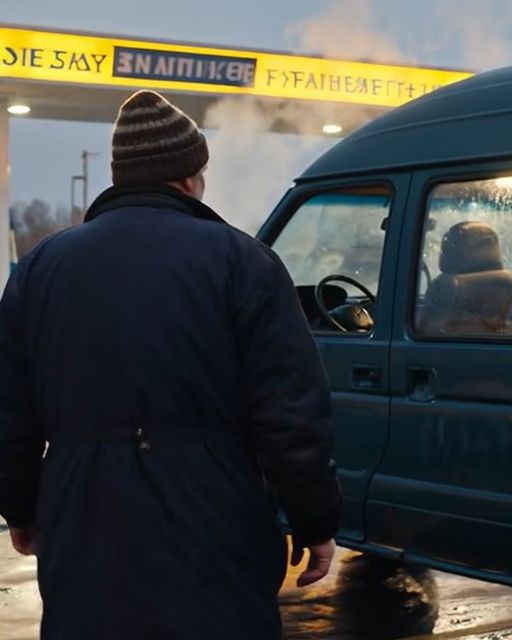
The van was wrong.
It sat crooked at the edge of the gas station lot, steam rising from the asphalt around it. A woman was slumped against the passenger window, her mouth open. A little boy was a small knot in the back seat.
Something pulled me closer. A bad feeling in my gut.
Then I saw her face. It was Leah. My daughter. The one I hadn’t spoken to in five years.
My knuckles rapped against the glass, a hollow sound.
Her eyes fluttered open. They were cloudy, lost. Then they found me.
“Pops?”
The word was a puff of air against the window.
The door wasn’t locked. The air inside was stale and thick with something like despair. She looked tired in a way sleep could never fix. The boy in the back, my grandson, just stared with old eyes before tucking his chin to his chest.
“Where’s your place?” I asked. My voice sounded rusty. “And the baby? Where’s the new baby?”
Leah swallowed, a painful-looking motion.
“Alex,” she said, her voice cracking. “And his mom. They changed the locks. They have the baby inside. They said I have no rights.”
The ground shifted under my feet.
My daughter. My grandson. Sleeping in a van. And a newborn grandchild trapped behind a locked door.
Then I heard it. My own voice, booming from five years ago. A cruel, proud sound.
“If you marry him, don’t you dare call me your father again.”
I pulled the van door open wider.
“Come with me.”
Her eyes were wide, terrified. “Where?”
“Home,” I said. “Then we fix this.”
At my house, she sat on the floor, as if a chair was a luxury she’d forgotten. My grandson, Leo, finally fell asleep on the couch, clutching a small, worn-out car. He’d flinch every time the old house creaked.
And the story spilled out of her.
Alex had been perfect, until he wasn’t. Until life got real. Leo needed a little extra help. The new baby never slept. Leah was exhausted. And they used that exhaustion against her, twisting it into a weapon. They called her unstable. Unfit.
One afternoon she went out for diapers.
She came back to a deadbolt that wouldn’t turn.
“They said the baby was better off with them,” she whispered to the floorboards. “I didn’t even have a number to call you.”
I felt a fire start in my chest. I wanted to drive over there and burn their whole world down.
But Leo whimpered in his sleep, and I saw the fear on his face even then. I had to swallow the fire, turn it into something cold and hard. Something useful.
I called David, an old friend. A lawyer. I told him everything, and he listened so long and so quietly I thought the line had gone dead.
Finally, he spoke. “It won’t be easy,” he said. “But it’s not impossible.”
The next day, we walked into that gleaming condo lobby.
Alex came down to meet us. He smelled like expensive cologne and arrogance. He didn’t even look at Leo. He spoke to the air around us, telling anyone who would listen that Leah had “left,” that she was “being dramatic.”
Then his mother appeared from the elevator, all polished teeth and quiet poison, talking about my daughter like she was a piece of trash to be thrown out.
People were staring. Leah started shaking, a tremor that went through her whole body until she couldn’t speak.
When the elevator doors hissed shut, she folded in on herself right there on the sidewalk.
“We lost, Pops,” she choked out.
“No,” I said, grabbing her arm. “We just saw the enemy.”
David knelt down. “We don’t win in the lobby,” he said, his voice low and urgent. “We win with proof. We win with a witness who saw what happened when that door was locked.”
That’s when a woman walking her dog paused.
“Security cameras,” she said.
My heart hammered against my ribs. The hallways. The lobby. The exact moment they locked her out.
If that footage still existed, it wasn’t her word against theirs anymore.
It was the truth.
The next morning, we were in the building manager’s office. He stared at his computer screen, clicking slowly.
“I can’t release footage without an official request,” he said, finally looking up. His eyes flickered. “But there’s a note on the file from that night. Something might still be there.”
Leah’s fingers dug into my arm.
The door behind us opened.
A uniformed security guard stepped into the small office. He cleared his throat, a small, dry sound that seemed to suck all the air out of the room.
His name tag read ‘Martin’. He wasn’t a big man, but he carried a weight of quiet authority.
He nodded at the manager. “Phil. I was on duty that night.”
Phil, the manager, looked uneasy. He shuffled some papers on his desk.
“This is a private matter, Martin,” he mumbled.
Martin’s eyes met mine. They were kind eyes. Tired eyes. He’d seen a lot from his post by the front doors.
“I saw what happened,” he said, his voice low and steady. “I saw the young lady try her key. I saw her calling up. I saw them ignore her.”
Leah let out a small, ragged breath. Someone else had seen. She wasn’t crazy.
“And later,” Martin continued, looking directly at Phil. “I saw Mr. Alex and his mother down here in this very office. I saw them hand you a very thick envelope, Phil.”
The manager’s face went pale, then a blotchy red. “That’s an accusation.”
“It’s a fact,” Martin said, not raising his voice. “I also saw you delete the footage from Hallway B. But you’re not as good with computers as you think you are.”
My hand found Leah’s. It was ice cold.
“The system does an automatic backup to a cloud server every hour,” Martin explained, turning to us. “He only deleted the local file. The truth is still up there.”
He looked back at the manager. “And I made a personal copy. Just in case my conscience got the better of me.”
For the first time in days, I saw a flicker of something other than fear in my daughter’s eyes. It was hope.
David stepped forward, his lawyer-mode fully engaged. “Phil, I’d advise you to cooperate fully. Obstruction charges are a lot messier than just providing a video file.”
Phil’s shoulders slumped. He typed for a moment, then spun the monitor around.
And there it was. Frame by frame.
Leah at the door. Her confusion turning to panic. Her frantic knocking. You could see her calling on her phone through the little window in the door.
Then, the camera from the lobby showed Alex’s mother looking down from the mezzanine, a cold, satisfied smile on her face, before she turned away.
It was everything. It was the proof we needed.
The days leading up to the emergency hearing were the longest of my life.
We tried to build a small bubble of normal in my quiet house. I dug out my old tools and Leo and I built a wobbly birdhouse in the backyard.
He didn’t talk much, but when he managed to hammer a nail in straight, he looked up at me and smiled. A real, genuine smile. It was like watching the sun come out after a storm.
Leah cooked. Simple things. Macaroni and cheese from a box. Scrambled eggs. But it was an act of taking back control, of making a space hers again.
She’d stand by the window that overlooked the garden, her hand resting on her stomach where her new baby should have been. The silence in those moments was deafening.
One night, I found her sitting in the dark, just looking at the phone in her hand.
“I’m a terrible mother, Pops,” she whispered. “I let this happen.”
I sat down on the floor next to her, my old knees protesting. “They did this to you, Leah. Not the other way around. They used your love for your kids as a weapon against you.”
“But I left you,” she said, tears finally falling. “I was so stubborn. I thought I knew everything.”
“So was I,” I admitted, the words tasting like rust. “Pride is a lonely business, kid. I’ve had five years of quiet to figure that out. I missed you every single day.”
We didn’t say much more after that. We just sat there in the dark, a father and a daughter, finally bridging the chasm we had built between us.
The day of the hearing arrived. The courtroom was cold and impersonal.
Alex and his mother sat on the other side with a lawyer who looked like he’d been carved from a block of ice. They were dressed in expensive suits, looking calm and powerful.
They presented their case first. Their lawyer painted a picture of Leah as a flighty, unstable woman who suffered from severe postpartum depression and had abandoned her children.
He brought up the fact she hadn’t spoken to her own father in five years. “A pattern of cutting off family,” he called it.
I felt the blood drain from my face. My own stupid pride was now being used as a weapon against my child.
When it was our turn, David was calm. He simply played the security footage.
The courtroom was silent as we all watched the truth unfold on the screen. The locked door. The unanswered calls. The smirk on the grandmother’s face.
You could feel the mood in the room shift.
Alex’s lawyer tried to dismiss it, calling it a “misunderstanding,” a “temporary argument.”
“A misunderstanding that left a mother and her child homeless?” the judge asked, her voice sharp.
Then David called his next witness.
“The defense calls Sarah Jennings to the stand.”
I looked over at Alex. All the color drained from his face. He looked like he’d seen a ghost.
A woman walked to the front of the courtroom. She looked familiar.
It was the woman from the lobby. The one who had been walking her dog.
She sat in the witness box, her hands folded neatly in her lap.
“Ms. Jennings,” David began. “How do you know the respondent, Mr. Alex Sterling?”
She took a deep breath. “He was my husband. I was his first wife.”
A gasp went through the courtroom. Leah looked at me, her eyes wide with shock.
The twist wasn’t just that there was footage. The twist was that history was repeating itself.
Sarah told her story. It was chillingly familiar. The charm, then the control. The isolation from her family. The way he and his mother would team up, making her feel small and crazy.
“He did the same thing to me,” she said, her voice shaking but strong. “We had an argument. I went to the store to get some air. When I came back, the locks were changed.”
She had a baby, too. A little girl.
“They told everyone I’d had a breakdown and left,” she said, looking directly at the judge. “They had more money. More power. They buried me in legal fees and character assassinations. I lost custody. It took me three years to get my daughter back.”
She had seen Leah on the sidewalk, crumpled and crying, and it was like looking in a mirror.
“I couldn’t just walk away,” she said. “I couldn’t let them do it to someone else.”
She had documents. Old emails. Threatening text messages from Alex’s mother. A police report that had been dismissed. It wasn’t just a story; it was a mountain of evidence showing a cold, calculated pattern of abuse.
The ice-block lawyer was sputtering. Alex and his mother were whispering furiously to each other. Their perfect, polished image had been shattered.
The judge looked down from her bench, her face like thunder. She didn’t even need to deliberate.
“This is one of the most egregious cases of coercive control and parental alienation I have ever seen,” she said, her voice ringing with authority.
She granted Leah immediate and full sole custody of the baby. Her name was Maya. I heard my new granddaughter’s name for the first time in a courtroom.
A permanent restraining order was granted against both Alex and his mother. The judge ordered a full investigation into their finances and past conduct. Their world was coming down around them.
The doors at the back of the courtroom opened, and a bailiff walked in, carrying a car seat.
Inside was the tiniest, most perfect little baby I had ever seen.
Leah let out a sound that was half-sob, half-cry of joy. She rushed forward and took her daughter into her arms.
She buried her face in the baby’s blanket, just breathing her in. Leo, who had been sitting quietly beside me, walked over and gently touched his little sister’s hand.
“Maya,” he whispered.
That night, my house was full.
The silence was gone, replaced by the soft gurgles of a baby and the quiet hum of a family healing.
I watched Leah rock Maya to sleep in the old chair my own wife had used. She looked up at me, her face wet with tears, but her eyes were shining.
“Thank you, Pops,” she said. “You saved us.”
“No,” I said, my own voice thick with emotion. “You saved me. I was just an old man living in a quiet house full of regrets.”
I thought back to that moment five years ago. My harsh words, spoken out of fear and pride. I had almost let that one terrible moment define the rest of my life.
Finding her in that van wasn’t a coincidence. It was a second chance. A chance to be a father again. A chance to be the grandfather these beautiful children deserved.
A year later, the house is rarely quiet.
Leo is a chatterbox now, his confidence growing every day. He’s the best big brother, always making sure Maya has her favorite stuffed rabbit.
Leah got a part-time job at the local library and is taking online classes. I see the light back in her eyes. She’s strong and resilient, a wonderful mother.
Sometimes, I watch them all playing in the backyard, their laughter echoing through the trees, and I feel a profound sense of gratitude.
My pride almost cost me everything. It almost made me miss all of this. That whisper of my own cruel words that I heard at the gas station wasn’t a ghost haunting me; it was a final, desperate warning.
Life doesn’t always give you a chance to fix your biggest mistakes. But when it does, you have to be ready to swallow your pride, open the door, and say the one word that matters most.
Home.