The laughter inside stopped the second I rang the bell.
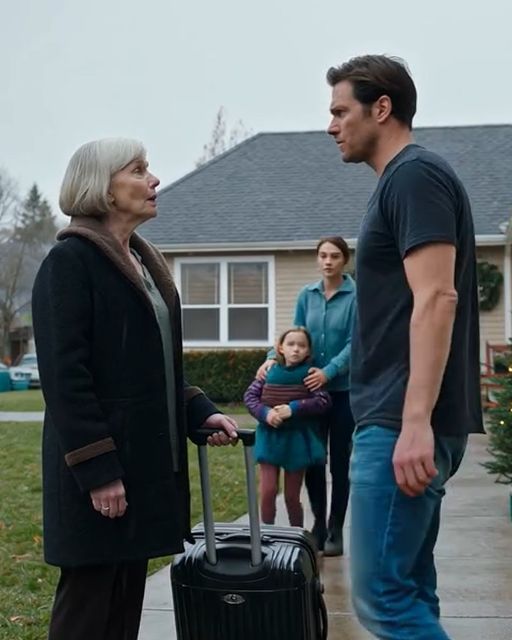
A lock clicked. The door opened. And for half a second, I saw my son, Mark, the boy I raised in a tiny house in the Midwest with floors that groaned under our feet.
Then a switch flipped behind his eyes.
His face went hard.
“Mom,” he said. It wasn’t a welcome. It was an accusation. “What are you doing here?”
I tried to make my voice light, to pretend this was normal. “I came to surprise you. I miss the kids.”
His eyes were like stones. “Who invited you?”
A small face peeked around his leg. Chloe. My granddaughter. Her face lit up. “Grandma,” she whispered.
Sarah, his wife, appeared like a ghost and pulled her back. Her smile was polished and perfect and had nothing in it.
This wasn’t how it was supposed to go.
It started with excuses. “The kids are sick.” Then, “Work is crazy.” Calls got shorter. Video chats became blurry waves from a distance.
Every attempt I made to schedule a visit was met with a polite, impenetrable wall.
Six months. I hadn’t held them in six months.
So I lay awake one night at 3 AM, listening to the radiator hiss in my quiet kitchen, and I did the one thing I’d never done.
I booked a flight without asking.
Now, on his perfect porch, in a city that smelled like wet pavement, my son stepped toward me, forcing me to take a step back.
“You can’t just show up,” he said, his voice flat.
“When is a good time, Mark?” The crack in my voice made me feel pathetic.
He didn’t explain. He didn’t argue. He just looked at me like I was a problem to be solved.
“Leave.”
The word was quiet. Final.
The door closed. The deadbolt clicked. It sounded like a bone snapping.
I don’t remember getting to the hotel. It was a generic room by the freeway with art bolted to the walls. I sat on the edge of the bed in my coat, my suitcase beside me like a tombstone.
I stared at my dark phone until my hands stopped shaking.
The next morning, the screen was so bright it hurt my eyes.
Seventy-two missed calls.
All from Mark.
Before I could even process it, the phone vibrated, his name flashing like an alarm.
The same people who shut me out were suddenly desperate to know where I was.
What changed overnight?
And why did their panic feel less like love… and more like fear?
My thumb hovered over the screen. Part of me, the part that felt small and broken on that porch, wanted to ignore it.
But I was a mother. It’s a switch you can never turn off.
I answered. “Mark?”
“Mom! Oh, thank God. Where are you?” He sounded breathless, like he’d been running.
There was no apology in his voice. Just raw, frantic need.
“I’m at a hotel near the airport,” I said, my voice steadier than I felt.
“Stay there. Don’t go anywhere. I’m coming to you.”
He hung up before I could ask why.
An hour later, he was knocking on my hotel room door. Not a confident knock, but a hesitant, scattered tapping.
I opened it and saw my son, but not the man from the porch.
This was a boy again. His shoulders were slumped, his eyes were red-rimmed, and the expensive suit he wore looked like a costume.
He didn’t say anything. He just walked past me and sank onto the edge of the bed, burying his face in his hands.
I sat down in the stiff chair opposite him, a chasm of cheap carpet between us.
The silence stretched on, filled only by the hum of the mini-fridge.
Finally, he looked up, and the story came tumbling out.
It wasn’t a story about me. It was about them. About Sarah.
Sarah came from money. Not just comfortable money, but the kind of wealth that came with rules and expectations.
Her parents, Eleanor and Richard, had never approved of Mark. They saw a boy from the Midwest with a state college degree and a mother who worked as a school secretary.
They saw someone beneath their daughter.
But Sarah loved him, so they made a deal. They would help them. They bought the house. They paid for the private schools. They funded Mark’s struggling business venture.
Their generosity was a gilded cage.
And the price of living in it was to slowly erase where he came from.
My phone calls were an inconvenience. My desire to visit was a threat.
They had to project an image of seamless, self-made success. A simple woman from a small town with groaning floors didn’t fit that image.
“Last night,” Mark choked out, “was supposed to be a big night.”
Eleanor and Richard were coming for dinner. It was an annual review of sorts, where they assessed his progress.
My arrival, my unannounced presence on their perfect porch, had sent them into a spiral of sheer terror.
They were terrified I’d still be there when her parents arrived. That I’d ruin everything.
That’s why he’d been so cruel. It was the desperate act of a cornered animal.
“So you sent me away,” I said, the words hollow.
He flinched. “I’m so sorry, Mom. You can’t imagine how sorry I am.”
But that wasn’t the reason for the seventy-two calls. The real reason was so much worse.
The dinner had been a disaster even without me.
There was another reason they needed Sarah’s parents. Another secret they had been keeping.
My other grandchild, their son Leo, was sick.
He had a rare heart condition that required a very specific, very expensive surgery from a specialist in another state.
They had been putting it off, hoping it would get better, hoping for a miracle. But the doctors said they couldn’t wait any longer.
At dinner, after suffering through Richard’s belittling comments, Mark had finally broken down and asked for the money for Leo’s surgery.
Richard had just stared at him.
He called Mark a failure. A bad investment. He said he wouldn’t throw good money after bad.
Eleanor just sat there, silent, smoothing the napkin in her lap.
They refused. They left. And they cut them off completely.
The house, the business, the car… it was all tied to them. It would all be gone.
But none of that mattered to Mark.
“It’s Leo,” he whispered, his voice cracking completely. “They won’t help us save our son.”
He looked at me then, his eyes pleading. “We have nothing, Mom. We’ve lost everything.”
In that moment, all the hurt, all the anger from being shut out, it just… evaporated.
It was replaced by the fierce, primal instinct of a grandmother.
My boy was hurting. My grandson was in danger.
I stood up and walked over to my suitcase. I unzipped the front pocket and pulled out a thick manila envelope.
I placed it on the bed next to him.
He looked at it, confused. “What’s this?”
“It’s for Leo,” I said quietly.
He opened it. Inside were bank statements, a deed, and transfer documents.
His eyes scanned the pages, his confusion turning to disbelief.
“Mom… what is this? This is… this is a lot of money.”
I took a deep breath. It was my secret. The one I’d been keeping for myself.
“I sold the house, Mark. The one with the groaning floors.”
He looked up, his face a mask of shock. “You sold our home? Why?”
“It wasn’t our home anymore. It was just my house. It was too big. Too quiet. Too full of memories.”
I had sold it over a year ago. I moved into a small, sensible apartment across town. I downsized my entire life.
I didn’t need much. A good book, a clean kitchen, a window with some sun.
The money from the sale, plus my retirement, my late husband’s life insurance… I’d been a careful saver my whole life.
It was my nest egg. My security.
It was the sum total of a simple life, lived carefully.
“It’s not enough for the life you were living,” I said. “But I think it’s enough for the surgery. It’s enough for what matters.”
Tears streamed down his face, silent and heavy. He didn’t try to wipe them away.
“I don’t understand,” he whispered. “We treated you so badly. We pushed you away. Why would you do this?”
I went and sat beside him on the bed. I finally put my arm around my son, and he leaned into me like he was a little boy again.
“Because you’re my son,” I said. “And a parent’s love isn’t a transaction. It doesn’t have terms and conditions.”
“It’s not something you earn. It’s just there. Always.”
That night, for the first time in a long time, we were a family again, huddled together in a cheap hotel room.
Sarah arrived an hour later, her perfect mask gone, her face blotchy from crying.
She didn’t make excuses. She just looked at me, her eyes filled with a profound shame that was more powerful than any apology.
She hugged me, a real hug that felt like it came from her bones. “I’m so sorry,” she wept into my shoulder. “I’m so, so sorry.”
The next few months were a blur.
We used my money to pay for Leo’s surgery. It was a success.
Mark and Sarah lost the big house. They lost the fancy cars and the country club membership.
Sarah’s parents never called again. Their silence was a gift.
Mark’s business folded, but he found a new job. It was less glamorous, working for a small local company, but he came home at five every night.
He came home tired, but he came home happy.
They moved into a small rental house, the kind with floors that might groan one day.
It was messy. It was loud. It was filled with toys and mismatched furniture.
It was a home.
I didn’t fly back to the Midwest. I stayed. I got my own little apartment just a few blocks away.
Now, I don’t have to surprise them.
I have a key.
I let myself in some afternoons and the sound of laughter doesn’t stop. Chloe runs to hug my legs, and Leo, with a healthy pink glow in his cheeks, shows me his new drawing.
Sarah is in the kitchen, flour on her nose, trying a recipe from my old cookbook. Mark is on the floor, being a monster for the kids to climb on.
They built a new life. A real one.
One not propped up by the cold expectations of others, but built on a foundation of something stronger.
Sometimes, Mark will just look at me from across the room and his eyes will fill with a gratitude that needs no words.
He’s learned that a person’s worth isn’t measured by their zip code or the car they drive.
It’s measured by the love they’re willing to give, and the grace with which they are able to receive it.
True wealth isn’t about having the best of everything. It’s about making the best of everything you have.
And sometimes, the most valuable thing you can offer someone is not a solution to their problems, but the unwavering certainty that they do not have to face them alone.