Eleanor thought her father’s medals were all there was to his story. Bronze Star. Purple Heart. A perfectly folded flag in a glass case on the mantel.
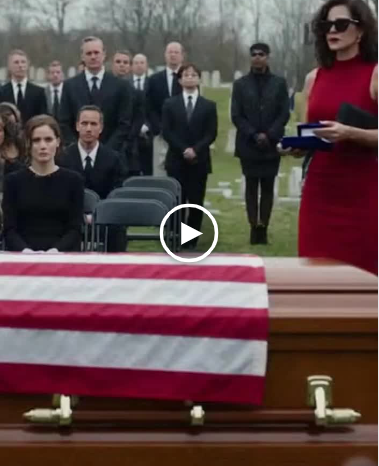
But at the funeral, the woman in the red dress didn’t sit with the family.
She waited until everyone else had left. Then she placed a small velvet box on the coffin.
Inside? A wedding ring.
Eleanor’s mother was buried six years ago. And her father never remarried. At least, not officially.
Confused, Eleanor asked the woman who she was.
“His wife,” the woman said. “We met at Walter Reed. He never wanted to hurt you.”
Her father had been living a double life—one family in Kentucky, one in Virginia. Two sets of holidays. Two versions of him. He kept the lines clean. Until he died.
Eleanor’s siblings didn’t believe her—until she showed them the letters. Dozens of them. Hidden in a cigar box behind the books on his shelf.
One read:
“When I’m with you, I forget the war. When I’m with them, I remember why I went.”
The VA pension. The inheritance. The house.
All suddenly in question.
What Eleanor didn’t know? The woman in red had already hired a lawyer—and she wasn’t just claiming love.
She was claiming everything.
And then Eleanor found the second will. Dated last year. Signed in secret.
Now Eleanor sits on the floor of her father’s study, the will shaking in her hands. Dust floats in the air like ash, drifting through the thin strip of light cutting under the blinds. The house still smells like his aftershave and old paper. His boots line up by the door, polished, waiting for a man who never walks through it again.
Her heart pounds so loudly she almost doesn’t hear Olivia.
“Len? You find something?” her sister calls from the hallway.
Eleanor swallows and forces her voice to work. “Yeah,” she says. “You need to see this.”
Olivia appears in the doorway, arms folded tight across her chest, dark hair pulled into a harsh knot like she’s holding herself together with it. Her eyes flick down to the document in Eleanor’s hands.
“What is that?”
“A will,” Eleanor says. “Another one.”
Olivia steps closer, then drops to her knees beside her. Together they look down at the pages spread on the carpet. The signatures. The notary stamp. The date in the top-right corner. Eleven months ago.
Olivia reads in silence, her lips moving. Eleanor watches the color drain from her sister’s face, leaving her pale and waxy, like one of the candles on the mantel after the funeral.
“This can’t be real,” Olivia whispers. “He wouldn’t do this.”
But he does, in black ink.
I, Colonel James Robert Harlow, being of sound mind and body…
Eleanor’s eyes trace the words again, even though she already knows what they say.
He leaves the house to “my beloved wife, Rachel Ann Sinclair-Harlow.” Not their mother. Not them. The VA pension? To be divided between “my dependents as recognized by the Department of Veterans Affairs, including but not limited to my spouse, Rachel Ann Sinclair-Harlow, and any minor children under my care.”
There’s a line about “provisions for Eleanor Marie Harlow, Olivia Jane Harlow, and Michael Thomas Harlow.” Provisions. Like they are footnotes. He gives them each a lump sum from a life insurance policy Eleanor doesn’t even know exists. It is money, yes. But smaller than what the first will promises. Smaller than what they expect. And the house—their mother’s curtains, the creaky stairs, the kitchen table covered in crayon marks from when they are kids—that goes to the woman in the red dress.
Rachel.
Olivia’s eyes shine. “We can contest this,” she says, voice sharp. “He was sick. He was on meds. Maybe he wasn’t in his right mind. We have rights, Len. We’re his actual family.”
Eleanor hears the word actual and it slices through the air, through her, like shrapnel.
“He signs it at a law office,” Eleanor says, tapping the notary seal with a trembling finger. “There are witnesses. It looks legit.”
“Then we make it not legit.” Olivia stands up like she is preparing for battle. “We call Dad’s lawyer. The real one. Not whoever she finds in Kentucky. We are not letting some stranger in a red dress walk into our lives and walk out with the house.”
Footsteps thud down the hall. Michael appears, still in the suit he wears to the funeral, tie loosened, eyes red.
“What now?” he asks, looking between them. “You guys are yelling like the house is on fire.”
Olivia thrusts the will toward him. “It is.”
Michael takes the pages and reads them. His jaw tightens, muscles twitching. “What the hell,” he breathes.
Eleanor watches both of them, the anger simmering between them like a live wire. She feels it too, a hot pressure rising in her chest, but underneath it something else throbs: confusion, grief, a raw ache for the man she thinks her father is. The man who teaches her how to drive, who weeps quietly at the sound of Taps at her mother’s burial. The man who presses a kiss to the top of her head when he thinks she is asleep and whispers, “I’m sorry” into her hair.
Sorry for what, she wonders now.
“For everything,” Michael says suddenly, as if he reads her thoughts. “He’s sorry for everything, and then he does this.”
He crumples the top edge of the will in his fist, then stops, fingers relaxing. He smooths it carefully, like part of him still can’t stand to damage anything with their father’s name on it.
“We need a lawyer,” Olivia repeats. “Now.”
Eleanor nods, but her gaze returns to the last page. To the small line at the bottom, separate from the others, handwritten in their father’s uneven scrawl.
See attached personal letter to my eldest daughter, Eleanor.
Her fingers tingle.
“There’s more,” she murmurs.
“What?” Michael looks up.
“There’s a letter. To me.”
They search the desk, pull open drawers, push aside old bank statements and yellowing copies of discharge papers. Olivia tosses open file folders with shaking hands. Michael crouches by the lower drawers, sifting through stacks of manila envelopes.
“Nothing,” he grunts.
“Wait.” Eleanor reaches behind the bottom drawer, where she once hides her report card in middle school so their father won’t see a B in geometry. Her fingertips brush cardboard. She pulls out a thin, flat envelope taped to the underside of the desk.
Her name sits on the front in his handwriting.
El,
If you are reading this, then the thing I dread most has already happened…
Her lungs tighten. She doesn’t read it out loud. Not yet. The letter feels like a fragile organ, like a heart removed from a body—alive with everything he never says while he is breathing.
“I need a minute,” she says, closing her fingers around it.
Olivia opens her mouth to argue, then looks at Eleanor’s face and stops. “Fine,” she says softly. “But after you read it, we talk. Because this… all of this… affects all of us.”
They leave her alone in the study.
Eleanor sits in their father’s chair, its leather creaking under her weight. The envelope opens with a slow tear. Her hands are cold, but her pulse hammers hot in her throat.
She unfolds the letter.
El,
If you are reading this, then the thing I dread most has already happened. You know I am gone.
I don’t have the courage to say this to your face while I am alive. I face mortars and gunfire easier than I face my own daughter’s eyes. That is my shame.
You always see through me. You always have.
There is no easy way to say this, so I won’t try.
I married Rachel. It is legal. It is real. I love her.
I never stop loving your mother. Those two truths sit in the same body and tear it apart.
I meet Rachel at Walter Reed, when I am trying to learn how to live in a body that feels foreign. She sits with other vets, makes them laugh when they are missing pieces of themselves. With her, I feel like I am more than a name on a memorial wall waiting to happen.
I don’t tell you, or your brother, or your sister, because I am a coward. Because I tell myself I am protecting you. Because I see how hard you take your mother’s death, and I can’t be the man who destroys what is left of the world you think you know.
So I live two lives. I am not proud of this. Neither life is a lie, but both are incomplete.
I know this will come out after I die. Secrets always do. But I hope that by the time you read this, you are old enough to see me as a man, not just as a father or a soldier carved in stone.
I don’t ask you to forgive me. I don’t deserve that on command.
I ask you to remember that I love you. I love Olivia. I love Michael. I love your mother. That love is not smaller because I also love someone else. It just means I am not the hero you want me to be. I am just a man who tries and fails and tries again.
The house is in this second will because Rachel has no safety net. I know you kids are strong. I try to set money aside for you in other ways. Maybe I fail at that too. I don’t know.
If the lawyers fight, they will drag my name through the mud. They will talk about PTSD and capacity and the medals on the wall and the nights I wake up screaming. They will paint me as broken one way or another.
I can’t control that. What I hope is this:
That you choose each other over my mistakes.
You are my legacy, El. Not the medals. Not the folded flag. You three.
If there is any way for you to make peace—with Rachel, with the truth, with me—I hope you take it.
I love you, kiddo.
Dad
The word Dad blurs. Eleanor closes her eyes, presses her thumb into the paper until it crinkles. Her chest feels tight and wide open at the same time.
He writes it like he knows exactly what he is doing. Like he signs the will and then sits down at this desk and writes her a confession he will never have to witness her reading.
The study door creaks. Michael leans in.
“You okay?” he asks.
“No,” she says honestly. “But I’m done.”
He steps inside. She passes him the letter. He reads it, shoulders curling inward, eyes narrowed. When he finishes, he scoffs, but the sound is wet with grief.
“So that’s it?” he says. “He hides a whole wife and maybe more family and then asks us to ‘choose each other’ like that fixes it?”
Eleanor doesn’t answer right away. She stares at the medals on the wall, the small brass plates with dates and campaigns engraved on them. Her father’s name. His rank. All the parts of him the world recognizes.
“He’s right about one thing,” she says finally. “This will turn ugly. They are going to dig up everything.”
“Good,” Michael says. “Let them see what he does to us.”
Olivia appears behind him, arms still wrapped around herself. “So what now?” she asks. “We just… go along with this? Hand over Mom’s house to some woman none of us know?”
Eleanor stands. Her legs feel like they belong to somebody else, but they hold.
“We meet her,” she says.
Olivia’s eyebrows shoot up. “Why?”
“Because lawyers are already involved,” Eleanor says. “Because a judge can’t understand everything from paper. Because before we decide what we’re willing to burn down, I want to see who he risks everything for.”
“That woman?” Olivia spits. “She risks nothing. Dad shields her from everything. He leaves us to deal with the fallout.”
“Exactly,” Eleanor says quietly. “So maybe it’s time we stop being the ones who don’t ask questions.”
They drive to the motel where the funeral director says Rachel is staying. Eleanor grips the steering wheel so hard her knuckles bleach white. The town outside the windshield blurs into a smear of brick and trees and flags waving in front of porches. Her father’s world. Their world. Suddenly it feels smaller.
Olivia sits stiff in the passenger seat, staring straight ahead. Michael is in the back, knee bouncing.
At the motel, the air smells like stale coffee and cleaning chemicals. The lobby rug curls at one corner. A TV drones quietly in the background, some news anchor talking about overseas conflict. Eleanor’s stomach twists at the sound of words like deployment and valor.
They knock on room 112. There is a pause, the muffled sound of movement, and then the door opens.
Rachel stands there in jeans and a simple gray T-shirt, hair pulled back in a loose ponytail. Without the red dress and lipstick, she looks softer. Older than Eleanor first thinks at the funeral. Lines carve around her eyes, not from bitterness but something heavier—years of worry, maybe.
For a second, no one speaks.
Then Rachel’s gaze drops to Eleanor’s hands, to the folded papers and envelope she clutches.
“You found it,” Rachel says. Her voice is quiet, but steady.
“We did,” Eleanor says. “The will. And the letter.”
Rachel’s eyes fill. She steps back. “Come in,” she says. “Please.”
The room is small. One bed. A suitcase open on the chair. A framed print of a sailboat on the wall, generic and peaceful in a way that feels wrong for the tension thickening the air.
They sit. Eleanor chooses the chair by the window. Olivia and Michael sit on the edge of the bed, not too close, not too far. Rachel perches on the far corner, like she is prepared to get up and leave if she has to.
“I know you must hate me,” Rachel says.
Michael snorts. Olivia’s fingers curl into the bedspread.
“I don’t know you,” Eleanor says. “That’s kind of the problem.”
Rachel nods. “Fair.”
She looks at Eleanor with clear, steady eyes. “What do you want to know?”
The question catches Eleanor off guard. She expects defensiveness, legal language, threats. Not this. Not a simple offer.
“How long?” she asks.
“Ten years,” Rachel says. “We meet nine years ago. We marry a year later.”
Ten years. That means Rachel is in their father’s life while their mother is still alive. While their mother is sick.
Eleanor’s throat tightens. “Did my mother know?” she asks.
Rachel flinches. “No,” she says. “He tells me she doesn’t. He says he will tell her when the time is right. Then she gets worse. Then she… passes. And the time is never right.”
Olivia’s eyes flash. “So you just let him keep lying? To all of us?”
Rachel exhales, long and shaky. “I tell myself I’m waiting for him to do the right thing. We fight about it. A lot. I tell him I won’t be his secret forever. I give him deadlines. I pack a bag more times than I can count. He always begs me to stay. He says he is trying to figure out how to tell you without breaking you.”
She looks at them with an expression that mixes shame and love in equal measure. “But of course it breaks you anyway.”
“Did you push him to change the will?” Michael asks.
“No,” she says firmly. “He brings it up. Says he is worried about what happens to me when he’s gone. I tell him he already has a will. He says it’s old. He says his life changes. He doesn’t tell me what’s in the first one, but I can guess.”
“Everything goes to us,” Olivia says, voice flat. “To me, to Len, to Michael. The house, the accounts, the pension, everything. There’s a clause to set aside money for charities he loves. That’s it.”
Rachel nods. “That sounds like him. The man who is always sacrificing himself at your altar.” She winces and shakes her head. “I’m sorry. That’s not fair. I’m just… angry. Not at you. At him. Because he puts all of us in this position.”
Eleanor studies her. The lines on her face. The calluses on her hands. The way her eyes shine when she says him. This is not some gold-digger in a red dress. This is a woman who sits beside beds in rehab wards, who holds broken hands and laughs at bad jokes.
“Do you live in Kentucky?” Eleanor asks.
“Yes. Outside Louisville,” Rachel says. “I have a little house. We don’t live together full-time. He comes when he can. For a few days. A week. Always with an excuse—training, conferences, reunions. We spend holidays when he says he’s ‘between deployments’ or ‘extended debriefs.’ We talk about closing the distance. He says after he retires. After you graduate. After, after, after.”
She wipes her eyes with the back of her hand. “There is always another war.”
“Do you have kids?” Michael asks abruptly.
Rachel hesitates. “No,” she says. “We try. It doesn’t happen. Maybe that’s a blessing now.”
The room falls silent.
Eleanor feels something shift inside her. The picture of her father’s double life sharpens. Not two happy families he juggles like a con artist, but one broken man desperately trying to glue together his own shattered parts with other people’s hearts.
“I don’t know what to do,” Eleanor says finally. “Legally, I mean. This second will… it changes everything.”
Rachel looks at her hands. “My lawyer is aggressive,” she admits. “He tells me to fight. Says I am his legal wife, that the most recent will wins. He talks about property rights and benefits and case law. I nod, but every word feels like another shovel of dirt on a grave that doesn’t need more burying.”
She lifts her gaze. “What do you want, Eleanor? Really. Not what you think you’re supposed to want. What you want.”
Eleanor thinks of the house. The worn couch in the living room where she falls asleep watching war movies with her father. The patch of sunlight on the kitchen floor where her mother used to stand to drink her morning tea. The dent in the hallway where Michael slams his bike into the wall when he is nine. She thinks of those memories being boxed up, sold, scattered.
“I want my father to be who I thought he was,” she says. “But that’s not an option.”
She takes a breath. “I want us not to destroy each other in court. I want his name not to become a joke in this town. I want to grieve without also strategizing.”
“Then maybe we don’t start with lawyers,” Rachel says.
Olivia bristles. “We’re not just giving up the house.”
“I’m not asking you to,” Rachel says. “I’m asking you to talk. To consider a settlement we choose, not one a stranger in a robe forces on us.”
Michael rubs his face. “You want to negotiate Dad’s life like a business deal.”
“I want to protect what I have left of him,” Rachel says softly. “Just like you do.”
The words hang there.
Later that afternoon, they sit around their father’s kitchen table. Same spot where he teaches Eleanor how to shuffle cards, where he yells at Michael for carving his initials into the wood. Now the table becomes a war room. Legal pads. Coffee mugs. Highlighters.
They call a local attorney, Mr. Pryce, who handled their father’s first will. He arrives with a battered briefcase and sympathetic eyes. He reads both wills, the letter, the marriage certificate.
“This is messy,” he says, which feels like an understatement. “But it’s not impossible.”
He explains their options. Contest the second will on grounds of diminished capacity or undue influence. Fight Rachel’s legal status as spouse. Drag in doctors, therapists, commanding officers, old friends. Put their father’s trauma on display.
Or they can acknowledge the second will’s validity, then negotiate a family settlement: restructure the distribution in a way everyone agrees to. The court then approves it. No public battle. Less blood.
Less, not none.
“Your father is not the first man to make a mess of his estate,” Pryce says gently. “But you have a chance to decide what comes of it.”
Olivia looks at Eleanor. Her eyes burn, but beneath the anger there is something more fragile. Fear.
“What do you think?” Olivia asks quietly.
Eleanor feels the weight around her shoulders. Oldest child. Executor in the first will. The one he writes to in the second.
She looks at Rachel, who sits at the far end of the table, hands folded, waiting. Her face is tense but open. This woman loves their father. Their father loves her. That is a fact, however ugly the rest may be.
She looks at Michael, whose eyes redden again at the mention of dragging their dad’s nightmares into court.
She thinks of the letter.
You are my legacy, El. Not the medals. Not the folded flag. You three.
“We negotiate,” Eleanor says. The words surprise even her with how steady they sound. “We don’t let strangers define him. We do it.”
Olivia exhales, long and shaky. “Okay,” she says. “But I want something clear. We don’t erase Mom. This house is as much hers as his. If we agree to anything, it has to honor that.”
“Agreed,” Eleanor says.
Rachel nods. “I would never try to erase her,” she says. “James talks about her all the time. It makes me crazy sometimes, hearing him talk about another woman with that much love. But I know she is part of him. Like you are.”
They begin.
It is not clean. It is not quick. Voices rise. Tempers flare. Old resentments bubble up—about who takes care of their father after their mother dies, about who moves away, who stays, who calls, who doesn’t.
Rachel listens more than she speaks. When she does speak, she tells stories.
She talks about the night their father wakes up in a cold sweat in her Kentucky house, convinced he is back in a burning convoy. How she sits with him on the floor and holds his head in her lap until his breathing slows.
She talks about the letter he keeps in his wallet from Eleanor, written when Eleanor is ten: a crayon drawing of a stick-figure soldier and the words “Come home, Daddy.”
She tells them how he takes that paper out when he thinks she isn’t watching, runs his thumb over the fading colors, smiles.
She talks about him crying on her shoulder the night he tells her he can’t bring himself to tell his children about her. “I survive two tours,” he says, “but I don’t survive looking into my daughter’s eyes while I admit I betrayed her mother.”
Bit by bit, picture by picture, the myth of Colonel James Harlow crumbles and something else stands in its place: a man who loves recklessly, who fears deeply, who fails spectacularly.
In the end, they arrive at a shape of compromise.
The house stays in the family. They agree to put it in a trust with all three siblings as beneficiaries and decision-makers. Rachel gives up her claim to outright ownership in exchange for a larger share of the liquid assets: the insurance policy, some retirement accounts. The VA benefits get structured in a way that recognizes her as spouse but still sets aside a regular portion for the siblings.
It is not perfectly fair, because nothing about this is. But it feels… bearable.
When they sign the settlement documents weeks later in Pryce’s office, Eleanor’s hand trembles. She signs her name under a line that might as well read: We choose not to destroy each other.
Rachel signs last. Her pen pauses halfway through her name, then finishes.
“It still feels like losing him again,” Rachel says as she hands the pen back.
“It feels like meeting him again,” Eleanor replies quietly. “For who he really is.”
They hold a small gathering in the backyard of the house afterward. Just family and a few close friends. No uniforms, no honors, no speeches about duty and sacrifice. Those already happen at the funeral.
Today is different.
They set the folded flag on a table between framed photos from both of his lives. One of him in dress uniform, chest gleaming with medals. One of him in jeans and a faded Army T-shirt, arm around Rachel on a Kentucky porch, grinning in a way Eleanor has never seen before. One of him at Olivia’s college graduation. One of him teaching Michael to grill. One of him standing beside their mother, her head tipped back in laughter.
For a moment, everyone stands awkwardly separated—Virginia on one side, Kentucky on the other. Two clumps of people linked by a dead man and a stack of legal documents.
Eleanor clears her throat.
“I used to think my dad was simple,” she says. Her voice carries in the warm evening air. “Hero. Soldier. The man who always does the right thing. The man whose story we tell at barbecues and on Veterans Day.”
She looks at the photos, at the faces around her. “He isn’t simple. He is complicated. He lies. He hurts people. He loves more than one woman. He builds two lives and leaves us to sort out the wreckage.”
A few people shift uncomfortably. She presses on.
“But he also tucks us in after nightmares. He drives through the night to make it to Olivia’s recital. He hides letters in cigar boxes and writes apologies he will never hear us accept or reject. He tries to be everything to everyone and fails. Spectacularly.”
Eleanor takes a breath.
“I don’t know if that makes him a good man or a bad one,” she says. “I think it makes him a human one. And I think if we want to honor him, we have to honor that truth, not just the polished version with the flag and the medals.”
She turns to Rachel.
“I didn’t want you in this house,” she admits. “But you are part of him. And if I cut you out, I cut out a piece of him too. I’m tired of pretending pieces don’t exist because they are inconvenient.”
Rachel’s eyes brim. She nods.
“So we’re here,” Eleanor finishes. “All of us. The people he loves and the people he hurts. And we’re going to decide for ourselves what his legacy is. Not the lawyers. Not the stories we tell in uniforms. Us.”
Silence follows, soft and thoughtful.
Then Michael lifts his beer bottle in a clumsy salute. “To Dad,” he says. “To the mess.”
A few people chuckle. The tension loosens.
“To Dad,” Olivia echoes.
Rachel hesitates, then raises her own glass. “To James,” she says. “All of him.”
Eleanor raises her glass last.
“To the truth,” she adds.
They drink.
As the sun sinks and the yard fills with the hum of low conversation, Eleanor stands by the mantel, looking at the flag in its case. She thinks of the day she dusts it with her mother, small and careful, her mother telling her, “This isn’t just your father’s. It belongs to all of us.”
Back then, she thinks her mother means the country.
Now she understands something else.
This flag, these medals, this legacy—they belong to the people who live with the consequences of the choices made in their name.
She traces the edge of the glass with her fingertip.
Her father is not here to defend himself, to explain, to apologize again. But his voice lives in the letter folded in her pocket. His handwriting presses against her thigh like a heartbeat.
You are my legacy, El.
She used to think that means she has to live up to his heroism.
Now she understands it differently.
Being his legacy means she gets to decide what parts of him move forward. She chooses the honesty, the love, the willingness to own his failures—even if he only does it on paper after he is gone.
She chooses to remember the man who kisses her forehead before deployment and the man who sits half-broken in a rehab room letting a stranger in a red dress make him laugh. She chooses to hold both versions at once, without pretending either is the whole story.
Behind her, she hears footsteps. Rachel joins her by the mantel.
“He tells me about that flag,” Rachel says quietly. “How he gets it. How heavy it feels. He says one day he wants it on a wall over a big table with all his kids around it.”
“He gets part of that,” Eleanor says. “The flag. The table.”
Rachel smiles faintly. “The kids are working on it.”
They stand in silence for a moment, watching the light from the setting sun reflect off the glass. In the yard, Olivia laughs at something Michael says. The sound floats through the open window, warm and real.
For the first time since she stands at her father’s coffin and watches a stranger in red lay a ring on it, Eleanor feels something that isn’t just grief or anger.
It feels like the beginning of something else.
Not forgiveness, exactly. Not yet.
But a kind of truce. With her father. With Rachel. With the version of herself who needs heroes to be perfect.
She turns from the flag and walks back toward the yard, toward the messy cluster of people who now share not just a man’s name, but the truth about him.
His medals shine on the wall behind her.
His real legacy walks, breathes, and argues under the fading evening sky.
And Eleanor steps into it fully, eyes open, heart bruised but beating, ready to carry forward not the myth of Colonel James Harlow, but the complicated, broken, fiercely human man he truly is.