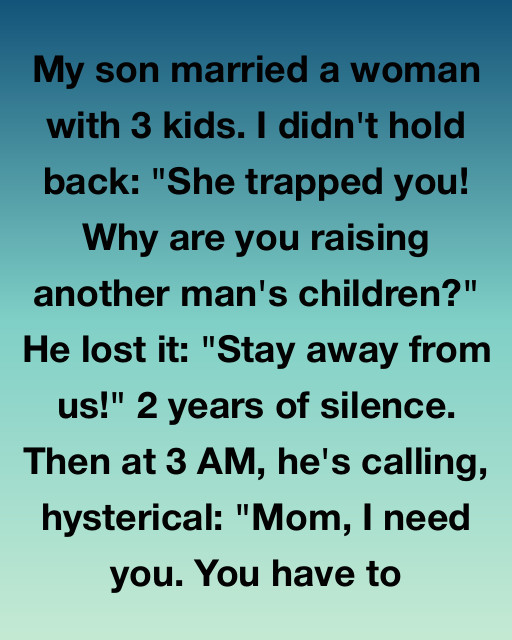
My son married a woman with 3 kids. I didn’t hold back: “She trapped you! Why are you raising another man’s children?” I was convinced I was protecting him from a life of burden and exhaustion. He was only twenty-six, a bright engineer with the world at his feet, and suddenly he was packing lunches and worrying about orthodontist appointments. He lost it: “Stay away from us!”
Two years of silence followed that shouting match in my driveway. I missed his wedding, I missed the holidays, and I missed seeing the man he was becoming. I spent my days in our quiet house in a suburb of Atlanta, telling myself I was the one who had been wronged. I’d look at the photos of him as a boy and feel a bitter sting of resentment toward the woman I thought had stolen his future.
Then at 3 AM, he’s calling, hysterical. My phone vibrated against the nightstand, and my heart nearly stopped before I even picked it up. His voice was a jagged mess of sobs and static. “Mom, I need you. You have to come to the hospital. Please, just come.”
I didn’t ask questions; I didn’t bring up the past. I threw on a coat over my pajamas and drove like a woman possessed through the empty, rain-slicked streets. I expected to find him in the emergency room after a car accident or a sudden illness. But when I burst through the sliding doors, I found him sitting in a plastic chair, his head in his hands, looking smaller than I’d ever seen him.
He looked up, and his eyes were red-rimmed and hollow. “It’s Callum,” he whispered, referring to the middle child, a seven-year-old boy I had never even met. “He has a rare blood disorder, Mom. We’ve been fighting it for months, but he needs a specific bone marrow match, and we’re running out of time.”
I sat down next to him, the cold air of the hospital prickling my skin. I realized in that moment that while I had been nursing my pride, my son had been fighting a war for a child he loved as his own. He explained that the biological father was nowhere to be found—gone before Callum was even born. My son wasn’t “trapped”; he was the only hero that little boy had ever known.
He looked at me with a desperate, gut-wrenching hope. “I’m not a match, Mom. Neither is his mother. But the doctors said that because of our shared lineage, there’s a chance… a small chance that someone in our family might be.” He didn’t have to finish the sentence. He was asking me to save the life of the child I had dismissed as “someone else’s.”
The next few hours were a blur of needles, paperwork, and sterile rooms. I went through the testing process in a daze, feeling a strange mix of guilt and purpose. As I waited for the results, I finally met her—the woman I had called a “trapper.” Her name was Natalie, and she looked like a shadow of a person, worn down by months of sleeping in hospital chairs and crying in the dark.
She didn’t yell at me, and she didn’t turn her back. She simply walked over and hugged me, her body shaking with silent sobs. “Thank you for coming,” she whispered. In that embrace, all the labels I had placed on her—the “single mom,” the “opportunist,” the “distraction”—simply dissolved. She was just a mother who loved her son, exactly like I loved mine.
Two days later, the news came back. I wasn’t just a potential match; I was a near-perfect one. The doctors called it a statistical miracle, but as I looked at my son’s face when they told him, I knew it wasn’t just luck. It was a second chance for me to be the mother I should have been two years ago.
The procedure was successful, but the recovery was long. I spent weeks at their house, the house I had been banned from, helping with the other two children while Natalie and my son focused on Callum. I found myself making those same school lunches I had once mocked. I found myself reading bedtime stories to a little girl who called me “Grandma” without a hint of hesitation.
I watched my son interact with those children, and I realized I had never seen him more fulfilled. He wasn’t burdened; he was anchored. He had a patience and a kindness that I hadn’t seen when he was just an ambitious young man focused on his career. He was raising “another man’s children,” but in every way that mattered, they were his, and they were mine.
We were sitting in the backyard, the kids playing in the grass, when my son pulled out an old, weathered envelope. “I wanted to show you this after the wedding,” he said, handing it to me. “But things got… complicated.”
I opened the envelope and found a copy of a private investigator’s report from years ago. I looked at the names and the dates, and my breath hitched. It turned out that Callum’s biological father wasn’t just some random stranger who had disappeared. He was a distant cousin of my own late husband, someone from a branch of the family we had lost touch with decades ago.
Callum wasn’t just “some kid” my son had happened to take on. He was family. He carried the same bloodline that I did, a twist of fate that meant the match wasn’t just a miracle—it was a biological inevitability. My husband’s family had always been small, and somehow, through the messy, unpredictable paths of life, a piece of that family had found its way back to us through Natalie.
I looked at the little boy running toward us, his cheeks finally flushed with color, and I realized how close I had come to letting my own prejudice destroy a piece of my own history. If I had stayed away, if I had held onto my bitterness, I might have let a member of my own bloodline slip through the cracks of a cold hospital ward. My son hadn’t been “trapped” by a stranger; he had been led by his heart to the very people who needed us most.
That evening, as the sun dipped below the trees, my son put his arm around my shoulders. “I’m sorry I yelled, Mom,” he said quietly. I shook my head, the tears finally falling freely. “I’m the one who should be sorry,” I told him. “I was looking at a balance sheet of what you were losing, and I completely missed everything you were gaining.”
We spent that night laughing and sharing stories, the two years of silence finally broken by the beautiful noise of a full house. I realized that my idea of a “perfect life” for my son was narrow and hollow. He didn’t need a high-powered life of independence; he needed the messy, loud, exhausting, and deeply rewarding reality of being a father and a husband.
I learned that we often judge the lives of others based on our own fears. I was afraid of the struggle, so I called it a trap. I was afraid of the responsibility, so I called it a burden. But the biggest trap of all is the one we build for ourselves out of pride and the refusal to see that love doesn’t care about biology or “fairness.” Love only cares about showing up when the world gets dark.
Callum is healthy now, a thriving nine-year-old who thinks I’m a superhero. He doesn’t know that I was the one who nearly walked away from him before we ever met. He just knows that when he needed a miracle, his grandma was there to give it to him. And in a way, he gave me a miracle too—he gave me my son back and taught me the true meaning of family.
Family isn’t always something you’re born into; sometimes it’s something you choose, and sometimes it’s something that finds you when you least expect it. Don’t let your own expectations blind you to the blessings that come in packages you didn’t ask for. The “another man’s children” I once looked down upon are now the center of my universe, and I wouldn’t have it any other way.
If this story reminded you that love is bigger than blood and that second chances are always possible, please share and like this post. We all need a reminder to put our pride aside and show up for the people who need us. Would you like me to help you find the right words to reach out to someone you’ve been estranged from?