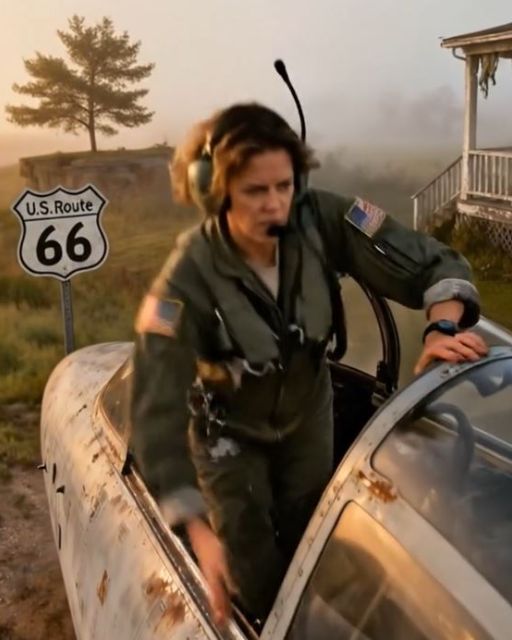
“Shepherd-One, you are ordered to stand down. Abort rescue. I repeat, abort.” The Colonel’s voice was like ice in my headset. Below me, the blizzard was swallowing Ice Station Zebra whole.
Twelve souls were down there. Geologists, they told me. Caught in a freak polar vortex. My chopper was their only way out.
“Negative, command,” I said, my voice tight. “I’m going in.” I cut the radio before he could reply. The wind slammed against the fuselage as I landed. The men rushed out, not with relief, but with a terrifying urgency. They weren’t carrying bags. They were carrying a heavy, sealed container.
“Get it on board! Now!” one of them screamed over the wind.
As they shoved it into my cargo bay, the latch on the container snapped. The lid slid open just an inch. My blood ran cold. These weren’t geologists. And that wasn’t scientific equipment.
The military didn’t court-martial me. They gave me a medal in a quiet ceremony. But I handed them my wings the next day. Because I know what I really brought back from that storm. And I can never close my eyes in a cockpit again without seeing what was really inside…
It was a hand. A small, pale hand.
It pressed against a tiny glass porthole from the inside, fingers splayed. Then it was gone.
For ten years, that image was my cellmate. It was there when I woke up in a sweat. It was there when I tried to lose myself in the bottom of a glass.
I didn’t fly anymore. Not really.
I traded the sleek, powerful Black Hawk for a rust-bucket crop duster named ‘The Pelican’ that coughed more than it flew. My sky was no longer a vast, endless blue but a ten-foot ceiling over fields of corn and soy in rural Nebraska.
People here didn’t ask questions. They saw the faraway look in my eyes and just figured I was another vet who’d seen too much. They were right, of course. They just had no idea what it was I’d seen.
My life was a simple loop. Wake, fly, fix the plane, sleep. The drone of the single-prop engine was a kind of therapy, loud enough to drown out the memory, but quiet enough to let the guilt fester.
I had saved twelve men. That’s what the medal said. But I had delivered their cargo. I was a getaway driver. Whatever nightmare they had locked in that box, I was the one who flew it to safety.
One dusty Tuesday, the loop broke. A car I didn’t recognize pulled up to my hangar, a neat, sensible sedan coated in a layer of prairie dust.
A woman got out. She looked out of place, with a sharp city haircut and a determined set to her jaw.
“Are you Sam Carter?” she asked, her voice clear and direct.
I just nodded, wiping grease from my hands with a rag.
“You flew a helicopter call sign Shepherd-One. Ten years ago. An unsanctioned rescue at Ice Station Zebra.”
It wasn’t a question. My stomach tightened into a cold knot.
“That life’s behind me,” I said, turning my back to her, fiddling with an engine cowling that didn’t need fiddling.
“I don’t think it is,” she said, stepping closer. “My name is Dr. Aris Thorne. I was a biologist at that station.”
I stopped. I turned to face her. “There were no women at that station. Twelve men. All accounted for.”
“I wasn’t on the official manifest,” she said, her eyes holding mine. “I was part of the real project. The one they were all there for.”
We sat on overturned buckets as the sun began to dip below the horizon, painting the sky in shades of orange and purple.
“They weren’t geologists,” she began, and my heart hammered against my ribs. “They were geneticists, biochemists… and private security. The project was codenamed Icarus.”
Her story spilled out, a torrent of classified secrets and ethical horrors. They weren’t studying ice cores. They were trying to create a human being capable of withstanding extreme environments.
“We were trying to unlock humanity’s potential,” she said, her voice laced with a decade of regret. “But the corporation funding us… Aegis Dynamics… they only saw a product. A soldier who didn’t need a coat in the Arctic. A miner who could work in sub-zero temperatures.”
The container. The small, pale hand.
“There was a child,” I whispered, the words tasting like ash.
Aris nodded, her eyes glistening. “A girl. We called her Elara. She was born in that lab. She’d never seen the sun. Her entire world was the sterile white of the station.”
The polar vortex, she explained, was their chance. The project was being shut down by a military oversight committee. The men I rescued weren’t being saved from the storm; they were stealing their life’s work before the legitimate authorities arrived.
“The Colonel’s order to stand down,” Aris said, her voice trembling. “It wasn’t to abandon them. It was because a Special Forces unit was on its way to secure the station. To rescue Elara.”
The world tilted on its axis. The medal I kept in a dusty box wasn’t for heroism. It was for aiding and abetting a kidnapping.
My act of defiance, the thing I secretly held onto as my one moment of true integrity, was a catastrophic mistake. I hadn’t saved twelve men. I had damned one little girl.
“Where is she?” I asked, my voice raw.
“Aegis has her,” Aris replied. “A private research facility in the Alaskan mountains. They’re still running tests. Pushing her limits. She’s nineteen now, Sam. And she’s never known a single day of freedom.”
The guilt I’d carried for ten years was nothing compared to the crushing weight of this new reality. The image of the hand wasn’t just a memory of a mystery; it was the memory of a plea for help I had completely misunderstood.
“I got out,” Aris continued. “Managed to leak a bit of data, create a new identity. It’s taken me ten years to piece together where they took her. Ten years to find you.”
“Why me?” I asked, the question hollow.
“Because you’re the only other person on the outside who was there. And because you disobeyed an order to save lives. Even if you were wrong about whose lives needed saving, your instinct was right. I need that man. She needs that man.”
I looked at my rusty crop duster. At my quiet, empty life built on a foundation of lies. I had run from the sky, from the memory. But it had found me.
There was no running anymore.
“What’s the plan?” I said.
A spark of hope lit up in Aris’s eyes. It was the first I’d seen.
It took us six months. Six months of planning, of cashing in my meager savings, of Aris using her old contacts to scrape together information.
We needed one more person. I knew who to call.
Finn was living in a cluttered apartment above a pawn shop in Denver, surrounded by a fortress of dismantled computers and soldering irons. He’d been a communications specialist in my old unit, a certified genius who got drummed out for “insubordination,” which really meant he told a general his new encrypted network was about as secure as a screen door.
“Sammy boy,” he said, opening the door. “You look like ten miles of bad road.”
“Good to see you too, Finn,” I smiled.
I laid it all out for him. The rescue, the container, the girl, the corporation. He listened without saying a word, just tapping a pen against a circuit board.
When I finished, he was quiet for a long time.
“So you’re telling me,” he said finally, “that we get to break into a high-tech corporate fortress, steal their most valuable asset, and right a decade-old wrong, all while sticking it to the kind of people who think rules are for other people?”
“That’s about the size of it,” I said.
A slow grin spread across his face. “I’m in. But I’m not doing it for free. You owe me a steak dinner. A real one.”
The Aegis facility was called ‘Olympus Base,’ a name dripping with arrogant ambition. It was carved into the side of a mountain, accessible only by a single road and a helipad.
Finn was our way in. He could spoof security codes, loop camera feeds, and create digital ghosts that would send guards on wild goose chases. Aris knew the internal layout, the lab protocols, Elara’s schedule.
I was the muscle and the exit strategy. It felt strange and terrifyingly familiar to be planning an operation again.
We used Aris’s life savings to buy a decommissioned medical transport helicopter. It was old and loud, but I spent a month taking it apart and putting it back together. Every bolt I tightened felt like an act of penance.
The night of the operation was cold and clear, the sky filled with a million unblinking stars. It was the first time in ten years I’d flown at night, the first time I’d piloted a chopper. The feeling was like a phantom limb starting to tingle.
Finn worked his magic from a van parked a few miles away. “Cameras are on a loop,” his voice crackled in our earpieces. “You have a twenty-minute window starting… now.”
Aris and I, dressed in stolen maintenance uniforms, slipped through a service entrance. The inside of the facility was exactly as I’d imagined: sterile, white, and silent as a tomb.
Aris led us through a maze of corridors. My heart pounded with a rhythm I hadn’t felt in a decade. It wasn’t just fear; it was purpose.
We reached the observation room for Elara’s habitat. It was a large, refrigerated chamber designed to mimic an arctic environment. And there she was.
She was nineteen, but seemed younger. Her hair was snow-white, her skin almost translucent. She was sitting on a block of ice, sketching on a datapad, looking not like a super-soldier, but like the loneliest person in the world.
Aris spoke into an intercom. “Elara. It’s me. It’s Aris.”
The girl’s head snapped up. Her eyes, a startlingly pale blue, widened in recognition.
“I’ve come to take you home,” Aris said, her voice thick with emotion.
Getting her out of the habitat was easy. The real challenge was the escape. As we moved towards the exit, a siren blared to life.
“They’re onto us!” Finn yelled in my ear. “Someone triggered a manual alarm! I can’t stop it!”
The corridors were suddenly flooded with guards in tactical gear. We were trapped.
We ducked into a dark laboratory, the door hissing shut behind us. Elara was trembling, not from cold, but from fear. It was the first time she’d ever been in danger.
The door flew open. A man stood there, flanked by two guards. He was older, his face hard, but I recognized him instantly. He was the one who had screamed at me to get the container on board all those years ago.
“Going somewhere, Doctor?” he said, his voice a low growl.
“It’s over, Kaelen,” Aris said, shielding Elara.
“It was over ten years ago,” he sneered, his eyes finding me. “The pilot. I never thought I’d see you again. You know, you ruined a very elegant plan.”
“I was saving your lives,” I shot back.
He laughed, a harsh, humorless sound. “Saving us? You have no idea what you did, do you?”
He took a step forward. “That Colonel of yours, the one who gave the stand-down order? He wasn’t trying to stop us for the government. He was a silent partner in Aegis.”
The floor dropped out from under me for the second time.
“He wanted the project for himself,” Kaelen continued, his eyes burning with old fury. “The freak storm was the perfect cover. His plan was for us to get stuck on the ice, for the ‘official’ team to never make it. He wanted us, and his investment, to be buried under a hundred feet of snow. No witnesses, no partners to share with.”
My mind reeled. The order to abort wasn’t about a legitimate military operation. It was a betrayal. The Colonel was trying to kill them all to take sole ownership of Elara.
“Your heroic disobedience,” Kaelen said with a twisted smile, “was the only reason any of us got off that ice. You saved her from him. You just delivered her to us instead.”
My whole story of guilt was built on a false premise. My instinct to go in, to save those twelve men, had been the right call after all. It had been messy and horribly compromised, but it had saved her life from an even worse fate. I hadn’t made a mistake. I had unknowingly threaded an impossible needle.
Sirens wailed closer. The entire facility was converging on our position.
Kaelen looked from me to Aris, and then his gaze settled on Elara, who was staring at him with wide, frightened eyes. For the first time, a flicker of something other than anger crossed his face. Maybe it was a reflection of the man he’d been before the project consumed him.
“This was never supposed to be her life,” he said, his voice barely a whisper. He looked at Aris. “You were right. We created something, but we forgot to be human.”
He turned to his guards. “Stun them,” he ordered. The guards hesitated. “That’s an order!”
Before they could react, Kaelen tackled his own men. He grabbed a radio from one of their belts as they fell. “All units, sector Gamma! They’re in Gamma! I have them cornered!”
He looked at me, a strange, grim finality in his eyes. “The west helipad. It’s the service pad. It’ll be clear for the next five minutes. Go. Give her the sky you took from me.”
Then he ran, firing his weapon down the opposite corridor, drawing the entire security force away from us.
We didn’t waste a second. We ran. Elara, unused to moving so fast, stumbled, but we held her up. The cold air of the Alaskan night hit us as we burst onto the helipad.
My chopper was waiting, its rotors already spinning, thanks to Finn’s remote access.
As we lifted off, the facility below us erupted in chaos, all focused on the far side of the mountain. We slipped away into the darkness, three ghosts leaving a nightmare behind.
We flew east, towards the dawn. I watched in the reflection of the cockpit glass as Elara pressed her hand to the window, her eyes wide with wonder. She was looking at the real world for the very first time.
The sky wasn’t a ceiling anymore. It was a promise.
We didn’t save the world. There was no parade, no medal. We just corrected a mistake that I had carried for a decade. We gave one person a chance at a life.
Sometimes, the choices we make are based on incomplete information. We disobey an order, we go left instead of right, and we spend years wrestling with the consequences, convinced we failed. We believe we are haunted by our mistakes.
But maybe we’re not haunted by our mistakes. Maybe we’re haunted by the moments we chose right, without ever knowing it. My defining failure was, in fact, my most profound, accidental success. The lesson wasn’t about the guilt of getting it wrong. It was about learning to accept the grace of getting it right, even in the dark.
My name is Sam Carter, and for the first time in ten years, I’m flying again. And this time, I know exactly what I’m carrying. It’s not cargo. It’s hope.