Every visit started with the same words:
“Mangia, you’re too thin.”
And then she’d hand me a plate I couldn’t refuse.
But today was different.
I showed up with a camera in one hand and an empty stomach in the other.
“Nonna, I want to learn. Not just eat.”
She paused, eyes narrowed.
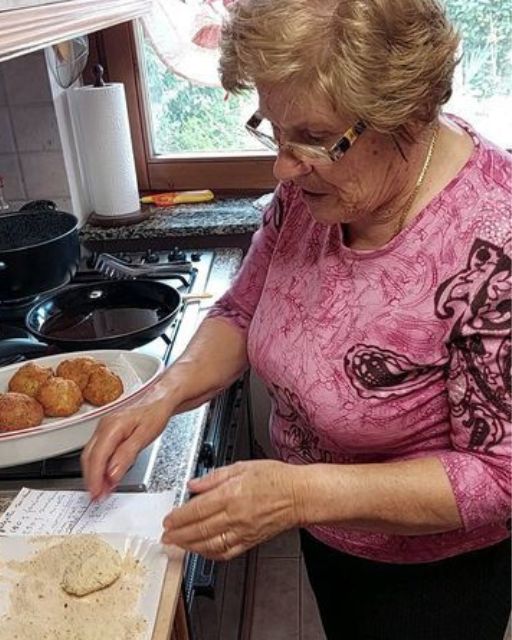
Then, silently, she handed me a stool and pointed to a crumpled piece of paper taped to the counter.
Her famous arancini recipe.
Smudged with oil and time.
I expected precision.
Measurements.
But instead, she said:
“You feel it in your hands. That’s how you know.”
She moved with rhythm—no rush, no doubt.
I asked her how long to fry them.
She smiled.
“Until they sing.”
And right there, something shifted.
I had always thought of her cooking as magic—some unspoken alchemy that turned basic ingredients into heaven. But today, there was no magic. There was only her hands, moving through the motions with such confidence, such ease.
For a moment, I forgot about the camera in my hand. I was just there. In the kitchen, with her.
“Nonna, I thought there was a secret ingredient. You know… the one you never tell anyone about?”
Her eyes softened. “There is one,” she said. “But it’s not in the recipe.”
I raised an eyebrow. “What do you mean?”
She stirred the rice carefully, her movements slow but deliberate. “The secret ingredient is trust. You have to trust the food. Trust the process. Trust yourself.”
I didn’t get it. I wasn’t sure I was supposed to. I had always watched her cook, but now, with the camera clicking away, the thought of making something as perfect as her seemed impossible.
“Don’t worry about the camera,” she added, as if reading my mind. “You’re here to learn, not to impress.”
I nodded, though the weight of her words lingered. I watched her work, but it wasn’t just the ingredients she was manipulating. She was manipulating time itself. The simple act of stirring the rice, the flour, the oil—she made it look effortless. But I knew, deep down, it was anything but.
I felt a pressure in my chest. Not just to recreate her dishes, but to understand her, to bridge the gap between what I had always known about her cooking and what I now had to learn. I had spent years in her kitchen, inhaling the aroma of her food, but today, everything felt different.
As Nonna began forming the arancini into perfect little balls, I picked up the rice and tried to do the same. But my hands trembled. The rice kept slipping through my fingers, and the pressure to get it just right was mounting.
She looked over, smiled softly, and walked over to me. “Don’t be afraid,” she said. “You can’t force it. It’s just food. It will come when you stop worrying.”
I let out a frustrated breath. “It’s not just food, Nonna. It’s your legacy.”
She chuckled, patting my hand. “Legacy? Legacy is nothing if you can’t enjoy the moment. Take your time.”
And then, just like that, I felt it. A small shift in the air around me. I was no longer racing against some invisible clock. For the first time, I was just… present.
I looked up at her. She was working on her own batch of arancini, rolling them with the ease of someone who had done it a thousand times before. But it wasn’t just the physicality of it. It was the calm. The deliberate care she took, the way she seemed to be in tune with every aspect of what she was doing.
When I finally managed to shape my first arancini, she looked at it, then at me. “Not bad,” she said. “But the next one will be better.”
She didn’t correct me or tell me how to do it right. She simply trusted that I would get there on my own.
I looked at her, unsure of what to say next. I had so many questions—about her life, about her cooking, about the things she had never told me. I had always wondered what made her who she was. But now, for the first time, I was beginning to realize something deeper than any recipe could explain.
“Nonna,” I said, my voice quieter than I intended, “How do you know when it’s right?”
She paused, still shaping the arancini, her hands steady. “I feel it,” she said. “In my heart, in my soul. It’s a connection between me, the food, and the person who will eat it.”
I swallowed hard. I never imagined that food could be so much more than just something to eat. It was about the connection. The love you put in it, the love you get back.
As the arancini sizzled in the oil, the room filled with the smell of golden rice and cheese, and a strange comfort washed over me. I realized that Nonna had always been more than just a cook. She was an artist—an artist of life itself. And now, I was beginning to understand her craft, not just through her hands, but through my own.
But then, the moment was shattered. My camera, which had been silently capturing the scene, suddenly blinked an error message. I hadn’t noticed that the memory card was full. I groaned, frustrated with myself.
Nonna chuckled. “You were so worried about getting it perfect, and now you’ve missed half of it.”
I felt my cheeks flush. I had been so focused on making sure everything was recorded, that I had missed the true essence of what she was trying to show me.
But she didn’t seem upset. Instead, she picked up the camera and turned it off. “No one needs to see this,” she said. “They only need to taste it.”
And then, as if it had been the simplest thing in the world, she guided me to the stove and showed me how to fry the arancini. The heat of the oil, the bubbling, the way it all came together in those few moments—it was magic, real magic, in the simplest form.
After they were done, she set the golden balls on a plate, arranging them carefully. “Now,” she said, “the best part.”
She handed me the plate, and as I took my first bite, I felt a warmth spread inside me. It wasn’t just the taste that made it special. It was everything that came before it—the time spent together, the trust, the learning.
I looked up at her, suddenly aware of the depth of everything she had given me. She had shared something so much more important than just a recipe. She had shared a part of herself—the part that was woven into every dish she made, the part that had been passed down through generations, quietly, without fanfare.
And for the first time, I understood. The secret ingredient was never in the recipe. It was in the love, the patience, the trust, and the joy you find in the smallest of moments.
Nonna smiled, as if she had been waiting for me to get it all along. “You’re ready now,” she said.
I wanted to ask her how she knew, but I didn’t need to. The answer was in the way she had always lived—slow, deliberate, and full of heart.
And in that moment, I realized that the recipe I had been chasing wasn’t for arancini at all. It was for life.
It wasn’t about following instructions, about getting it perfect, about impressing anyone. It was about feeling it, trusting it, and letting it unfold in its own time.
As I sat there with my plate of arancini, I couldn’t help but smile. Nonna had taught me something I would never forget.
The next time I picked up the camera, it wouldn’t be to capture perfection. It would be to capture the moments that truly mattered—the ones that could never be written down, but that would live on in the heart.
So here’s to the secret ingredients in life. The ones you can’t see, but you can always feel. The ones that make everything worth it.
If you’ve ever found yourself searching for the right recipe or the right path, remember this: it’s never about following someone else’s rules. It’s about trusting your hands, your heart, and your instincts. The rest will come.
And, as Nonna would say, “Mangia, you’re just right the way you are.”