The coffee in the secure briefing room tasted like battery acid. Commander Wilson didn’t mind. He leaned against the back wall, his flight suit worn grey, his boots scuffed to hell. He looked like a mechanic who had wandered into the wrong building.
A fresh-faced Lieutenant stormed in. Crisp uniform. Shiny shoes. He saw Wilson and sneered.
“Hey. You,” the Lieutenant snapped. “Service staff waits in the hall.”
Wilson blew on his coffee. “I’m good right here.”
The room went dead silent. Three Navy Captains looked at the floor. They knew what was coming. The Lieutenant didn’t. He stepped closer, invading Wilson’s personal space.
“Are you deaf?” the Lieutenant spat. “This is a classified briefing for active duty pilots. Take your mop bucket and get out before I call the MPs.”
He reached out to grab Wilson’s arm.
The heavy steel doors slammed open.
“Attention!” a Marine yelled.
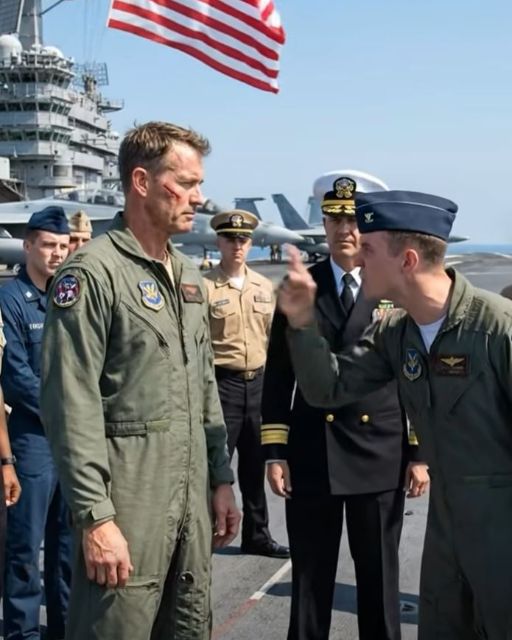
Admiral Hayes strode in. Four stars. Stone face. The entire room snapped to attention – except Wilson, who took another sip of coffee.
The Lieutenant stiffened, chest out, smiling. “Admiral. I was just removing this intruder. He refused to identify himself.”
Hayes stopped. He looked at the Lieutenant. Then he looked at the man in the dirty flight suit leaning against the wall.
The Admiral went pale. He walked right past the Lieutenant, stood in front of Wilson, and snapped the sharpest salute of his career.
“Lieutenant,” the Admiral whispered, not breaking eye contact with the old man. “That isn’t an intruder. That is the only pilot who has ever manually re-entered the atmosphere in a dead craft and landed it.”
A collective gasp sucked the air from the room. The Lieutenant, whose name was Pierce, felt his face flush a violent, blotchy red. His hand, which had been reaching for Wilson, dropped to his side like a lead weight.
Manual re-entry in a dead craft was a myth. It was a boogeyman story they told cadets at the academy. A cautionary tale about what happens when every system fails at the edge of space. It was a theoretical impossibility, a guaranteed cremation.
Admiral Hayes held his salute. Wilson finally set his coffee cup down on a nearby console and gave a lazy, two-fingered salute in return, a gesture of comfortable familiarity.
“At ease, David,” Wilson said, his voice raspy like gravel rolling downhill. “You’re making the kids nervous.”
The Admiral slowly lowered his arm. He turned to the room, his eyes like chips of ice.
“This is Commander Samuel Wilson,” Hayes announced, his voice booming in the small space. “He is here at my personal request. And he has more flight hours in experimental craft than every single person in this room combined.”
He then fixed his gaze on Lieutenant Pierce. “And for your information, Lieutenant, those scuff marks on his boots? He got them kicking his way out of a burning cockpit after saving my life and the lives of three other men over the Zagros Mountains.”
Pierce felt like the floor had just dropped out from under him. He wanted to apologize, to explain, to simply vanish into the wall. But he was frozen, trapped in the glare of the Admiral’s fury and the quiet, assessing gaze of the old pilot.
Wilson just picked up his coffee again. He seemed utterly unbothered.
“Now,” the Admiral said, turning to a large screen on the wall. “To the matter at hand.”
An image appeared. It was a satellite, sleek and menacing, but pieces of it were clearly damaged, trailing crystalline debris.
“This is Chimera-7,” Hayes explained. “Our most advanced surveillance and comms platform. Twelve hours ago, it was struck by a piece of orbital debris from a defunct Chinese rocket.”
He zoomed in on a section of the satellite. “The collision took out its primary power and automated guidance systems. It’s dead in the water, and its orbit is decaying. In seventy-two hours, it will burn up on re-entry.”
One of the Captains, a man named Jennings with a perfectly manicured mustache, spoke up. “Admiral, with all due respect, why not let it burn? Surely the data is encrypted.”
“The data is encrypted,” Hayes confirmed. “But the hardware isn’t. The processor cores in that bird are twenty years ahead of anything our rivals have. If a piece of it survives re-entry and falls into the wrong hands, we have a catastrophic technology leak.”
“We can’t send a shuttle,” another Captain added. “The debris field is too dense and unpredictable. Automated drones can’t handle the complex maneuvering required. It’s a suicide mission.”
“Correct,” the Admiral said grimly. “No existing craft in our active fleet can perform the retrieval. The flight computer would overload trying to calculate the trajectory through that junk field.”
The room was silent. The problem seemed insurmountable.
Admiral Hayes turned his gaze back to the old man leaning against the wall. “No computer can do it,” he said, emphasizing the word. “But a man can.”
All eyes fell on Wilson. He finished his coffee and tossed the paper cup into a bin with a soft thud.
“You want me to fly the ‘Stargazer’ again, don’t you, David?” Wilson asked. It wasn’t really a question.
The name sent another ripple through the room. The ‘Stargazer’ was another legend. A prototype from a canceled program. It was a small, agile craft designed for extreme environments, rumored to be more of an extension of the pilot than a machine. It had no advanced flight computer. It was all stick and rudder, completely manual.
It was the same craft Wilson had landed dead all those years ago.
“It’s the only ship that can do it, Sam,” the Admiral said softly. “It’s been in mothballs at Edwards for twenty years. But we’ve kept it maintained. Just in case.”
Wilson ran a hand over his tired face. “I’m sixty-three years old, David. My hands aren’t what they used to be.”
“They’re the only hands I trust,” Hayes replied, his voice unwavering.
Wilson looked around the room, his eyes lingering for a moment on the terrified Lieutenant Pierce. A strange, unreadable expression crossed his face.
“Alright,” he said with a sigh. “I’ll do it. But I need a co-pilot.”
A wave of relief washed over the room. The Captains visibly relaxed.
“Of course,” Hayes said. “Take your pick. Captain Jennings is our top-rated pilot for deep space ops.”
Jennings puffed out his chest slightly. Wilson looked at him, then at the other Captains. His gaze was dismissive, as if he were scanning a line of uninspired paintings.
Then, his eyes settled back on Lieutenant Pierce. The young officer tried to shrink into himself.
“I’ll take him,” Wilson said, pointing a calloused finger at Pierce.
The silence that followed was heavier than before. It was a thick, suffocating thing. Lieutenant Pierce looked as though Wilson had just sentenced him to death.
Admiral Hayes was the first to speak. “Sam… are you sure? The Lieutenant is… green.”
“He’s got good eyes,” Wilson said simply. “And fast reflexes, I’ll bet. All polished up and shiny. Means he spends a lot of time in the simulator.”
“Sir, I…” Pierce stammered, his voice cracking. “I’m not qualified. I’ve never even broken atmosphere.”
Wilson walked over and stood in front of the young man. He was shorter than Pierce, but he seemed to take up all the air around him.
“Son,” he said, his voice surprisingly gentle. “I don’t need a qualified pilot. I need someone who can follow orders instantly and read a screen without asking stupid questions. The ‘Stargazer’ doesn’t have a co-pilot’s seat. You’ll be at the sensor station. Your only job is to be my eyes. Can you do that?”
Pierce, utterly humbled and confused, could only nod. He felt the weight of every condescending word he had spoken just minutes earlier. This wasn’t a punishment. It felt like something far more complicated.
“Good,” Wilson grunted. “Meet me at Hangar 14 at 0600. And wear something you don’t mind getting dirty.”
He turned and walked out of the room, leaving a trail of stunned silence in his wake.
The next morning, Pierce arrived at the cavernous, dusty Hangar 14. He had traded his crisp uniform for a standard flight suit. In the center of the hangar sat the ‘Stargazer.’
It wasn’t a thing of beauty. It looked like a fighter jet that had been welded to a shipping container. Its heat shielding was a patchwork of different shades of black and grey, scarred and pitted from its one and only flight. It looked ancient and dangerous.
Wilson was already there, running his hand along the fuselage like he was stroking an old horse. He didn’t even turn as Pierce approached.
“She’s not much to look at, is she?” Wilson said. “But she’s honest. No computer between you and the vacuum. You pull a lever, something actually moves. You push a button, a circuit closes.”
Over the next two days, Wilson put Pierce through the most grueling training of his life. There were no simulators. It was all hands-on. He made Pierce memorize every circuit breaker, every backup system, every valve on the ship. He didn’t teach him how to fly it; he taught him how it breathed.
Pierce was a quick study. His arrogance had been sandblasted away, replaced by a deep, quiet respect. He saw the genius in Wilson’s methods. The old man didn’t just know the machine; he understood it. He knew the sounds it made when it was stressed, the way it vibrated just before a system failed.
“The book teaches you how to fly the perfect mission,” Wilson told him one afternoon, while they were elbow-deep in a coolant line. “The real world teaches you how to survive when the mission goes to hell.”
Finally, the day came. They were strapped into the ‘Stargazer’s’ cramped cockpit. Wilson sat at the controls, his hands resting on the stick with a familiar ease. Pierce was crammed into the station behind him, surrounded by screens and gauges.
The launch was brutal. The ‘Stargazer’ rattled and shook, a violent, untamed beast. It wasn’t the smooth, computer-guided ascent of a modern craft. It was a bare-knuckle brawl against gravity.
Once they reached orbit, a strange calm descended. Below them, the Earth was a silent, swirling marble of blue and white.
“Alright, kid,” Wilson’s voice crackled through the intercom. “Time to earn your pay. Talk to me. Where’s the junk?”
Pierce focused on his screen, his simulator training kicking in. He began calling out trajectories, velocities, and distances of the debris. “Multiple hostiles, bearing zero-niner-five. Closing fast. Largest piece is the size of a school bus.”
For the next hour, they danced. Wilson didn’t fly the ‘Stargazer’ so much as he willed it through the debris field. He made a thousand tiny adjustments, his movements economical and precise. It was a terrifying, beautiful ballet.
They reached the Chimera satellite. It was tumbling slowly, a wounded bird in the endless night.
“Gonna be a rough grab,” Wilson said. “The magnetic clamps are on your board, Pierce. You’ll have one shot when I get us close enough.”
Wilson eased them in, using short bursts from the thrusters. The ship groaned in protest.
“Now!” he yelled.
Pierce slammed his hand down on the activation button. A heavy thud echoed through the hull as the clamps engaged. They had it.
Suddenly, a proximity alarm blared. A huge piece of debris, previously hidden by the satellite’s bulk, was hurtling directly toward them.
“No time to detach!” Pierce shouted. “Impact in ten seconds!”
“Hold on!” Wilson barked. He fired the main engine, a desperate, full-power burn to pull both the ‘Stargazer’ and the satellite out of the way.
The maneuver worked, but the stress was too much. A series of loud bangs erupted from the engine compartment. The main engine died.
Every warning light on the board lit up at once. They were adrift.
“We’ve lost main power,” Pierce reported, his voice tight with fear. “We’re on battery, and it’s not going to last through re-entry.”
This was it. The nightmare scenario. A dead ship on a decaying orbit.
Wilson was eerily calm. “I’ve been here before,” he said. “Get ready to jettison the satellite. We’ll give it a push into a safer orbit and worry about ourselves.”
“But the mission…”
“The mission is over,” Wilson snapped. “Our mission now is to live. On my mark.”
As Pierce’s hand hovered over the jettison button, a single screen on his console flickered. It was a diagnostic feed from the Chimera’s processor, which had started drawing a tiny trickle of power from their ship’s battery.
“Wait,” Pierce said. “Commander, I’m getting something. The satellite is trying to… talk to us.”
“What?”
“It’s a data burst. A compressed log file. It must have been triggered by the power transfer. It’s downloading to our flight recorder.”
The download finished just as the last of the battery power died. The cockpit went dark, save for the faint glow of the Earth outside. They were truly dead now.
“Well,” Wilson said into the silence. “At least someone will know what happened. Now, let’s go for a ride.”
What followed was the stuff of legend. Wilson used the last puffs of air in the maneuvering thrusters to angle the ship. He talked Pierce through the manual sequence to separate the cockpit module from the main fuselage. They fell into the atmosphere, a blazing fireball. The heat was immense, the G-forces crushing.
Pierce was sure they were going to die. But through the shaking and the fire, Wilson was a rock. He coached him, kept him focused, his calm voice a lifeline in the chaos. Just as the story went, he flew a brick and landed it. Their emergency parachutes deployed at the last possible second, and they slammed into the Pacific Ocean.
They were picked up hours later, exhausted but alive.
Back at base, Admiral Hayes was waiting. He embraced Wilson, his face a mask of relief.
But the story wasn’t over. The flight recorder was recovered. The data burst from the Chimera satellite told a shocking story. The “orbital debris” that hit it wasn’t random. It had been a targeted strike from a decommissioned military satellite, deliberately reactivated and set on a collision course.
It was an inside job.
The file also contained encrypted communication logs. It took the cryptographers a week, but they finally broke it. The logs detailed a conspiracy to sell the Chimera’s technology, orchestrated by a high-ranking officer.
That officer was Captain Jennings.
The perfectly manicured Captain who had sneered alongside Pierce had been selling secrets for years. He had tried to destroy the Chimera to cover his tracks, never imagining anyone could possibly retrieve it.
But the final twist, the one that made Admiral Hayes sit down heavily in his chair, was buried deeper in the logs. They found records of payments and communications stretching back twenty years. It turned out Jennings was also responsible for sabotaging the ‘Stargazer’ program. He had remotely triggered the malfunction that had nearly killed Wilson and Hayes two decades ago, all to get ahead in his own career.
He had tried to bury two legends. And in the end, they had been the ones to unearth his treason.
A week later, Pierce found Wilson in the same dusty hangar, staring at the scarred and battered ‘Stargazer.’ The young Lieutenant’s uniform was immaculate, but his posture was different. The arrogance was gone, replaced by a quiet humility.
“Commander,” Pierce said. “I came to thank you.”
Wilson turned. “For what? Nearly getting you killed?”
“For not leaving me behind,” Pierce said, his voice thick with emotion. “And for showing me what really matters.”
Wilson nodded slowly. “You did good up there, kid. When everything hit the fan, you didn’t panic. You kept your eyes open. That’s all that matters.”
“Why did you pick me?” Pierce finally asked the question that had been haunting him. “You could have had anyone.”
Wilson walked over to a workbench and picked up a piece of metal, a bent and warped fragment from the ‘Stargazer’s’ old engine. “Because I saw myself in you, Lieutenant. Arrogant. Cocky. Believing that a shiny uniform and a perfect record were the same thing as being a good officer.”
He looked Pierce in the eye. “I was a lot like you, before that first flight. That crash… it burned all the nonsense out of me. I figured you could use the lesson without having to go through the fire.”
He had seen the potential beneath the polish. The mission wasn’t just about the satellite. It was about saving a young officer from himself.
A rewarding conclusion had been delivered not just to the mission, but to a life lived in the shadows of another’s betrayal. Wilson was no longer just the ghost in the machine; he was the man who had, after twenty years, finally seen justice done.
He held up the twisted piece of metal. “Remember this, Pierce. The shiniest wings don’t make the best pilot. It’s the scars that tell the real story. They prove you’ve been tested and you’re still flying.”