He didn’t come home alone.
That was the first thought that cut through the noise. My husband, Mark, stood in the marble foyer, but my eyes were locked on the woman standing just behind his shoulder.
She was young, nervous, and wearing a dress the color of weak coffee.
My heart didn’t break. It just went cold.
“Anna,” he said, his voice too loud for the room. “Things are going to change.”
He put his arm around the girl. Her name was Jenna, he said. She would be staying.
He told me to start packing.
The air felt thick, heavy. I could hear the hum of the refrigerator from the kitchen. I focused on that sound.
“You’re bringing her here?” My own voice sounded distant, like it was coming from across a canyon.
“Yes,” he snapped. “Don’t start. I built this life. This house. You’ve been along for the ride, but the ride is over.”
He gestured around the room, at the high ceilings, the art on the walls.
“This is all mine. You don’t deserve to live here anymore.”
The girl, Jenna, pretended to study a painting. She was a ghost already.
Mark’s words kept coming, each one a perfectly aimed stone. He called me dead weight. He said I should be grateful he was letting me leave with my dignity.
I stood up.
My calmness seemed to unnerve him. He expected tears. A scene. I gave him nothing.
“Is that what you believe?” I asked.
He sneered. “It’s a fact. This house, this life—mine.”
I let his words hang in the air for a moment. I let him feel the weight of his victory.
Then I walked to the old oak cabinet by the stairs. My movements were slow, deliberate. I opened the bottom drawer.
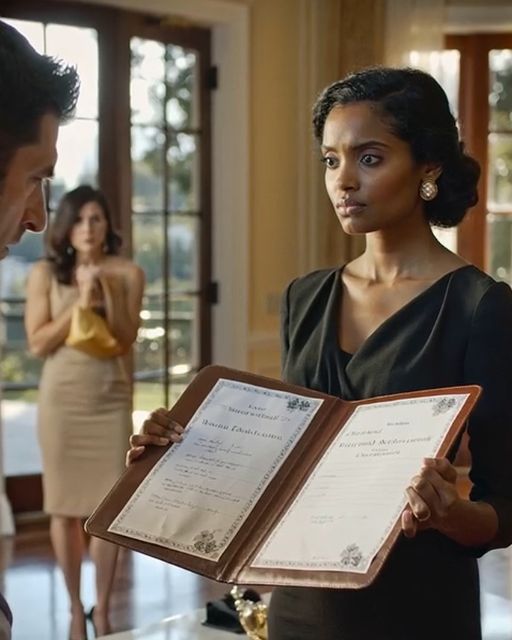
I pulled out a dark leather folder.
I placed it on the coffee table between us. The sound it made was soft, but it echoed in the crushing silence.
I opened the clasp and slid a single sheet of paper out.
Mark leaned forward, a frown creasing his forehead. Jenna peered over his shoulder, her curiosity getting the better of her.
The document was crisp. The ink was black.
There, on a single, clear line, were two words.
Owner: Anna Miller.
The blood drained from Mark’s face. I watched the arrogance crumble, replaced by a gray, hollow shock.
Jenna took a sharp, quiet step back.
My voice was steady. Almost a whisper.
“You built this life, Mark. You just forgot whose land you built it on.”
He stared at the paper, then at me.
He thought he owned everything. He just never thought to read the fine print.
His mouth opened and closed, like a fish pulled from water. No sound came out.
“This is a joke,” he finally managed to say, his voice a ragged croak. “A forgery.”
“It’s the deed, Mark,” I said calmly. “The original deed to the land, gifted to me by my grandfather on my eighteenth birthday. Long before I ever met you.”
He shook his head, a frantic, jerky motion. “The house, Anna. I paid for the house! I hired the architects, the builders.”
“You did,” I agreed. “With money from a joint account. But the structure is legally an ‘improvement’ on the land. And the land has always, and only, been mine.”
I remembered the day my grandfather gave it to me. We’d stood on this very hill, nothing but wildflowers and tall grass around us.
“Never let anyone make you feel small on your own patch of earth, Annie,” he had said, pressing the folded document into my hand.
I hadn’t understood the weight of his words then. I understood them now.
Mark’s face was turning a blotchy red. “You tricked me. All these years, you let me believe…”
“Believe what?” I interrupted, my voice finally gaining an edge. “That your name being on the mortgage paperwork trumped the foundational deed? You never asked. You never cared to look.”
He was a man who only read the headlines, never the story.
He had seen a vacant plot of land owned by his quiet girlfriend and saw an opportunity, not a partnership.
Jenna, the girl in the coffee-colored dress, was slowly edging toward the door. Her fantasy was dissolving in real time.
She had signed up to be the queen of a castle, not a trespasser in a stranger’s home.
“You can’t do this,” Mark hissed, his desperation growing. “I’ll take you to court. I’ll tell them you misled me. I’ll…”
“You’ll what, Mark?” I met his gaze, and for the first time in a decade, I didn’t flinch. “You’ll tell a judge you were so arrogant you spent a fortune building a house without confirming who owned the ground beneath it?”
I paused, letting that sink in.
“A judge might find that… amusing.”
The fight went out of him then. He sagged, his shoulders slumping, his grand pronouncements shrinking into the silence.
He looked around the foyer, at the life he thought was his masterpiece. He was seeing it now for what it was: a beautiful painting in someone else’s gallery.
“Get your things,” I said, my voice soft again, but firm. “Both of you.”
Jenna didn’t need to be told twice. She practically fled, her heels clicking a panicked rhythm on the marble.
She didn’t even look back at Mark.
He just stood there, a statue of a broken man. He looked at me, his eyes searching for the woman he had married, the one who used to soothe his ego and forgive his transgressions.
But she wasn’t there anymore.
She had packed her bags a long time ago, emotionally speaking. I was just waiting for my body to follow.
“I need my clothes,” he mumbled. “My computer.”
“I’ll have them boxed up and sent to your office tomorrow,” I said. “For now, I want you to take your coat, your car keys, and your guest, and leave my property.”
The word “my” hung in the air, a final, undeniable truth.
He took his coat from the rack. He couldn’t look at me.
As he reached the door, he turned back one last time.
“Was any of it real, Anna?” he asked, his voice small. “Did you ever love me?”
I thought about that for a long moment. I thought about the early years, the laughter, the dreams we shared before his ambition consumed them.
“I loved the man I thought you were,” I replied honestly. “But he left this house a long, long time ago. You’re just the one who finally shut the door behind him.”
He nodded slowly, accepting the verdict. Then he was gone.
The heavy oak door closed with a quiet click.
And the silence that followed wasn’t crushing at all. It was the sound of peace. It was the sound of my own life, beginning again.
The first week was the strangest. The house was too quiet.
Every creak of the floorboards sounded like his footsteps. Every time the phone rang, I expected it to be him, ready to either beg or threaten.
But he never called.
I spent my days walking from room to room, touching the furniture, looking out the windows. It was like I was seeing it all for the first time.
The house had always felt like his stage, and I was just part of the set dressing. Now, it was just… a house. My house.
I started making small changes. I moved the big, ugly leather armchair he loved into the garage. I replaced the dark, heavy curtains in the living room with light, airy ones.
Each change was a small act of reclaiming myself.
About a month after he left, I got a letter from his lawyer. It was full of bluster and legal threats, demanding half the value of the property.
My hand didn’t even shake as I read it.
I forwarded it to my own lawyer, a kind, sharp woman named Sarah who had been a friend of my mother’s.
Sarah called me that afternoon. “Don’t you worry about this, Anna. It’s noise. He has no legal footing, and he knows it.”
“Then why is he doing it?” I asked.
“Because powerful men hate to lose,” she said simply. “It’s not about the money. It’s about the humiliation. Just ignore it. Live your life.”
So I did.
I started gardening again, something I’d given up because Mark complained about the dirt under my fingernails. I planted roses and lavender along the stone walkway.
I felt the sun on my back and the soil between my fingers. I felt alive.
One crisp autumn afternoon, there was a knock at the door.
I wasn’t expecting anyone. I opened it to find Jenna standing on my doorstep.
She looked different. The expensive dress was gone, replaced by simple jeans and a sweater. Her hair was pulled back, and her face was free of the heavy makeup she’d worn that day.
She looked her age. She looked tired.
“Can I talk to you for a minute?” she asked, her voice barely a whisper. She couldn’t meet my eyes.
A part of me wanted to slam the door in her face. But my curiosity, and maybe a sliver of pity, won out.
I stepped aside and let her in.
We sat in the living room, in the sunlight streaming through my new curtains. I offered her tea, and she accepted with a grateful nod.
She held the warm mug in her hands as if it were a lifeline.
“He lied to me,” she said, finally looking at me. “He lied about everything.”
I just listened.
“He told me his business was booming. He said he owned this house, a condo in the city, a boat. He painted this picture of a perfect life, and all I had to do was step into it.”
She took a shaky sip of tea.
“It was all a lie. The business is bankrupt. He’s drowning in debt. The condo is a rental he’s being evicted from. The boat was sold months ago to pay off a loan.”
Suddenly, Mark’s desperation that day made a new, darker kind of sense.
It wasn’t just his pride on the line. It was his survival.
“This house…” she continued, looking around the room. “This was his last resort. His only real asset, he called it. He was planning to force you out and sell it to pay off his creditors.”
“He was going to throw me out with nothing, to save himself?” The coldness I felt that day returned, but this time it was laced with a grim understanding.
“Worse,” Jenna said, her voice dropping. “He had already taken out a secret loan against the house’s expected value from a very… unsavory person. He used forged documents, saying he was the sole owner.”
My blood ran cold. He hadn’t just been arrogant; he’d committed fraud.
“He was so sure you’d just crumble,” she said. “He told me you were weak, that you’d just pack your bags and go.”
I looked at her then, this young woman who had been a willing participant in my life’s demolition. I didn’t feel anger anymore. I just felt a profound sadness for her, for me, for the years I wasted on a man who was nothing more than a hollow shell.
“Why are you telling me this, Jenna?” I asked quietly.
“Because the people he owes money to came looking for him. At my apartment.” Her eyes filled with tears. “They thought I knew where he was. I was so scared.”
Mark had disappeared. Vanished, leaving his mess for everyone else to clean up.
“He used you, too,” I said. It wasn’t an accusation, just a statement of fact.
She nodded, wiping a tear away with the back of her hand. “I know I don’t deserve your kindness. What I did was awful. But I wanted you to know the whole truth. And to warn you. He’s a dangerous man, Anna. Not because he’s strong, but because he’s desperate.”
After she left, I stood by the window for a long time, watching the leaves fall from the trees.
The story wasn’t what I thought it was. I hadn’t just defeated a cheating husband. I had escaped a sinking ship, moments before it was pulled under by the weight of its captain’s lies.
The legal threats from Mark stopped. His lawyer sent a final letter, formally withdrawing all claims. The house was mine, free and clear. The storm had passed.
Life settled into a new, peaceful rhythm. I found joy in the simple things: the smell of coffee in the morning, the warmth of a quilt on a cold night, the sound of birds outside my window.
I started a small business from home, selling the organic vegetables and herbs I grew in my garden to local restaurants. It didn’t make me rich, but it made me happy. It was mine.
One day, I was digging in the garden, turning over the soil for the spring planting. My shovel hit something hard.
I dug around it and pulled out a small, rusty metal box. It was an old biscuit tin, the paint faded and peeling.
With some effort, I pried it open. Inside, nestled on a bed of yellowed cotton, was a collection of my grandfather’s things. An old pocket watch, a fountain pen, and a stack of letters tied with a ribbon.
The letters were from my grandmother, written to him while he was away at war. They were full of love, hope, and the quiet strength that saw their family through the hardest of times.
At the very bottom of the box was another folded document.
It wasn’t a deed. It was a certificate of deposit from a small, local bank, dated the same year he gave me the land. He had opened a trust fund in my name.
It wasn’t a fortune, but it was a significant amount of money. Enough to guarantee I would never have to depend on anyone else. Enough to build a new life from the ground up if I ever needed to.
A note was clipped to it, written in his familiar, spidery script.
“For my Annie. A foundation is more than just land. It’s freedom. Use it to build a life that is truly yours. All my love, Grandpa.”
Tears streamed down my face. All these years, he was still looking out for me.
Mark thought the house was the prize. He thought the land was the source of my power. He was wrong.
My grandfather hadn’t just given me a piece of property. He had given me a head start, a safety net, a tangible expression of his love and belief in me. He had armed me for a battle he prayed I would never have to fight.
The house was beautiful, but it was just a thing. My true inheritance was the lesson he had taught me: to know my own worth, to stand on my own ground, and to always, always read the fine print.
My foundation wasn’t made of dirt and stone. It was made of love and foresight. And that was something no one could ever take from me.