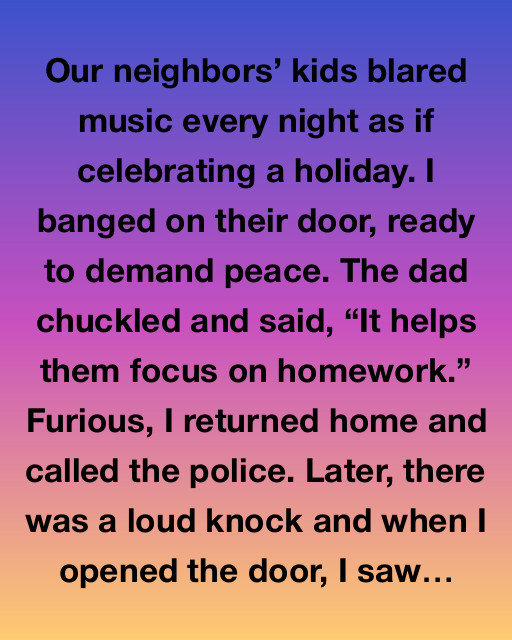
Our neighbors’ kids blared music every night as if celebrating a holiday. I banged on their door, ready to demand peace. The dad chuckled and said, “It helps them focus on homework.” Furious, I returned home and called the police. Later, there was a loud knock and when I opened the door, I saw two officers standing there, looking apologetic but firm about the noise complaint.
The officers explained they had spoken with Mr. and Mrs. Hart, the neighbors, and suggested a compromise instead of legal action. They proposed the kids could lower the volume by 10 pm every night, which seemed reasonable to me. Although hesitant at first, I nodded in agreement, appreciating their attempt to mediate peacefully rather than jumping to conclusions.
To my surprise, the Harts invited me over the next evening to discuss the music issue further. Each of their three kids greeted me earnestly, expressing eagerness to reach an amicable solution. I relaxed a bit, realizing they truly valued harmony as much as I did, despite my original assumptions about their seemingly careless ways.
During the meeting, the youngest, Charlie, sheepishly explained how he found concentration through specific tunes, likening the rhythms to a metronome for his mind. I was intrigued and empathetic to his struggles. As someone who struggled with attention in my youth, I understood the urge to find innovative paths to focus.
The middle child, Julia, eagerly chimed in, sharing her own experiences of how certain music helped her tackle challenging math problems. Her enthusiasm sparked a flash of nostalgia, bringing back memories of my own zestful academic pursuits. In listening to them, I learned more about youthful resilience and adaptability.
The oldest sibling, Max, appeared less convinced about needing music, yet supported his siblings’ needs unconditionally. His demeanor suggested wisdom beyond his years, displaying a sense of maturity and loyalty uncommon among peers. It’s always refreshing to witness sibling bonds, particularly where compassion and patience overshadow competitive tensions.
Over the following weeks, we worked collectively towards a satisfactory schedule ensuring quiet filled the night after ten. Encouragingly, this compromise restored much-needed tranquility in the neighborhood, soothing tensions while maintaining the Harts’ household routines intact. It reinvigorated not only neighborly relations but also taught us about the virtue of patience and understanding.
One evening, as I sipped tea on my balcony, Julia approached shyly, requesting I lend her an unused space in my garden for growing herbs. Intrigued by her idea, I agreed, appreciating the chance to foster a budding horticulturist’s dream. Teaching her about soil and seed sowing became a shared passion, bridging the generational gap.
Gardening sessions became a weekly ritual where, aside from caring for plants, I shared stories of my childhood. Julia enthusiastically reciprocated, detailing her school projects and ambitions to study environmental science. The inherent cycle of giving and receiving flourished, enriching our bond and perspectives.
Several months passed unnoticed, until one Friday night was bizarrely devoid of music entirely. Concerned by this turn of events, I headed over to check in on the Harts. To my relief, they were simply out of town, visiting grandparents in Wales for the weekend.
In their absence, the street hummed a gentle lullaby, resonating with an unfamiliar yet peaceful solitude. However, life had more surprises waiting, subtly testing our resolve. Not long after, I chanced upon an old diary buried amidst boxed books in the attic – a relic pre-dating my occupation of the house.
Compelled to explore its secrets, I discovered entries dating back to the home’s original owner, Mrs. Goodwin, chronicling tales of neighborhood camaraderie. Her earnest reflections painted a picture of compassion and mutual aid that resonated with my experiences lately concerning the Harts.
Interestingly, the diary’s latter sections described an orchestra drone emanating from a house party next door, skillfully avoiding conflict through polite discussions akin to mine with the Hart family. Mrs. Goodwin’s words reminded me of the timeless nature of community barriers, recurrent yet not insurmountable.
Finding myself inspired by these vivid narratives, I initiated a get-together, inviting neighbors to share memories and forge deeper connections. Excitement burgeoned, and soon every doorstep buzzed with anticipation, everyone united by curiosity and goodwill.
The gathering commenced smoothly, hallmarked by laughter and delicious potluck dishes. Conversations sparked curiosity and kindness, eventually leading us to an unexpected discovery. Amelia, a reserved resident, revealed her talents as a pianist, delighting us all with an impromptu performance that left everyone in awe.
These monthly neighborhood gatherings gradually formed a cherished tradition, allowing bonds to flourish. Music, once seen as a barrier, now served as a conduit for shared joys. Each Member contributed their unique flair, infusing the community with vibrancy akin to a living mosaic.
In time, Charlie, already blossoming under the Harts’ supportive home environment, went on to play in the county’s youth orchestra. His initially questionable love for loud music played a pivotal role by steering him toward uncovering this innate talent, garnering unparalleled admiration from spectators.
The Harts beamed with pride, their neighbors providing a cheering section that warmed the coldest of evenings during outdoor concerts. Witnessing his progress convinced us all of the power embedded within families rallying steadfastly in pursuit of individual aspirations.
Interestingly, Max discovered an adoration for architecture sparked during our gatherings at different homes, his sketches evolving from brief doodles into meaningful blueprints. His efforts culminated in a scholarship validating his aspirations from noted institutions.
Sharing each other’s triumphs intensified our pride, serving as potent reminders of humanity’s potential for fostering shared ekpériences. The truth lay in understanding our delicate threads, woven into a vast tapestry intertwining cultures, backgrounds, dreams, and futures.
Mrs. Goodwin’s diary, intriguing artifact that it was, became a cherished beacon pinpointing tranquility amidst the stormy thick of daily routines. Its pages transcended time, illuminating insights stretching across generations, leaving an indelible impact on future residents.
The story eventually found its closure one brisk spring day, when a neighborhood ballot concerning charity allocations sparked debates over prioritizing causes. Heated exchanges soon gave way to prudent discussions informed by shared empathy, our collective voice strengthening public institutions focused on enriching community wellbeing.
Finally, a rekindled camaraderie ensured any barriers forged from misunderstanding crumbled as swiftly as they’d emerged. This quest to chase compromise over confounding impulses ultimately rewarded our neighborhood manifold, fostering lasting diplomacy and unwavering unity.
Reflecting on these poignant experiences, I realized life’s sweetest thrills dwell within moments forged from understanding and patience. Together, our neighbors took history to heart, embodying Mrs. Goodwin’s legacy in advocating neighborhoods that celebrate differences.
And so, what began with a simple noise complaint evolved into relationships painted with compassion, laughter, shared gardens, and even a touch of musical harmony. The blended trust became our most cherished asset, crossing age and sentiment, built on steadfast foundations.
In retrospect, I learned that harmonizing differences needn’t compromise identity. On the contrary, together is where relief and melody entwine, ever sowing days graced with joyous rhythms.