That’s how long I stood on the curb, watching other families find each other.
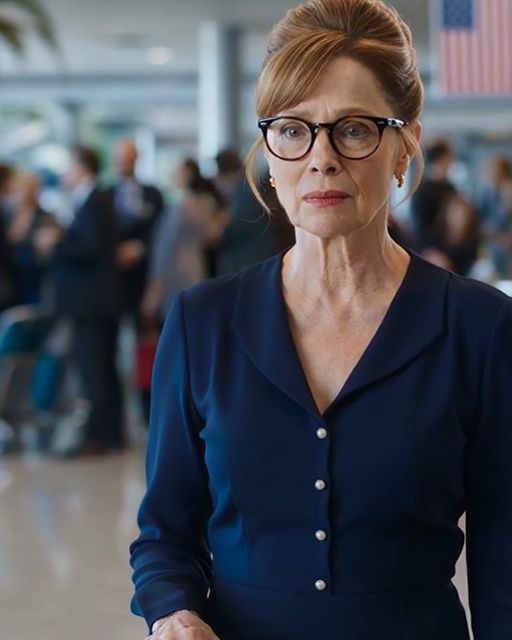
The air at the LA airport tasted like exhaust. My new dress, the navy one with the little pearl buttons, felt stiff and foolish.
I had pictured a hug. Maybe the grandkids holding a clumsy, crayon-drawn sign.
Instead, my phone was a dead weight in my hand.
The call had come three weeks earlier. My daughter, Chloe, her voice bright and syrupy over the line. “Mom, you’re turning seventy. We want to celebrate you.”
It was an actual call. Not a text. I took that as a sign.
I let myself believe her.
So I booked the flight. I packed the low heels I never wear. I tucked two books for the kids next to a gift for Chloe I’d been saving for.
Now, under the buzzing fluorescent lights of the arrivals lane, my calls went to her voicemail. Mark’s, too.
My thumb, acting on its own, opened the social media app.
Her new post loaded instantly.
Four wine glasses raised against a backdrop of rolling green hills. The sun was perfect. The caption was a little knife.
Girls trip goals.
Another video clip. Sunglasses. Laughter. Open road. A sign that said welcome to wine country.
Wine country was hours away from here.
My stomach didn’t drop. It just went still. A sudden, cold quiet inside me.
I called her again. This time, she answered.
Music blared in the background. Other women were laughing.
“Mom! Hey! What’s up?”
Her voice was so casual. So normal.
“I’m at the airport,” I said. The words came out flat. “I’m here.”
A pause. Just a tiny crack in the noise, but I heard it.
“Wait… what do you mean you’re there?”
“The party,” I said, my voice barely a whisper. “You told me you’d pick me up.”
Another pause. The sound of her rearranging reality.
“Mom… I think the dates got mixed up.”
I looked at the picture on my screen. Her smiling face, her raised glass, the sun hitting her hair just right.
The lie was so easy for her.
And the truth was so simple for me.
I was a loose end. A scheduling error. An itinerary item she had simply deleted.
Standing there with my suitcase and my party dress, I felt a switch flip.
I didn’t go to their house.
I turned around, walked back into the terminal, and found a quiet seat by a gate.
Then I made the one call I should have made a long, long time ago.
My sister’s number was still in my phone, buried under years of neglect. My finger hovered over the name: Sarah.
It rang four times. I almost hung up, my throat tight with a familiar mix of shame and pride.
Then her voice, a little raspy, but unmistakably hers. “Helen?”
My name. She said my name like it was a question she hadn’t expected to ask.
“Sarah,” I breathed out. “It’s me.”
A long silence stretched between us, filled with all the birthdays we’d missed, the holidays spent apart.
“Where are you?” she asked finally. There was no accusation in her tone, just tired curiosity.
“I’m at LAX,” I said, the words feeling ridiculous. “I… there was a mix-up with Chloe.”
I didn’t have to explain. Sarah knew all about Chloe’s mix-ups.
She had warned me, gently at first, then more firmly. She’d told me I was letting my daughter walk all over me, that I was a doormat in a party dress. I had resented her for it. I had chosen Chloe’s fragile peace over my sister’s hard truth.
And in doing so, I had lost my sister.
“Where are you staying?” Sarah asked.
“I’m not,” I said. “I’m at a gate. I was just going to book a flight home.”
Another silence. I could hear the hum of a refrigerator on her end. I could picture her kitchen, the one with the chipped yellow mugs and the unruly plants in the window.
“Don’t,” she said, her voice suddenly firm. “Don’t you dare.”
“What else am I supposed to do?”
“You wait,” she said. “It’s a two-hour drive. I’m leaving now. Stay right where you are.”
The line went dead before I could argue.
I sat there, my suitcase at my feet, and for the first time in hours, I didn’t feel foolish. I just felt… held.
Two and a half hours later, a battered Subaru pulled up to the curb.
Sarah got out. Her hair was grayer than I remembered, cut short and practical. She wore jeans and a faded t-shirt. She looked tired, and strong, and real.
We didn’t hug. We just stood there for a moment.
“You look thin,” she said.
“You look good,” I replied.
She took my suitcase, heaved it into the back of her car, and we drove away from the airport.
The first hour was mostly quiet. The landscape changed from concrete sprawl to rolling, sun-bleached hills. It was the same kind of scenery from Chloe’s video, but without the filters, it felt more honest.
“She went to wine country,” I said eventually, just to break the silence.
Sarah glanced at me. “Of course she did.”
There was no ‘I told you so’ in her voice. Just a deep, settled sadness that I now understood.
She hadn’t been judging me all those years. She had been grieving for me.
Sarah’s house was small and cluttered with life. Books were stacked on every surface. The air smelled like soil and brewed tea. A fat, ginger cat regarded me from the arm of a worn floral sofa.
“He’s Arthur,” Sarah said. “He’s the man of the house. He expects to be fed and admired.”
I managed a small smile.
She showed me to a small guest room. The quilt on the bed was handmade, a swirl of blues and greens. It was the quilt our mother had started and Sarah had finished.
I had one just like it, tucked away in a chest in my own sterile, guest-ready house.
That night, I slept for ten hours straight. I didn’t dream of Chloe or grandchildren or missed phone calls. I dreamed of nothing at all.
The next morning, I woke up to the sound of a wind chime.
I found Sarah in her garden, a sprawling, chaotic paradise behind the house. She was on her knees, hands buried in the dark earth, humming to herself.
She handed me a mug of coffee without a word.
We sat on her back steps, watching the sun climb over the hills.
“I feel like I’ve been asleep for thirty years,” I said.
“You haven’t been asleep,” she said, her gaze fixed on a stubborn patch of weeds. “You’ve been on duty.”
And that was it. That was the perfect word for it.
On duty. Waiting for calls. Waiting for invitations. Waiting for the brief, fleeting moments of affection that Chloe would dole out when it suited her. I had organized my entire life around her schedule, her needs, her dramas.
My husband, Robert, had seen it. Before he passed, he used to gently tell me, “Helen, you need a life of your own.” I’d always waved him off. My life was my family.
But my family had shrunk to a single, demanding point of light, and I had orbited it until I was dizzy and lost.
The days at Sarah’s turned into a week.
My phone buzzed with texts from Chloe.
First, casual. Hey Mom, hope you got home okay! The dates were just so confusing.
Then, a little more pointed. Haven’t heard from you. Are you mad?
Finally, a voicemail from Mark. His voice was placating, reasonable. “Helen, Chloe feels just terrible about this whole thing. She just got overwhelmed. You know how she is. Give us a call, we want to make it up to you.”
I listened to it, then deleted it.
Sarah never asked what the messages said. She just kept handing me mugs of coffee in the morning and glasses of wine in the evening.
We talked. We talked about our childhood, about our parents. We talked about the men we had loved and the mistakes we had made.
“I was so angry at you,” she confessed one night, her face illuminated by the citronella candle between us. “Every time I tried to get close, it felt like I had to get in line behind her.”
“I thought I was being a good mother,” I whispered.
“You were,” she said, reaching across the table to touch my hand. “You were the best mother. But you forgot to be Helen.”
That was the truth that settled in my bones. I had packed away Helen, with her love for painting and her silly sense of humor, into an attic in my heart. I’d become simply ‘Mom.’ And then, ‘Grandma.’ Roles I played, not a person I was.
The gift I’d brought for Chloe was still in my suitcase. It was a beautiful, hand-tooled leather-bound journal and a silver pen. I’d had her initials engraved on it. Inside the cover, I had written a long note about the importance of recording her life, her memories.
Looking at it now, the irony was crushing. I was encouraging her to document a life she was living so carelessly, while I had forgotten to live my own.
On the tenth day, a sleek, white SUV pulled into Sarah’s gravel driveway.
Chloe and Mark got out.
They looked like they were visiting a distant, slightly embarrassing relative. Chloe had on a stylish linen jumpsuit. Mark wore crisp shorts and a polo shirt.
They brought flowers. The expensive, cellophane-wrapped kind from a supermarket.
Sarah and I were in the garden, covered in dirt. I was wearing a pair of her old overalls, my hair tied up in a scarf. I had never felt more myself.
“Mom!” Chloe’s voice was bright, a little too loud. “We were so worried! You weren’t answering your phone.”
She came toward me, arms open for a hug.
For the first time, I didn’t lean in. I just stood there, holding a trowel caked with mud.
Her arms dropped. A flicker of confusion crossed her face.
“We came to take you home,” Mark said, stepping forward with that peacemaker smile of his. “This has all been a giant misunderstanding.”
“No,” I said. The word was quiet, but it landed with surprising weight. “It wasn’t a misunderstanding. It was very clear.”
Chloe’s perfect smile faltered. “Mom, don’t be dramatic. I said I was sorry.”
“You said the dates got mixed up,” I corrected her gently. “You never said you were sorry.”
A tense silence fell over the garden. The bees buzzed. The wind chimes tinkled.
Sarah stood by the back door, just watching. She wasn’t my defender. She was just my witness.
“This is ridiculous,” Chloe finally snapped, her voice losing its syrupy coating. “You’re here with her, getting your head filled with who knows what. We’re your family.”
“Yes, you are,” I agreed. “But this is my life. And I’ve decided I want to live it a little differently now.”
I went inside, my muddy boots leaving prints on the floor. I came back with the gift-wrapped box.
I held it out to her. “I brought this for you.”
She took it, a flash of victory in her eyes. See? All is forgiven.
“Don’t open it,” I said. “Just take it back. I want you to return it and get the money back.”
Her jaw actually dropped. “What? Why?”
“Because it’s a gift for a daughter I thought I knew. A daughter who I thought would value a piece of her mother’s heart.” I took a breath. “I don’t want to give gifts anymore, Chloe. Not when they feel like an obligation.”
Mark looked at Sarah, then at me, as if trying to figure out who the ringleader was.
“Helen, let’s all just calm down,” he started.
“I am calm,” I said, and I was. The cold quiet that had settled in my stomach at the airport had transformed into a strange, solid peace. “I’m not angry. I’m just… done. I will not be a scheduling error in my own life anymore.”
They left. The expensive flowers sat on the driveway, forgotten. Sarah and I watched the white SUV disappear down the road.
When it was gone, Sarah came over and wrapped her arms around me. This time, we hugged. It was a real hug, fierce and forgiving.
A month later, a thick manila envelope arrived, addressed to me. It was from Robert’s estate lawyer. I was confused. Everything had been settled years ago.
Sarah and I sat at her kitchen table as I carefully opened it.
Inside was a letter and a set of official-looking documents.
The letter was from the lawyer. He wrote that my husband, Robert, had set up a private trust for me before his death. It was a secret, kept even from me.
It had a very specific, very unusual condition.
The funds were to be released to me only upon my seventieth birthday. But there was a clause. A behavioral clause.
The trust would only become active if, at that time, I was not residing with Chloe and Mark, and if I was not in a situation deemed by the executor to be one of emotional or financial dependency on them.
Robert had seen it all.
He had seen the casual cruelty, the thoughtlessness, the way I made myself smaller and smaller to fit into Chloe’s world. He hadn’t fought me on it, because he knew I had to see it for myself.
But he had left me a parachute. A way out.
He had left me a key to a door I didn’t even know existed.
The amount was not a king’s ransom, but it was enough. It was more than enough. It was freedom money. It was a future.
I put the letter down on the table, my hands trembling.
Tears streamed down my face. They weren’t tears of sadness for being forgotten at the airport. They were tears of gratitude for being remembered, so deeply and so completely, by the man I had loved.
He had given me the ultimate birthday present. Permission to choose myself.
That winter, Sarah and I bought the small, struggling nursery at the end of town. We poured the trust money into it. We filled it with lavender and roses and sturdy, hopeful little vegetable starts.
We called it “The Second Spring.”
I learned the names of plants, the feel of good soil. I painted a beautiful sign to hang out front. I found Helen again. She had been there all along, just waiting.
Chloe calls sometimes. The conversations are brief, a little strained. She talks about the kids, her busy schedule. She never mentions the girls trip, or the scene in the garden. It’s as if it never happened.
But it did happen.
It was the best birthday present I ever received. It was the day I stopped waiting on the curb for someone else to pick me up, and finally, after seventy years, decided to drive myself home.
It’s never too late to find the person you put on a shelf for someone else. Your life is not an appointment that can be rescheduled or forgotten. It’s happening right now. And the most important person to show up for is you.