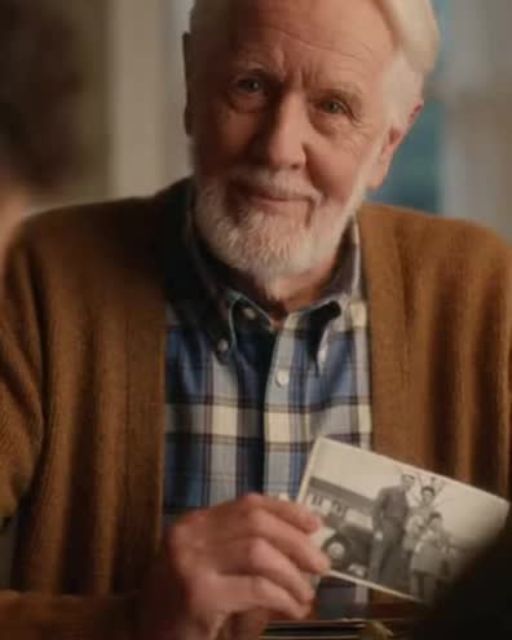
“That never happened, Dad. You’re remembering it wrong.”
My uncle said it first, but the rest of the family nodded, trying to gently correct my grandfather as he told a story about the cabin he claimed to have built with his bare hands back in 1964.
They laughed it off like it was sweet, senile nostalgia.
But I knew better.
I’d grown up hearing the stories too. The frozen winters. The tools he borrowed. The name he carved into the foundation stone.
Still, now that he was 89, everyone just smiled and patronized him. They said he was “confusing movies with memories.”
That night, during dinner, he quietly placed a dusty wooden box on the table.
No one noticed at first.
Then he looked at me. “Open it.”
Inside were a few folded maps, brittle with age. A rusted compass. A photograph of a younger version of him standing in front of a log cabin, hammer in hand.
But it was the envelope underneath that changed everything.
Postmarked July 1965. Addressed to his late wife.
The letter inside? Written in pencil, barely legible, but it started with: “The cabin’s finally finished. I built it for us, just like I promised. Come see.”
Everyone went quiet. You could hear forks hitting plates.
And then he pulled out one more thing: a small metal plate, slightly bent, covered in dust.
He turned it over.
Etched on the back was one line: “Property of Walter Cain. 1964.”
His name. His year. His proof.
No one said a word. Not even Uncle Rick.
But Grandpa just smiled, sipped his coffee, and said: “Funny how the mind works, huh?”
I watched my uncle’s face turn red. Aunt Patricia stared down at her plate like she wished she could disappear into it.
My cousin Marcus, who’d been the loudest about Grandpa’s “confusion,” suddenly found his phone very interesting.
Grandpa didn’t gloat. He never was that kind of man.
He just carefully placed everything back in the box, except for one thing. A small brass key I hadn’t noticed before.
“There’s more,” he said quietly, looking directly at me. “But not here. Not tonight.”
The dinner ended awkwardly. People made excuses about early mornings and long drives home.
But I stayed behind, helping Grandpa clear the dishes while everyone else scattered like leaves in wind.
“You believed me, didn’t you?” he asked, his voice soft but steady.
I nodded. “Always did, Grandpa. Always will.”
He squeezed my shoulder with a grip stronger than you’d expect from an 89-year-old man. “Good. Because tomorrow, I need you to drive me somewhere.”
The next morning, I picked him up at dawn. He was already waiting on the porch, that wooden box tucked under his arm.
“Where are we going?” I asked.
“North. About three hours. You’ll see.”
We drove in comfortable silence for the first hour. Then he started talking, really talking, in a way he hadn’t in years.
He told me about meeting my grandmother at a county fair in 1962. How he’d promised her a home in the mountains, away from the noise and crowds.
How he’d worked double shifts at the lumber mill for two years, saving every penny. How he’d bought the land from a farmer who thought he was crazy.
“Nobody believed I could do it,” he said, staring out the window. “Not my parents, not my friends. They said I was a dreamer with no sense.”
“But Grandma believed you,” I said.
His eyes got misty. “She did. She was the only one.”
We pulled off the highway onto a dirt road that looked like it hadn’t been maintained in decades. The truck bounced over ruts and rocks.
Finally, we reached a clearing, and there it was.
The cabin from the photograph. Older, weathered by sixty years of storms and seasons, but unmistakably the same structure.
My breath caught in my throat.
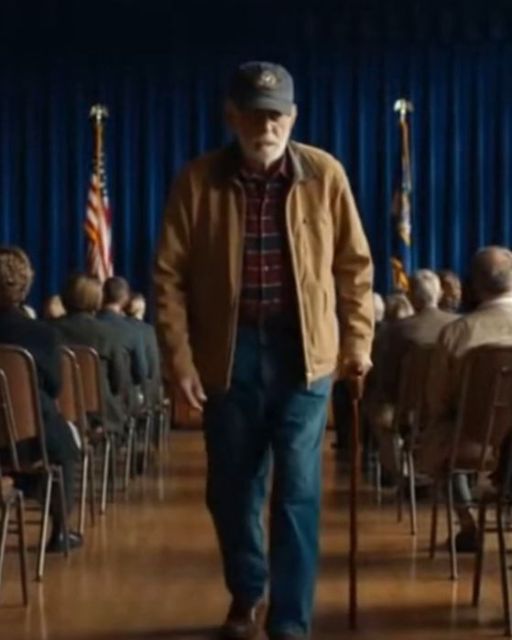
Grandpa climbed out slowly, using his cane, and I followed. The cabin’s logs were gray with age, and the roof sagged in places, but it stood proud.
“I brought her here in the fall of 1965,” he said. “We spent our first anniversary in this place. No electricity, no running water, just us and the mountains.”
He walked to the foundation, bent down with effort, and brushed away decades of moss and dirt. There it was, carved deep into the stone: W.C. 1964.
I felt something break inside my chest. All those years of people doubting him, dismissing him, treating his memories like fairy tales.
“Why didn’t you ever bring the family here?” I asked.
His smile faded. “I tried. Once. Your uncle was about twelve. But the road was worse then, and we got stuck halfway. By the time we got out, everyone was angry and muddy and miserable.”
“After that, whenever I mentioned it, they’d groan and change the subject. Eventually, I just stopped talking about it.”
He pulled out the brass key. “Come on. Let’s go inside.”
The door creaked open, releasing the smell of old wood and mountain air. Inside, dust covered everything, but the furniture was still there.
A handmade table. Two chairs. A stone fireplace. A bed frame in the corner.
On the mantle sat a glass jar, and inside it were dozens of folded paper scraps.
Grandpa’s hands trembled as he opened it. “Your grandmother and I had a tradition. Every time we came here, we’d write down something we were grateful for and add it to the jar.”
I unfolded one. In faded ink, it read: “Grateful for Walter’s strong hands that built our dream.”
Another: “Grateful for the silence that lets us hear each other.”
And another, in Grandpa’s handwriting: “Grateful that she never stopped believing in me.”
We stood there in that cabin for an hour, reading those tiny pieces of their love story. Some made us laugh. Some made us cry.
Then Grandpa handed me the box. “This is yours now. Everything in it. The deed to this land is at the bottom.”
I stared at him. “Grandpa, I can’t—”
“You can, and you will,” he said firmly. “You’re the only one who never made me feel like I was losing my mind. The only one who listened.”
“This place needs someone who understands what it means. Someone who won’t let it disappear.”
That’s when I noticed something else in the box. A journal, leather-bound and thick.
“I kept records,” Grandpa said. “Every nail, every board, every problem I solved. I wrote it all down because I knew someday I might need to prove it was real.”
The journal was filled with sketches, calculations, supply lists, and daily entries. Page after page of evidence that this cabin, this dream, this memory was absolutely, undeniably real.
“Why didn’t you show them this years ago?” I asked.
He shrugged. “Pride, maybe. Or hurt. When people you love don’t believe you, showing them proof feels less like vindication and more like begging.”
We drove back that afternoon, and I could tell Grandpa felt lighter somehow, like he’d set down a burden he’d been carrying for decades.
A week later, I organized a family gathering. Not at someone’s house this time, but at the cabin.
I didn’t tell anyone where we were going. I just said it was important and gave them directions.
Uncle Rick complained the whole drive up. Aunt Patricia worried about getting her car dirty. Marcus asked three times if there was cell service.
But when they arrived and saw that cabin, saw the proof carved in stone, saw the journal and the photographs and the jar of grateful moments, everything changed.
My uncle cried. Actually cried.
“I’m so sorry, Dad,” he said, his voice breaking. “I’m so sorry I didn’t believe you.”
Aunt Patricia held Grandma’s old letters and sobbed. “I told my kids their grandfather was losing it. What have I done?”
But Grandpa, true to form, didn’t rub it in. He just hugged them and said, “You’re here now. That’s what matters.”
We spent that day cleaning up the cabin together. Sweeping away years of neglect. Replacing broken boards. Clearing the overgrowth.
Marcus found an old toolbox in the shed, filled with the same tools Grandpa had used to build the place. He held them like they were sacred relics.
“Can you teach me, Grandpa?” he asked. “About building? About doing things right?”
Grandpa smiled wider than I’d seen in years. “Thought you’d never ask.”
Over the following months, the cabin became our family’s gathering place again. We took turns visiting, maintaining it, adding our own grateful moments to a new jar.
Grandpa came up as often as his health allowed, and every time, he’d sit on the porch and tell us stories. Real stories, detailed stories, stories we finally listened to properly.
He told us about the winter of 1963 when he worked through blizzards. About the neighbor who taught him stonework. About the day he finished the roof and sat up there, looking at the mountains, knowing he’d kept his promise.
And we believed every single word.
The lesson wasn’t just about proving people wrong. It was about the quiet dignity of knowing your own truth, even when others doubt it.
It was about persistence, about building something real with your own hands, about keeping promises even when they’re hard.
But most of all, it was about listening. Really listening to the people we love before their stories, their truths, their memories fade into silence.
Grandpa passed away last spring, just shy of his 91st birthday. We held his memorial at the cabin, naturally.
We buried his ashes near that foundation stone, right next to where Grandma’s name is now carved beside his.
The cabin is mine now, and I visit every month. I’m teaching my own kids how to maintain it, how to respect what it represents.
And I’m filling my own journal with stories about Grandpa, about the lessons he taught, about the importance of believing in people even when it’s easier to dismiss them.
Sometimes the greatest gift we can give someone isn’t agreement or validation. It’s simply the willingness to believe their truth matters, even when we can’t see the proof yet.
Grandpa taught me that. And now, every time I unlock that cabin door, I remember: our elders aren’t losing their minds; we’re just not listening hard enough.
If this story touched your heart, please share it with someone who needs to hear it. And hit that like button to remind others that every story deserves to be believed until proven otherwise.