“Take it down. He doesn’t deserve to be up there.”
That’s what my cousin said, pointing to the photo of my father hanging in Grandma’s hallway—a black-and-white snapshot from the late ’80s, him in his uniform, smiling like he owned the world.
No one argued. They just took it down.
They’ve always treated my dad like a shadow—someone you don’t bring up unless you have to. He left town when I was six. No explanation. No contact.
They say he abandoned us.
But I remember him differently. Sunday pancakes. Silly voices during bedtime stories. A kiss on my forehead that still burns in my memory like it happened yesterday.
I tried to ask about him growing up, but all I ever got was: “He made his choice.”
So I let it go.
Until last week.
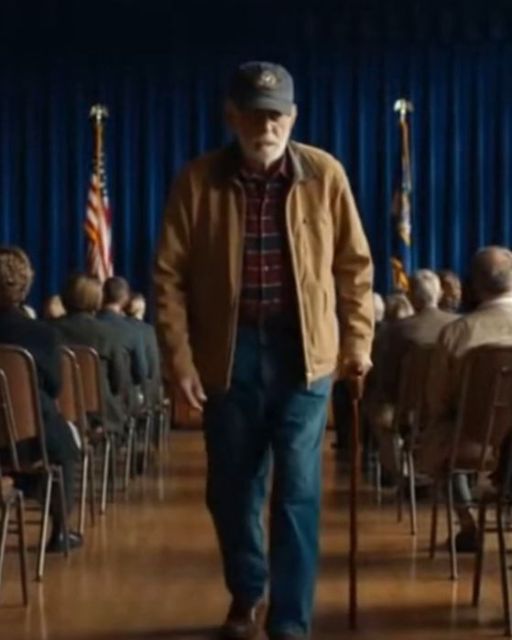
A man showed up at Grandma’s house. Late sixties. Heavy coat. Holding a folder.
He asked if “the family of Desmond Calloway” still lived here.
We froze. That was my father’s name.
“I served with him overseas,” the man said quietly. “I just found out he passed. I had to come.”
Everyone stared like he was a ghost.
Then he reached into his folder and pulled out a photo—different from the one we took down.
It was my dad standing beside a military vehicle. Grinning. Arm around me, as a toddler, in pigtails.
He turned it over and read aloud the words my dad had written in faded ink:
“My reason for making it home.”
Grandma sat down. My uncle left the room.
And that man? He said one more thing before he left. Something that rewrote everything I thought I knew.
“Your father didn’t abandon you,” the stranger said, looking directly at me. His eyes were honest, tired, like someone who’d carried a burden too long.
“What are you talking about?” my cousin snapped. She’d always been the most vocal about Dad.
The man introduced himself as Warren Hayes. He pulled out a worn military ID card to prove it, then sat down at the kitchen table without being invited.
We all followed, drawn by something we couldn’t name.
“Desmond and I served together in the Gulf,” Warren began. “He was the kind of guy who’d give you his last cigarette, you know? Always had a picture of his little girl in his pocket. Showed her off to everyone.”
I felt my throat tighten.
Warren continued. “When we came home, Des was different. We all were. But he had it worse than most. PTSD, they call it now. Back then, we just called it being messed up.”
My mother had come into the room. She stood in the doorway, arms crossed, face unreadable.
“He tried to get help,” Warren said. “But the VA was a nightmare. Six-month waitlists. Pills that made him feel like a zombie. He was falling apart, and he knew it.”
“So he left us to deal with it alone,” my cousin said bitterly.
“No,” Warren said firmly. “He left to protect you.”
The room went silent.
Warren opened his folder and pulled out a stack of letters. They were addressed to my mother, postmarked from different cities over the years. All unopened. All returned to sender.
My mother’s face went pale.
“He wrote every month,” Warren said. “For eight years. Until he couldn’t anymore.”
“I never got any letters,” my mother whispered.
Warren looked at my grandmother. Something passed between them. A knowing look that made my stomach drop.
Grandma’s hands started shaking. She reached for the table to steady herself.
“Mom?” my mother said, her voice rising. “Mom, what did you do?”
What came out next shattered everything.
Grandma had been intercepting the letters. Every single one. She admitted it right there, tears streaming down her wrinkled face.
“He was sick,” she said defensively. “I saw what he was becoming. The drinking. The nightmares. I couldn’t let him drag you all down with him.”
“That wasn’t your choice to make,” my mother said, her voice breaking.
Warren reached into his folder again. This time he pulled out a final letter, sealed in plastic to preserve it.
“This one’s different,” he said. “I found it in his things after he died. It was never mailed. I think he knew he was running out of time.”
He handed it to me.
My hands trembled as I opened it. The handwriting was shaky but unmistakably the same from the photo. I read it aloud, my voice cracking with every word.
“To my daughter, if you ever read this, know that leaving you was the hardest thing I ever did. Harder than any war. I was sick in ways I didn’t understand, and I was scared I’d hurt you. Not on purpose, but in one of those moments when I couldn’t tell what was real. I loved you too much to risk that. I worked construction jobs under the table, saved every penny, and sent it to your mom. Or tried to. I hope she got it. I hope you had birthdays and Christmases and everything a kid deserves. I’ve been in treatment for three years now. I’m better. Not perfect, but better. I was going to come home next month. I was going to see you. But the cancer has other plans. I’m writing this from a hospital in Nevada. They say I’ve got weeks. I want you to know I never stopped loving you. Not for one second. You were my reason for making it home from that war. And you’re my reason for fighting this one too. Even if I lose. I’m sorry I couldn’t be the dad you needed. But I hope someday you’ll understand I did what I thought was right. All my love, always. Dad.”
I couldn’t see the paper anymore through my tears.
My mother was sobbing. My uncle, who’d come back into the room, stood frozen against the wall.
Even my cousin, who’d wanted the photo taken down, had her hand over her mouth.
Warren spoke quietly. “The money he sent? Your grandmother kept that too. Said it was blood money. She put it in an account she never told anyone about.”
All eyes turned to Grandma. She was crying so hard she could barely speak.
“I thought I was protecting you,” she whispered. “I thought I was doing the right thing.”
“You kept a father from his daughter,” my mother said, her voice sharp as glass. “You kept me from knowing the truth. You let us hate him.”
Warren stood up slowly. “I’m sorry to bring all this pain to your door. But Des made me promise. If anything happened to him, I had to find you. I had to tell you the truth.”
He left the folder on the table. Inside were more photos. Letters. Medical records showing years of treatment. Receipts from money orders sent and returned.
A whole life we never knew about.
After Warren left, nobody spoke for a long time.
Then my mother did something I’ll never forget. She went to the hallway where the photo had been taken down. She picked it up from where it had been leaning against the wall.
And she hung it back up.
Higher than before. Right in the center.
“He was sick, and he tried to get better,” she said. “He loved his daughter enough to stay away when he thought he was dangerous. That takes more strength than staying ever would have.”
My cousin started to protest, but my mother cut her off.
“We don’t get to decide who was wrong anymore. We already did that, and we got it all backwards.”
In the weeks that followed, we learned more. Warren connected us with other veterans who’d known Dad. They told stories of a man who struggled but never gave up. Who worked odd jobs to send money home. Who talked about his little girl every single day.
We found the bank account Grandma had hidden. Thirty-eight thousand dollars. Every cent Dad had sent over the years, plus interest.
My mother gave it all to me. Said it was what he would’ve wanted.
I used some of it to visit his grave in Nevada. Warren came with me. We planted flowers and I left that photo from the folder, the one of him holding me as a toddler.
I told him I understood. That I forgave him. That I wished I could’ve told him in person.
The rest of the money? I’m using it to finish college. Something Dad never got to do. I’m studying social work, specializing in helping veterans with PTSD and their families.
Because I learned something through all of this.
Sometimes the people we think abandoned us were actually the ones fighting the hardest to protect us. Sometimes love looks like distance. Sometimes strength looks like walking away.
And sometimes the stories we’re told about the people we’ve lost are just that—stories. Not truth.
My father wasn’t a coward. He wasn’t selfish. He was a man dealing with invisible wounds in a time when nobody understood them. A man who made an impossible choice because he thought it was the only way to keep his daughter safe.
I have his photo on my own wall now. Same one that used to hang in Grandma’s hallway. I look at it every morning.
And I remember that he loved me. That he never stopped. That his reasons for making it home from war weren’t just words on the back of a photograph.
They were real.
Grandma apologized to me privately, months later. She’s old now, confused sometimes, but that day she was clear. She said she thought she was saving us from heartbreak. That she’d watched her own father drink himself to death and couldn’t bear to see history repeat itself.
I told her I forgave her too. Because holding onto anger only poisons the person carrying it.
We can’t change the past. We can’t bring back the years we lost. But we can choose to honor the truth, now that we know it.
Dad spent his last years trying to become the man he wanted to be for me. He died thinking I hated him. That breaks my heart. But it also drives me forward.
I share his story now, whenever I can. Not for sympathy. But because there are other families out there living with half-truths and assumptions. Other kids who think they were abandoned. Other parents who are too sick to come home but too loving to stop trying.
The truth matters. It always matters.
And love? Real love finds a way to reach us, even across years and miles and returned letters.
Even when we’re too stubborn or too hurt or too misled to recognize it at first.
My father’s love reached me. Finally. Through a stranger with a folder and the courage to keep a promise.
That’s the kind of legacy worth remembering.
If this story touched you, please share it. You never know whose heart needs to hear that it’s never too late for truth. And if you’ve ever judged someone without knowing their full story, maybe take a moment to reconsider. We’re all fighting battles others can’t see. Like this post if you believe in the power of forgiveness and understanding. The truth will always find its way home.