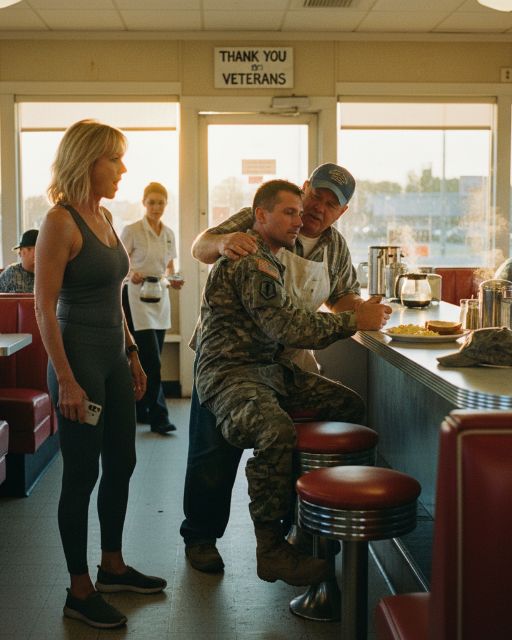
I staggered into the diner after 14 hours on patrol, uniform filthy, boots caked in mud. All I wanted was coffee and eggs. Sat at the counter, dead quiet.
The woman next to me – bleached hair, yoga pants, Karen vibes – wrinkled her nose. “Ew, do you smell that? This isn’t a homeless shelter! Get him out!”
The server froze. “Ma’am, he’s just – ”
“Manager! Now!” she screeched, waving her phone like a badge.
I sighed, grabbed my cap. No point fighting. Started to stand.
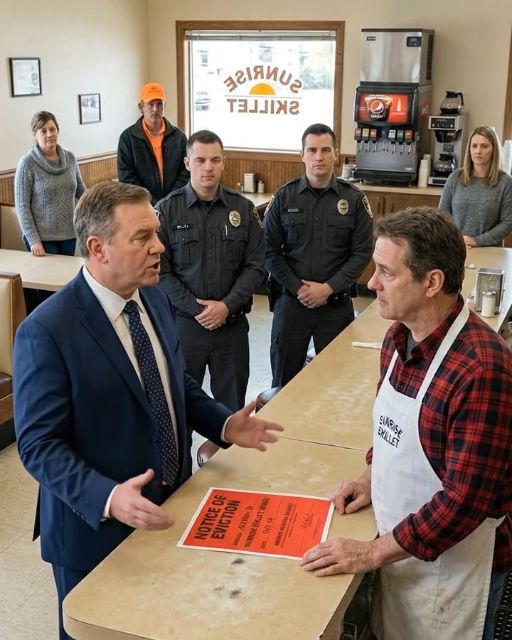
That’s when the owner, Vernon, burst from the kitchen. His eyes locked on me. “Duane? Holy hell, son!”
He crushed me in a bear hug, grease-stained apron and all. Ignored her completely.
The diner went dead silent.
Vernon turned to the Karen, face like thunder. “Lady, that soldier saved my life in Fallujah. Pulled me from a burning Humvee. And this stool? It’s his—always has been.”
She sputtered. “But I—”
He cut her off. “Because Duane isn’t just any soldier. He’s my son.”
The words hung in the air, heavier than the smell of bacon grease. You could have heard a pin drop on the checkerboard floor.
The woman’s jaw unhinged slightly. Her perfectly manicured hand, still holding her phone, slowly lowered.
Her face cycled through a whole weather system of emotions: shock, confusion, then a flash of crimson embarrassment. She looked from Vernon’s furious face to my exhausted one.
Vernon kept a heavy hand on my shoulder, grounding me. “We haven’t seen each other in five years,” he said, his voice thick with emotion, but still loud enough for the whole room to hear.
“Five years of him serving this country, so people like you can sit here and complain about the smell of honest work.”
He wasn’t yelling anymore. His voice was low and dangerous, each word a carefully placed stone.
The woman, let’s call her Brenda, finally found her voice. “Well, I didn’t know,” she stammered, trying to gather some shred of dignity. “There was no way I could have known.”
“You didn’t have to know,” Vernon shot back. “You just had to be decent. You just had to see a man in uniform, looking like he’s been through hell, and show a little kindness. That’s all.”
I finally spoke, my voice raspy. “It’s alright, Dad. Let it go.”
The word “Dad” seemed to land like another blow on Brenda. She flinched.
She stood up abruptly, her chair scraping loudly against the floor. She fumbled in her purse, threw a twenty-dollar bill on the counter. “Fine. I’m leaving.”
She turned, chin held high in a pathetic attempt at salvaging her pride. As she pushed through the door, she muttered, “I’ll be leaving a review.”
The little bell above the door tinkled, announcing her departure.
For a moment, nobody moved. Then, an old man in a booth at the back started clapping, slow and deliberate.
Soon, another person joined in, then another. The small diner filled with a smattering of applause.
I felt my face get hot. I wasn’t used to this kind of attention. Out there, you’re just a number, a part of a unit.
Vernon—my dad—finally broke his glare from the door and looked at me. The anger in his eyes melted away, replaced by something I hadn’t seen in a very long time.
It was a deep, aching relief. “Come on,” he said, his voice cracking. “Let’s get you some food.”
He led me to his personal booth in the corner, the one with the worn-out red vinyl. The one where I used to do my homework as a kid.
He poured me a coffee himself, his hands shaking slightly. He disappeared into the kitchen and came back a few minutes later with a plate piled high with steak, eggs, hashbrowns, and toast.
It was the “Patriot’s Plate,” the most expensive thing on the menu. He never let me order it when I was a kid.
We sat in silence for a bit while I ate. Every bite tasted like coming home.
“Why didn’t you call, Duane?” he finally asked, his voice quiet. “Five years. Not a single letter, not one phone call.”
I stopped chewing, the food suddenly heavy in my stomach. I looked down at my hands, still caked with dirt under the nails.
“I didn’t know what to say,” I admitted. “We… we didn’t exactly part on the best of terms.”
That was the understatement of the century. The last time I’d seen him, we were standing in this very diner, screaming at each other.
I had just told him I’d enlisted. He had just come undone.
He’d seen his own war. He carried scars, both inside and out, that he never talked about. He wanted a different life for me. A peaceful one.
He told me I was throwing my life away. I told him he was a hypocrite who didn’t respect my choices.
I’d walked out that door and never looked back. It was easier to face enemy fire than to face the disappointment in my own father’s eyes.
“I was scared,” he said now, his confession a quiet rumble. “I was terrified I’d get that knock on the door. Every single day.”
“I was just trying to be like you,” I said, the words I’d been holding back for years finally tumbling out. “I always looked up to you, Dad. To your service.”
His eyes glistened. “I know, son. I know that now.”
Just then, his cell phone buzzed on the table. He glanced at it, a frown creasing his forehead.
It was my sister, Sarah. He put it on speaker.
“Dad, have you seen Facebook?” she asked, her voice tight with panic. “You need to look at the town’s community page. Right now.”
My dad fumbled with his phone, his big, calloused fingers tapping at the screen. He pulled up the page.
And there it was. A video, posted by Brenda.
It was cleverly edited, starting only at the moment my dad came out of the kitchen, his face red with anger. It showed him yelling, “Lady, that soldier saved my life.”
The camera work was shaky, making him seem aggressive and unstable. It cut off right before he said I was his son.
The caption read: “Vicious diner owner verbally assaults paying customer for making a simple complaint about a filthy vagrant. Harassed and threatened me. Boycott Vernon’s Diner!”
My heart sank into my boots. The comments were already pouring in.
“Disgusting behavior!”
“I’m never eating there again.”
“How dare he treat a woman like that? And for what? Some homeless guy?”
“Someone call the health department! Look at the state of that soldier!”
The one-star reviews were flooding the diner’s page. The business he had built from nothing, the place that was our entire family’s legacy, was being torn apart in minutes.
All because of me.
“Dad, I’m so sorry,” I whispered, the shame a physical weight on my shoulders. “I shouldn’t have come here. I brought this on you.”
He switched off the phone, his expression unreadable. He took a long sip of his coffee.
“Don’t you dare be sorry,” he said, his voice firm as steel. “You did nothing wrong. I did nothing wrong.”
“We stood up for what was right,” he continued, looking me straight in the eye. “If my business fails because I chose to defend my son, then so be it.”
But I could see the worry etched in the lines around his eyes. This diner was his life.
The next day was brutal. The morning rush was just a trickle. The phone rang, but it was people calling to cancel their usual lunch orders.
Sarah came in, her face pale. She showed us her phone. The local news had picked up the story, running Brenda’s video and a headline about a local business owner’s “shocking outburst.”
I felt like I couldn’t breathe. I had survived firefights and ambushes, but this felt so much worse. This was an attack on my family, and I was the cause.
I spent the day in the kitchen, washing dishes, trying to make myself useful. I couldn’t bear to see the empty tables.
My dad and I didn’t talk much. We didn’t need to. The same heavy dread hung over both of us.
We were closing up early, the quiet of the diner deafening, when a young man walked in. He looked like a college kid, holding his phone.
“Are you Vernon?” he asked, looking at my dad.
My dad nodded warily. “Can I help you?”
“I was here yesterday,” the kid said. “I was in the booth by the window. I saw the whole thing.”
My heart pounded in my chest.
“That woman’s video is a lie,” he went on. “She edited it. She cut out the part where she called him,” he gestured to me, “a homeless person and screamed at your server.”
My dad and I exchanged a look.
“So,” the kid said, a determined glint in his eye, “I posted my own video.”
He held up his phone. “I was filming a little video for my girlfriend, just messing around. And I caught it all. From the very beginning.”
He played it for us.
His video was clear. The audio was perfect. It showed Brenda wrinkling her nose in disgust. It captured her screeching, “This isn’t a homeless shelter!”
It showed me, looking weary, trying to leave without a fuss. It showed my dad’s raw, emotional reunion. And it included the part that Brenda had conveniently cut out.
“Because Duane isn’t just any soldier,” my dad’s voice boomed from the tiny phone speaker. “He’s my son.”
The kid had uploaded it with a simple title: “The Truth About Vernon’s Diner.”
“It’s starting to get some views,” he said with a shrug. “I just thought you should know. What she did was wrong.”
My dad stood there, speechless. He reached out and grabbed the young man’s hand, shaking it firmly. “Thank you,” he said, his voice thick. “What’s your name?”
“Thomas,” he said. “And no need to thank me. My grandfather served. I know what respect looks like.”
Thomas left, and my dad, my sister, and I stood huddled around Sarah’s phone, watching the numbers on the new video climb.
First hundreds of views. Then thousands. Then tens of thousands.
The comments were a complete reversal.
“Wow. She’s the real garbage here.”
“That poor soldier just wanted a meal. Thank you for your service, sir.”
“The hug between the father and son made me cry. I’m going to Vernon’s Diner for breakfast tomorrow!”
A hashtag started trending in our small town, and then beyond: #StandWithVernonsDiner.
The next morning, when we arrived to open up, there was a line of people stretching down the block.
When my dad unlocked the door, they cheered.
The diner was packed from open to close. We could barely keep up. People were leaving hundred-dollar tips on ten-dollar bills.
Veterans from the local VFW post came in, all wearing their hats, and sat at the counter, swapping stories with my dad. They all made a point to shake my hand.
A local lawyer came in and offered to represent us, pro bono, if Brenda decided to pursue any legal action.
The local news station that had run the first story showed up, cameras in tow. This time, they wanted to do a story on the veteran father and son, reunited.
My dad, in his element, told them our story. He told them about his service, and about mine. He didn’t badmouth Brenda. He just said it was a misunderstanding that highlighted the importance of kindness.
By the end of the week, Brenda’s video had been taken down. Her social media profiles vanished. We heard through the grapevine that her employer, a high-end real estate firm, had seen the “Truth” video.
They released a statement saying they were a company that “valued community and respect,” and that Brenda was “no longer an employee.”
The flood of support for the diner didn’t stop. We had to hire two more servers. Sarah quit her part-time job to help manage the front of the house.
And me? I stayed.
I traded my combat boots for kitchen clogs. I learned how to flip pancakes and run the grill just like my dad.
I found a new kind of peace in the rhythm of the diner, in the simple act of feeding people. I talked to the other veterans who came in. I listened to their stories. I shared some of my own.
The stool at the counter, the one my dad had called “mine,” was now officially reserved. A small, brass plaque was installed on the back of it.
It just said: “Reserved for Cpl. Duane Miller. Welcome Home.”
One afternoon, during a lull, my dad and I were standing side-by-side, cleaning the griddle.
“You know,” he said, not looking at me. “I was wrong. All those years ago.”
“I was so afraid of you getting hurt, I didn’t see that you were becoming a man I could be proud of. You were already that man.”
“I’m proud of you, son,” he said, finally turning to me, his eyes shining. “Then and now.”
I just nodded, unable to speak past the lump in my throat. We didn’t need a big hug or a dramatic scene. The understanding was there, solid and true, in the shared space between a father and his son.
The diner had always been my dad’s dream. But now, it was something more. It was a place of second chances.
A place where a dirty soldier could walk in and not be judged, but be welcomed. A place where a father and son could bridge the gap of years and wars. A place where a single act of contempt was washed away by a tidal wave of community and kindness.
It turns out, the ugliest moments can sometimes lead to the most beautiful outcomes. You can’t always control the battles you face, but you can control how you stand your ground, armed with truth and decency. And sometimes, that’s all the armor you need.