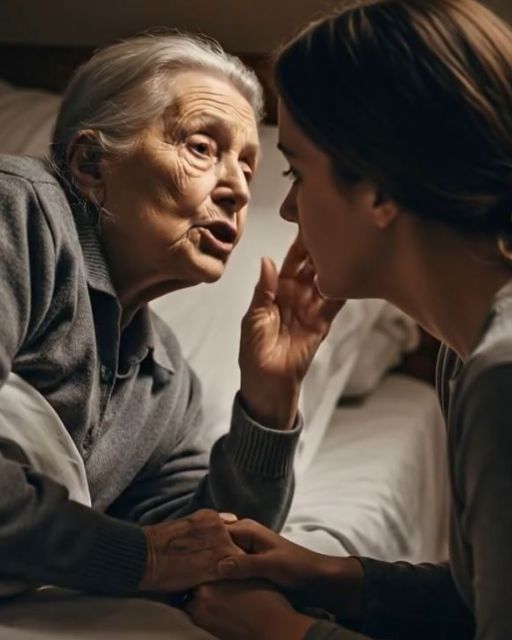
Just before my grandma passed, she gripped my hand and whispered, “Check behind the frames.” When I finally did, my heart stopped. Why didn’t I look sooner?…
Her last words were a dry rasp in my ear.
“Check behind the frames.”
At the time, I thought she was delirious. Lost in the fog of her final moments.
I was wrong.
Tonight, alone in her quiet house, I obeyed.
I started with her wedding photo. Her and grandpa, frozen in a time before me. My fingers shook as I worked the backing loose.
A yellowed envelope was taped to the cardboard.
My breath hitched.
Inside was a deed. A sprawling property up north. Acres of land I never knew existed.
And the name on it was mine.
It had been mine since I was fourteen.
The floor seemed to drop out from under me. All those years, sleeping in a damp basement. Eating their leftovers. Being treated like a ghost in my own home.
They made me feel worthless while living on land that belonged to me.
A cold fire started in my gut. This was just the beginning. My grandma had left me more than a deed. She had left me proof.
Secret audio recordings. Hidden camera videos.
But my eyes went to the second frame. An ugly, ornate thing by the staircase she always claimed to hate.
Behind it, I found a flash drive. And a name I hadn’t heard in years. Mr. Hayes.
My old teacher. A kind man whose career my father destroyed over a lie.
Grandma’s note was tucked beside the drive.
“He tried to warn them. Now you must.”
I found his number. When I spoke my name into the phone, there was a long, heavy pause.
“Finally,” he said. “Your grandmother promised me you’d call one day.”
We met in a quiet cafe. He placed a metal briefcase on the table between us, secured with a heavy, time-rusted padlock.
“She gave this to me over a decade ago,” he said, his voice trembling. “She told me if anything ever happened to her, I was to give it to you. Your grandmother saved everything.”
When he opened the case, my world tilted.
Folders. Photographs. Medical reports. All about me.
But one photo stole the air from my lungs.
It was me at seven years old. A collection of dark, ugly bruises bloomed across my upper arm.
I turned it over.
In my grandma’s familiar script, it said: Sent to the school principal. No one did a thing.
I understood then.
This wasn’t a family matter.
This was a dark truth they thought they had buried forever.
My hands trembled as I sifted through the contents of the briefcase. Mr. Hayes just watched, his expression a mixture of sorrow and resolve.
Each folder was a new chapter in a story I had lived but never truly understood.
There were letters. Copies of letters my grandmother had sent to social services, each one more desperate than the last. They were filled with detailed accounts of my neglect.
Stapled to each was the sterile, dismissive response. “Case reviewed. No cause for action found.”
Then came the financial records. A trust fund, set up by my grandfather, with a substantial amount of money in it.
It was meant for me. For my education, my future.
Account statements showed systematic withdrawals. Small at first, then larger and more brazen. My parents, Richard and Eleanor, had been draining it dry for years.
They bought cars. They took vacations. They renovated their house. All with money that was meant to give me a life they denied me.
The betrayal was a physical thing, a weight pressing down on my chest.
Mr. Hayes gently pushed the flash drive across the table. “Your grandmother said this was the hardest part to listen to.”
I slid it into my laptop.
The first audio file was dated twelve years ago. I heard my mother’s voice, sharp and cold.
“He’s getting curious,” she said. “He asked about the land again.”
My father’s reply was a low growl. “He doesn’t need to know. He has everything he needs right here.”
A bitter laugh escaped my lips. Everything I needed. A cold basement and their contempt.
Another file. This one was a hushed phone call.
“The school called,” my father said, his voice tight with anger. “That teacher, Hayes, reported a bruise. I’ll handle it. I’ll make sure he can’t teach in this state ever again.”
And he had. He’d spun a story about Mr. Hayes being unstable, of having an inappropriate fixation on me.
They ruined a good man’s life to protect their lie.
The final recording was the worst. It was my grandma’s voice, pleading with them.
“You can’t keep doing this,” she sobbed. “You are destroying a child. Your child.”
“Stay out of it, Mother,” my father’s voice cut in, icy and final. “You have no idea what’s at stake. We’re protecting him.”
Protecting me? The words made no sense. It was a lie so twisted, so nonsensical, that it almost sounded like the truth.
I closed the laptop, my head spinning.
“What do I do?” I asked, my voice barely a whisper.
Mr. Hayes looked at me, his eyes clear for the first time. “First,” he said, pointing to the deed, “you see what they were so afraid of you finding.”
The drive north was long. Hours of highway turned into winding country roads. Mr. Hayes drove, his quiet presence a steadying force beside me.
We followed the directions on the deed, ending up on a gravel path that seemed to lead to nowhere.
And then we saw it.
The land.
It was breathtaking. Hundreds of acres of rolling hills, dense forest, and a sparkling river that snaked through the valley. It was more beautiful than I could have imagined.
An old, weathered cabin stood on a bluff overlooking the river. It was small and simple, but it looked strong.
As I stepped out of the car, I felt something I hadn’t felt in my entire life.
A sense of belonging. A sense of home.
This was mine.
We spent the afternoon walking the property. It was peaceful, untouched. But a strange feeling lingered in the air. A feeling of being watched.
Inside the cabin, dust motes danced in the slivers of afternoon light. It was sparse. A simple bed, a stone fireplace, a sturdy wooden table.
It was my grandfather’s retreat. The one place he could be himself.
Mr. Hayes ran a hand along the stone of the fireplace. “Your grandmother said he built this himself.”
My eyes scanned the room, and I noticed something odd. One of the floorboards near the hearth was a slightly different color. It was newer than the others.
Curiosity piqued, I knelt down. There was a small notch along the edge.
I wedged my fingers into it and pulled. The board came up with a soft groan.
Beneath it was a hollow space. And inside that space was a metal box.
My heart pounded against my ribs.
I lifted it out. It wasn’t locked.
Inside, nestled on a bed of old felt, was a leather-bound journal.
My grandfather’s journal.
His handwriting was strong and clear. The first few pages were about building the cabin, about his love for my grandmother, about his hopes for their family.
Then the tone shifted.
He wrote about his job. He was a geological engineer for a massive corporation, a company called Geo-Core.
They were celebrated as innovators, leaders in their field.
But my grandfather had discovered their secret.
He found evidence they were illegally dumping carcinogenic waste into a network of underground caves. Those caves fed the water table for the entire region, including the town just a few miles from his cabin.
He had the proof. Soil samples, water analysis reports, internal memos he’d copied.
He went to his superiors. They offered him a promotion, a huge bonus. A bribe to keep him quiet.
When he refused, they threatened him. They threatened my grandmother. They threatened my father.
He wrote, “Richard believes their lies. He is weak, easily swayed by money and power. He thinks I am the criminal, a fool throwing away our family’s fortune.”
The corporation framed him. They manufactured a financial scandal, ruining his reputation and career.
They thought they had broken him.
But he had one last card to play.
He used his remaining money to buy this land. Not just for its beauty, but for its location.
The land sat directly on top of the main access point to the cave system. The proof wasn’t just in his reports; it was physically beneath my feet.
The corporation couldn’t touch the land without revealing their crime. So they controlled the next best thing: the heir.
They paid my parents. A generous, unending stipend to keep me under their thumb. To make sure I never learned about my inheritance, never questioned, never came looking.
My parents weren’t just cruel and greedy. They were cowards. They sold my childhood and my safety for a life of comfort.
And the man my father got fired, Mr. Hayes, wasn’t just any teacher. He had been my grandfather’s intern years ago. He knew my grandfather was a good man and had kept an eye on me as a promise to him.
It all clicked into place. The lies, the neglect, the rage when I asked questions. The “protection” my father spoke of on the tape.
They were protecting their dirty secret. Their blood money.
Tears streamed down my face. Not tears of sadness, but of pure, clarifying anger.
My grandmother knew. She couldn’t fight them all, not with a son who had turned against his own father. So she waited.
She collected every piece of evidence. Every letter, every photo, every recording.
She gave it to the one man she could trust, Mr. Hayes.
And she gave me the key to it all. The deed to the land that held the truth.
I closed the journal and looked at Mr. Hayes. His face was a grim mask.
“She played the long game,” he said softly.
“Now,” I said, my voice hard as steel, “we finish it.”
We didn’t go back to my parents’ house immediately. Instead, we went to a lawyer Mr. Hayes knew. A woman named Sarah who specialized in corporate whistleblowing cases.
She listened to our story for three hours without interruption, her expression growing more intense with every folder I opened, every page of my grandfather’s journal I showed her.
When I was finished, she leaned back in her chair.
“This is bigger than family fraud,” she said. “This is a criminal conspiracy that has spanned decades. Your parents are the least of their worries.”
The plan was set.
A few days later, I walked up to the front door of the house I grew up in. The place that was never a home.
Mr. Hayes and Sarah waited in the car down the street.
My mother opened the door. Her face, usually a mask of annoyed indifference, registered a flicker of surprise.
“What are you doing here?” she asked.
“I think we need to talk,” I said, walking past her into the living room.
My father was on the couch, reading the paper. He lowered it, a scowl already forming.
“This is not a good time,” he snapped.
“You’re going to want to make time for this,” I said. I placed a single photograph on the coffee table.
The picture of me at seven, with the bruises on my arm.
My mother’s breath caught. My father’s face went pale.
“Where did you get that?” he demanded.
“Grandma saved everything,” I said, my voice calm and steady. “The letters to social services. The bank statements from my trust fund. The audio recordings of you both.”
I let that sink in.
“She even left me the deed to the land up north,” I continued. “I went to see it. It’s beautiful.”
My father stood up, his fists clenched. “You have no idea what you’re messing with. We did what we did to protect you!”
“Protect me?” I laughed, a raw, painful sound. “Or protect your paycheck from Geo-Core?”
The name hit him like a physical blow. He staggered back.
“They paid you to be my jailers,” I said, the words falling like stones in the silent room. “They paid you to keep me ignorant and afraid. They told you my grandfather was a criminal, and you were too weak and too greedy to question it.”
My mother started to cry, weak, pathetic sobs. “We didn’t have a choice,” she whimpered.
“You always have a choice,” I shot back. “You chose the money. You chose the cars. You chose this house. You chose everything over me.”
I placed my grandfather’s journal on the table next to the photo.
“He wasn’t a criminal,” I said, my voice shaking with the force of my conviction. “He was a hero. And you let them destroy his name while you lived off the blood money they gave you to betray him.”
That was when the doorbell rang.
My father looked at the door, then back at me, a wild panic in his eyes.
“That will be my lawyer,” I said. “And some people who are very interested in talking to you about Geo-Core.”
The fallout was like a tidal wave.
The story was national news. The evidence my grandmother and grandfather had collected was airtight.
The CEO of Geo-Core was arrested. The company’s stock plummeted. Investigations were launched, and the full scale of their environmental crimes was laid bare.
The town near my land finally got justice. The company was forced to fund a massive cleanup and pay reparations to the families they had poisoned for years.
My parents were arrested, too. Not just for embezzlement and fraud, but for their role in the conspiracy. Their carefully constructed world of suburban comfort shattered into a million pieces.
I saw them one last time, in a courtroom. They looked small and broken, stripped of the arrogance and power they had wielded over me my whole life. They couldn’t even look me in the eye.
There was no satisfaction in their ruin. Only a quiet, somber sense of justice. A chapter finally closed.
Mr. Hayes was a hero. His name was cleared, and the story of how my father had him fired became a symbol of the corporation’s ruthless tactics. He was offered his old job back, but he declined.
Instead, he accepted a position at a university, training a new generation of teachers to be brave, to listen to children, and to never, ever look away.
With the trust fund money I recovered, and the immense value of the now-famous land, I set up a foundation. It’s named after my grandparents.
We fund legal aid for whistleblowers and support programs for neglected children. We fight for the people who have no one else to fight for them.
Sometimes, I go up to the cabin. I sit by the fireplace my grandfather built with his own hands. I look out over the hills he bought to protect a truth he knew was worth more than anything.
I finally understand what my grandmother’s last words meant. It wasn’t just about finding things behind the picture frames. It was about looking behind the picture they had painted of my life, of my family, of the world.
It was about finding the truth that was hidden in plain sight all along.
The deepest wounds can come from the people meant to protect us, but the truth, no matter how long it’s buried, has a way of finding the light. And in that light, you don’t just find justice. You find yourself.