At a military terminal buzzing with quiet tension, a sharply dressed officer locked eyes with an old man in flannel, assuming silence meant submission. He was seconds from learning the past doesn’t always stay in the past…
Ever stepped into one of those places where time feels like it’s holding its breath, waiting to exhale? That’s the kind of stillness you find in an air base terminal.
At Ramstein, on a day like any other, the constant hum of engines and movement filled the space—until a single voice sliced through it like steel. “Are you hard of hearing, or just wandering around?” the voice snapped. “This seating is reserved for those still serving—not for… strays.”
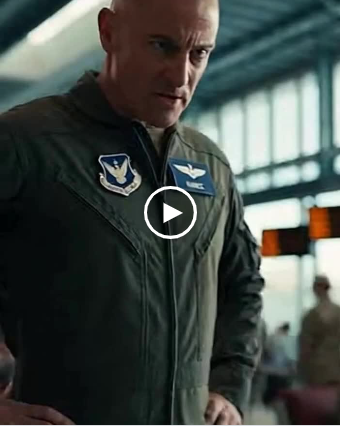
The man barking orders? Colonel Richard Vance. Everything about him screamed authority—his flight suit razor-sharp, his stance rigid with control.
Across from him, sitting deep in a cushioned chair, was an elderly man who looked like he belonged in a different era. Flannel shirt faded from years of wear, khakis soft from age, and a well-worn duffel rested quietly by his side. His eyes, pale and quiet, lifted to meet the Colonel’s glare.
But instead of reacting, the old man simply absorbed the moment. There was a kind of peace in him—the kind earned, not given.
“I’m waiting for a flight,” he said, voice rough, but firm.
Colonel Vance scoffed. “A flight? This is a secure military base, not a Greyhound station. Let’s see your ID and orders. Now.” He snapped his fingers, sharp and dismissive, causing a nearby airman—who’d just been reaching to offer a bottle of water—to freeze mid-motion.
With a slow breath, the older man reached into his coat and pulled out an ID—worn, yellowed, and old enough to have seen a few wars.
Vance snatched it, sneering as he read aloud: “Samuel Peterson. Retired.” His tone dripped with disdain.
“Retired doesn’t cut it, Peterson. That seat is for active duty. You see these folks?” He motioned broadly. “They’re the real deal. You? You’re a leftover.”
He jabbed a thumb toward the civilian area. “Grab your bag and find another seat.”
But the old man didn’t budge.
In a voice calm as ever, he replied, “The Master Sergeant at the desk said I could wait here.”
Something about that response lit a fuse. Vance’s face turned crimson. “You think I’m playing games? I’m a full Colonel. I run operations here. You think some desk sergeant outranks me?”
And just like that, the room seemed to freeze. The old man’s quiet presence suddenly outweighed every medal on Vance’s chest…
For a second, nothing moves. A TV murmurs somewhere with muted news. A coffee cup rattles softly against its saucer in the hand of a young captain who suddenly realizes he’s staring. The air feels heavier, like the whole terminal leans in to see which way this moment tilts.
Samuel Peterson doesn’t raise his voice. He doesn’t lean forward. He doesn’t do any of the things that announce a challenge. Instead, he simply tilts his head, eyes steady on Vance, and asks, “Colonel, have you finished reading that ID?”
Vance snorts. “I read enough. ‘Retired.’ That’s all I need.”
“Humor me,” Peterson says. “Top line. Under the name.”
Vance rolls his eyes but glances down again, more out of habit than respect. His gaze runs over the faded laminate, the micro-creases, the ghost of fingerprints ground into the surface by time. And then his eyes hit the line he somehow skips the first time.
His mouth stops moving.
The airman with the water bottle sees it first—from his angle behind the Colonel, he catches the tiny crest stamped into the corner of the ID. Not the standard retired insignia. A different crest. One that people whisper about more than they explain.
“Sir…” the airman says quietly, voice tight. “Sir, that’s—”
Vance cuts him off. “At ease, Airman.” But his voice doesn’t land as sharply as before. His eyes blink once, twice, as he reads the text again, like the letters rearrange themselves into something impossible.
SPECIAL OPERATIONS COMMAND
MEDAL OF HONOR – RECIPIENT
There it is, burned into the plastic like a brand. Vance swallows. His jaw tightens, but this time it isn’t anger. It’s something more dangerous to a man like him: doubt.
“That ID is a novelty print,” he says, but the conviction isn’t all there. “We don’t issue them like this anymore.”
“No,” Peterson agrees. “You don’t. That one dates back to when they hand-deliver them and shake your hand like it means something.”
A seat two rows over scrapes against tile. A staff sergeant in BDUs, mid-thirties, solid build, steps closer, brow furrowed. He peers at the ID in Vance’s hand, then at Peterson’s face. Recognition doesn’t flash all at once; it creeps in, slow and disbelieving.
“No way,” the sergeant whispers. “Sir… that can’t be…”
Peterson looks at him, a faint half-smile touching his lips. “You got a name, Sergeant?”
“Baker. Staff Sergeant Baker, sir.”
“Sergeant Baker,” Peterson says, with a nod like he’s acknowledging an equal, “you mind telling your Colonel here what that crest means?”
Baker straightens, eyes flicking between the two men. “Sir, that’s SOCOM Delta. Old insignia. Black Ridge operations. Cold War era. It’s… uh… not exactly standard issue.”
The buzz in the room shifts. People aren’t just pretending not to listen anymore; they are openly listening. Phones hover just below chest level, cameras off but ready. The Master Sergeant at the desk stands now, lips pressed together, watching.
Vance feels all of it. He feels eyes on him like laser sights. He feels the weight of the ID in his hand, suddenly heavier than his entire rack of ribbons.
“Even if that’s real,” he says, clinging to his last angle of control, “you’re still retired. This seating is for those currently serving in theater. You are not.”
Peterson nods once, as if that’s fair. “That’s true,” he says. “I don’t wear a uniform anymore. Don’t draw a regular paycheck. Don’t click my heels when someone barks my name. But here’s the thing, Colonel Vance.”
His eyes sharpen. The peace doesn’t leave, but something else steps forward behind it—something colder, older.
“Service doesn’t stop just because the paperwork does.”
Vance opens his mouth to retort, but a new voice slices in—low, controlled, edged with command.
“Colonel Vance, what exactly are you doing?”
Every head snaps toward the entrance to the terminal lounge. A woman strides in—short dark hair, crisp suit instead of a uniform, badge clipped to her belt. OSI. Air Force Office of Special Investigations. Her presence carries a different kind of authority, one that doesn’t rely on volume.
“Ma’am,” Vance says quickly, too quickly. “Just enforcing protocol. This area is—”
“Reserved, yes,” she finishes, eyes already on the ID in his hand. “For mission-critical personnel.”
She reaches out, and Vance surrenders the card without thinking. She studies it. Her face is a wall for a long moment, then one corner of her mouth tightens in something like—respect? Concern? Both?
“Colonel,” she says, “where did you obtain this identification card?”
Vance gestures stiffly to Peterson. “From him. He’s trespassing in secured seating. I requested orders. He has none.”
She looks at Peterson, and this time her voice softens just enough that people close by hear the shift.
“Mr. Peterson,” she says, “I wasn’t expecting you until 1400.”
Peterson shrugs. “Old bones wake early. Lines take longer than they used to. I figured I’d rather sit where I can see the runway.”
The room reacts in a ripple. Vance feels heat crawling up his neck.
“You know him,” Vance says, but it comes out more like an accusation than a question.
“Colonel,” the OSI agent replies, “everyone in my line of work knows him. You’re standing in front of a man whose file is still redacted to people wearing stars.”
She turns to Peterson. “Sir, I apologize for the delay at the gate. We are still clearing access for some members of the escort team. You are absolutely authorized to remain here.”
Peterson almost smiles. “Told you,” he says quietly.
The simple line lands harder than any insult.
A siren suddenly chirps, short and sharp. Not the full wail of an attack alarm, but a localized tone. The big screen near the windows flickers, and the scrolling status bar along the bottom turns amber.
INBOUND MEDICAL EVAC – 10 MINUTES
STATUS: PRIORITY
The OSI agent glances at the screen, then at her watch. “They’re early,” she mutters.
Vance seizes on the distraction. “Ma’am, I’m commanding officer of this wing. Any mission-critical movement through my terminal goes through me. I still don’t see documented orders for this man, and until I do—”
“You don’t have clearance for his orders,” she interrupts, matter-of-fact. “Your scope is aircraft and personnel currently on your roster. Mr. Peterson’s presence here comes from another level.”
He bristles. “Ma’am, with respect, no one runs ops on my base behind my back.”
Peterson watches the exchange quietly, fingers resting on his duffel strap. Then he sighs, like a man who sees a storm building in a sky that already owes him too much rain.
“Colonel Vance,” he says, voice softer now, “what’s your father’s name?”
The question seems to come out of nowhere. Vance frowns. “That’s irrelevant to this discussion.”
“Maybe,” Peterson replies. “Maybe not. Humor an old stray.”
The air feels like it leans in again. Even the OSI agent watches more closely now.
Vance hesitates, annoyance and caution tangling in his chest. “Robert,” he says at last. “Robert Vance. Also a Colonel. Retired now.”
Peterson nods once, like he knows. Not like he learns, but like he confirms.
“Flew F-4 Phantoms,” Peterson says calmly. “Then F-16s. Stationed at Aviano, then Incirlik. Shot down once, in ‘89, over restricted airspace that doesn’t officially exist.”
Vance’s spine stiffens. “How do you know that?” His voice cracks on the edge of the question.
Peterson’s eyes don’t leave his. “Because I’m the one who brings him home.”
The room narrows around those words. Even the ambient hum of the base seems to dim for a heartbeat.
“I lead the recovery team,” Peterson continues. “We hike in at night. No lights, no support, no backup. Just coordinates, cold air, and a clock that ticks louder every minute. We find his chute. He’s injured, bleeding, half-conscious, and surrounded on three sides by people who don’t particularly care if he gets back to a wife and a new son or not.”
Vance’s breath catches.
“He keeps saying one thing to me,” Peterson says, voice low but steady. “Keeps pulling at my sleeve, looking me in the eye. ‘I’ve got a boy,’ he says. ‘You get me home, I’ll raise him right. I’ll teach him respect. I’ll make sure he never forgets who got him here.’”
You can almost see it as he speaks—the darkness, the weight, the desperate promises people make when death presses its thumb on them.
Peterson’s gaze never wavers. “We get him out,” he says. “He lives. Goes home to that boy. That boy grows up, puts on a uniform, earns a rank. Stands in front of me in a terminal one day and snaps his fingers in my face like I’m a dog that wanders into the wrong yard.”
The color drains from Vance’s face so fast it almost looks like someone flips a switch. His eyes are glassy, flicking between Peterson and some invisible memory he never personally lives but hears in his father’s voice a hundred times.
“My dad never tells that story,” he whispers. “He just says… he says a man pulls him out of hell and disappears.”
Peterson nods. “That sounds like me.”
Silence hits harder than any explosion in that moment. The OSI agent looks away, jaw tight, giving Vance a fraction of privacy his voice doesn’t ask for. Sergeant Baker’s fists clench and unclench at his sides, as if he wants to salute and apologize at the same time.
Vance’s throat works. The rank on his chest suddenly feels like costume jewelry.
“I… I didn’t know,” he says, and it’s the first honest thing he says since he opens his mouth.
“That’s the thing about respect, son,” Peterson replies, and the word “son” lands, not as an insult, but as a weight. “You don’t save it for people with impressive titles or convenient histories. You give it first. You hold it back only when someone proves they don’t deserve it.”
His gaze sweeps the room briefly, taking in the young airmen, the tired faces, the anxious glances at the medevac timer on the screen.
“Especially in a place like this,” he adds. “You have no idea what ghosts sit in these chairs. What they already give.”
The PA crackles overhead. “Attention in the terminal: inbound medevac flight now on final approach. All medical and command liaisons report to Gate C.”
The OSI agent straightens. “That’s us,” she says. She looks at Peterson. “Sir, your presence for this briefing is still requested. Command wants your input before they make the call on routing.”
“What routing?” Vance asks automatically.
She looks at him, weighing how much to say. “Civilian carrier in distress diverting here,” she replies. “Unknown risk profile. There are people on that aircraft who shared a location with some very bad actors in the last forty-eight hours. We’re trying to decide if we keep it on the far runway or bring it into main for faster treatment and screening.”
“And you want his input?” Vance asks, but there’s no arrogance left. Only genuine confusion.
“The profile on that plane matches an operation from his file,” she says. “Almost detail for detail. And his decisions that night keep an entire wing from going down.”
Peterson shifts in his seat, joints protesting as he rises. He grips the duffel and stands, just a fraction shorter than Vance but immeasurably taller all the same.
His legs wobble slightly. Before anyone can move, Vance reaches out, hand instinctively steadying his elbow. The touch surprises both of them.
“Careful, sir,” Vance says quietly.
The “sir” is not protocol this time. It’s personal.
Peterson gives him a sideways glance. “You sure I belong in this section?” he asks, voice dry, the ghost of humor tucked into the question.
Vance swallows hard. “This section belongs to you,” he says. He looks around the room, at the watching faces. “Everyone, if you have a seat, you stand. Now.”
Chairs scrape, feet find the floor, backs straighten. No one questions it. Not now.
As the entire section of the terminal rises, Vance turns to Peterson fully and, in front of everyone, snaps to attention. His boots click together. His hand lifts in a salute that he holds, eyes locked on the old man’s face.
“Colonel Richard Vance,” he says, voice steady but thick, “United States Air Force. Thank you, Mr. Peterson… for my father’s life. And for mine.”
Peterson looks at him for a long beat. Then, slowly, he returns the salute—not crisp, not textbook, but deeper than any regulation.
“Then do something worthy with it,” he replies.
The OSI agent clears her throat softly. “Gentlemen, we really do need to move.”
They head toward Gate C together, Peterson walking between Vance and the agent. Sergeant Baker falls in behind them without being asked, a quiet escort of one. As they move, the room parts around them, forming a narrow path.
At the doorway, Peterson pauses. He glances back at the sea of uniforms and scattered civilians.
“You,” he says, pointing lightly at the young airman with the water bottle still in his hand. “You were going to bring this to me before all this started, right?”
The kid startles, then nods vigorously. “Yes, sir.”
“Keep doing that,” Peterson says. “See someone tired, thirsty, worn down—you hand them the damn water. Don’t wait for permission. That’s how you lead before they pin anything shiny on your chest.”
The airman’s face flushes with pride. “Yes, sir.”
Peterson turns back toward the gate. His steps are slower than the people around him, but nobody rushes him. Time, for once, bends around him instead of the other way around.
As they approach the glass doors overlooking the tarmac, the medevac plane comes into view, wheels just kissing the runway. Emergency vehicles line up like a grim reception line. The sirens stay mercifully silent, but their lights spin, painting the windows in pulsing color.
“There,” the OSI agent says, pointing to a digital board mounted by the gate door. “Here’s everything we know. Passenger list, seating manifest, contact traces. The algorithms flag three high-risk profiles for potential contamination or hostile connection, but we’re short on ground intel.”
She hands a tablet to Peterson. His weathered fingers close around it, oddly steady now. His eyes flick over the data with a speed that doesn’t match his years. Vance watches, fascinated.
“You read like that often?” Vance asks quietly.
“Only when people might die,” Peterson answers, not looking up.
The minutes tighten, every second pulling tension tighter around the group. Finally, Peterson exhales through his nose and hands the tablet back.
“Keep it on the far runway,” he says. “You bring that into main, you turn this terminal into a petri dish and a target. You set up triage out there, with a controlled corridor. You stagger disembarkation. You isolate rows seventeen through twenty-three first. You’ll find your three there. Maybe four.”
The OSI agent frowns at the manifest. “That’s a very specific slice. How do you know?”
“Because the ones who want to hurt you never sit in the first rows,” Peterson replies. “Too visible. They also don’t hide in the very back where the crew can keep an eye on them. They sit where people stop paying attention. Middle of the herd.”
He taps the screen lightly. “And those seats line up with the origin gate pattern from that earlier op. They adapt, but they’re not as clever as they think they are.”
Vance studies him. “You see all that from a seating chart.”
“I see all that,” Peterson says, “because I spend a lifetime watching how people behave when they think no one is watching.”
The OSI agent doesn’t hesitate. “I’m relaying this to command,” she says. “We execute on your call.”
She steps aside, phone already at her ear, voice low and urgent.
Vance and Peterson stand side by side, watching the medevac roll to a stop, emergency vehicles closing in around it. The world outside the glass is a choreography of crisis; the world inside holds its breath again.
“You know,” Vance says quietly, “I always think of the military as a ladder. You climb, you outrank. You get to the top, you look down, and it feels good to see how far you’ve come.”
Peterson’s eyes stay on the plane. “And now?” he asks.
“Now,” Vance says slowly, “it feels more like… like a circle. Like I’m just one point on something bigger. Not above. Not below. Just part of it.”
Peterson’s mouth twitches. “That’s closer to the truth.”
He shifts his weight, then glances sideways at Vance. “Your father ever tell you why he doesn’t talk about that night?”
Vance shakes his head. “Just that it’s classified. And that he owes someone everything.”
“He doesn’t talk about it,” Peterson says, “because he’s ashamed.”
Vance stiffens. “Ashamed? My father—”
“Is a good man,” Peterson cuts in. “And a brave one. But that night, he freezes for two seconds too long. Two seconds that nearly get his wingman killed. Two seconds that almost cost him his own life. He carries that. Every time he looks in the mirror, he sees those two seconds.”
He looks Vance dead in the eye. “You know what I tell him when he tries to apologize?”
Vance shakes his head, speechless.
“I tell him this,” Peterson says. “We are not the moment we fail. We are what we do next.”
The words land inside Vance like a weight and a release all at once. He thinks of himself standing over Peterson a few minutes ago, barking orders, snapping fingers, calling him a leftover. He feels that same burn of shame his father must feel when he remembers freezing.
“What do I do next, then?” Vance asks, voice barely above a whisper.
Peterson considers him, really considers him, for the first time. “You remember,” he says. “You remember that you stand here wearing rank you only have because someone else crawls through hell for your family. You remember that anyone you see—old, young, uniform, civilian—might be carrying a story you don’t deserve to judge. And you act accordingly.”
He lets that sit for a second. Then he adds, “And you call your father. Not to ask about the mission. Just to tell him you know he did the best he could. That you’re trying to do the same.”
On the tarmac, the aircraft door opens. Figures in hazmat gear move up the stairs. Medics line up stretchers. The crisis unfolds with clinical precision, guided partly by the insight of a man who, by some measures, stops serving decades ago.
Inside the glass, the tension shifts from fear to focus. Orders fly, boots move, lives thread between danger and safety, all under the quiet watch of someone who sits in a flannel shirt and faded khakis.
After a while, the OSI agent returns, eyes tired but satisfied.
“You were right,” she tells Peterson. “Rows seventeen through twenty-three. Three high-risk individuals. One more questionable connection. We’ve got them isolated. No secondary spread, no breach.”
Peterson nods. “Good.”
“Command sends their thanks,” she adds. “And their apologies for the… less than welcoming reception.”
Her eyes flick meaningfully toward Vance. He doesn’t flinch from it.
“You can tell Command,” Peterson says, “that if I want apologies from them, I’ll ask. Today, I don’t.”
He turns to Vance instead. “Today, I’m more interested in his.”
Vance doesn’t hesitate. He steps forward, boots feeling heavier than they ever have.
“Mr. Peterson,” he says, and his voice carries just enough for the people nearby to hear, “I am sorry. I insult you. I disrespected you. I disrespected everyone who ever sits in a chair like that with quiet eyes and an old ID. I let my rank talk louder than my humanity. That won’t happen again.”
The words don’t erase what happens, but they do something better—they build something new.
Peterson studies him. Then he reaches out, placing a hand on the Colonel’s shoulder.
“See that it doesn’t,” he says. “And we’re square.”
Around them, the subtle sounds of relief ripple through the room. People who don’t directly know what just transpires still feel the shift, the way storm clouds sometimes break without anyone seeing the lightning.
The boarding call for a different flight echoes over the PA, mundane and almost comically normal after everything that just happens.
Peterson glances at the time on the screen. “Looks like my ride is almost here,” he says. “They still send me where the trouble is, now and then. Only now they add more cushions on the seats.”
Vance huffs a quiet laugh. “Sir… if you’d allow it… I’d like to personally escort you to the gate.”
Peterson arches a brow. “Afraid I’ll get lost between here and there?”
“Afraid someone else might forget to show you the respect you deserve,” Vance answers.
Peterson considers, then nods. “All right, Colonel. Walk with me.”
They move together through the terminal, side by side, the difference in age and posture obvious, the difference in worth anything but. People step aside, not because of the uniform this time, but because of the man in flannel who walks beside it.
At the gate, the attendant straightens, eyes going wide as the OSI agent shows her a brief flash of credentials and a notation on her tablet. She nods hurriedly.
“Mr. Peterson,” she says, “your flight is ready for pre-board. Whenever you’re ready, sir.”
Peterson hesitates. He looks out the window one last time, watching the medevac crew finish their work, watching the base breathe, engines rolling, lights blinking.
He turns back to Vance.
“You run a good outfit here,” he says. “It stumbles a bit.” His eyes flick downward pointedly. “But it learns fast.”
“I hope so,” Vance says.
“You don’t hope,” Peterson replies. “You choose. Every minute. Every interaction. You choose the man you’re going to be.”
He squeezes Vance’s arm once. “Choose well.”
Vance nods. “I will.”
Peterson picks up his duffel, then pauses. “One more thing, Colonel.”
“Yes, sir?”
“When you call your father,” Peterson says, “tell him Samuel still remembers his promise. He did raise that boy right. Eventually.”
The faintest glint of mischief shines in his eyes.
A laugh breaks out of Vance, short and raw, but real. “I’ll tell him,” he says.
Peterson gives him one last nod, then turns and walks down the jet bridge. His steps are slow, but unburdened. The doors close behind him with a soft hiss, the kind of quiet that sounds nothing like an ending, and everything like a chapter closing exactly where it should.
Vance stands there for a moment, hand resting lightly on the railing, watching the blank door where the old man disappears. Around him, life surges again—calls over the PA, boots on tile, the everyday rhythms of a base that never truly sleeps.
He pulls out his phone. For the first time in a long time, he doesn’t think about duty rosters or logistics or command reports. He scrolls to a familiar name and hits call.
“Dad?” he says when the line picks up. He looks back at the runway, at the sky above it, at the world that spins on the shoulders of people he never sees. “I just meet someone you once called a ghost. And I think… I finally understand.”
The words drift into the noise of the terminal, into the hum of engines, into the spaces where time holds its breath.
Somewhere above the clouds, an old man in flannel sits back in his seat, closes his eyes, and rests—not because his story is forgotten, but because, at last, it is seen.