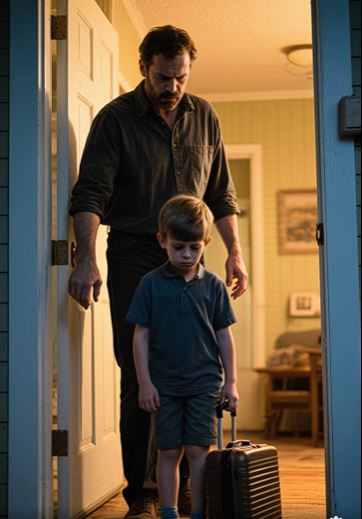
The last thing she said to me was, “Take care of him.” I nodded like I meant it—but I didn’t.
When I married Fabiola, her son Nico was eight. Quiet kid. Big eyes. He’d already been through hell—his bio dad bailed before he was born, and her ex-boyfriend wasn’t much better. I tried. I really did. Baseball games, bike riding, helping with math homework I barely understood. But it never clicked. He always looked at me like I was one more man passing through.
Then Fab got sick. It happened fast. Stage IV, everywhere. Suddenly I was the one doing school pickups and managing her meds, pretending I had any clue how to hold it all together. When she died, Nico was sixteen. Angry, silent, unreachable.
Three weeks later, we had a screaming match. He called me a coward. I called him ungrateful. He punched a hole in the drywall. I told him to pack his shit and go. I never checked where he went. Never called. I told myself I wasn’t his real dad.
Last week, I finally opened the box of her old journals. I don’t know what made me do it. Maybe guilt. Maybe boredom. Page after page of her handwriting—until I hit one entry, dated the week she was diagnosed.
“He asked if I’d marry him even if Nico wasn’t part of the package. I said no. He cried. That’s how I knew he’d try.”
I dropped the journal. My throat went dry. Because I remembered that conversation. And I had cried.
And then I saw the envelope—my name on the front, sealed, never opened, with Nico’s handwriting. Inside was—
A folded sheet of notebook paper. Neat, blocky handwriting. No smudges, no doodles. It read:
“If you’re reading this, it means Mom’s gone. I don’t hate you. I know you tried. I just don’t think you ever saw me. Not really. But I saw you. I saw how you stayed up with her. I saw you crying in the garage. I just wish you’d told me you were scared too. Maybe we could’ve helped each other. I don’t want to be angry anymore. I’m sorry I broke the wall.”
I read it twice. Then three more times. I don’t know how long I sat there.
I hadn’t even remembered the hole in the wall. But he did. And he apologized for that. Not for yelling. Not for storming out. For the wall.
That letter hit harder than any punch.
I hadn’t even tried to find him after he left. I told myself he had family. Maybe his aunt in Fresno. Maybe a friend. But if I’m being honest, I didn’t care where he went. I felt like I’d done enough. That he was someone else’s responsibility now.
But now, I couldn’t get that letter out of my head.
I started Googling him that night. “Nico Duarte.” Nothing solid. Facebook was a dead end. Too many names, and the ones with pictures didn’t match the boy I remembered.
Then I searched his high school alumni page. Someone had posted an old yearbook photo of the class of 2011. There he was.
And under it? A comment from a “N. Duarte” linking to a nonprofit in Oakland. A youth program for kids in the foster system.
I clicked the link. And there he was. Older. Taller. Still quiet-looking. His staff profile read: “Nico Duarte, Program Director. Survivor. Advocate. Former foster youth.”
Foster.
My stomach dropped.
He didn’t go to family. He went into the system.
I was the adult. I had a job, a house, a savings account. I could’ve given him a home. But I kicked him out at sixteen with a duffel bag and a shattered heart. And I went on with my life.
That night, I didn’t sleep. I kept seeing his face. The way he used to sit on the couch, legs tucked up, headphones on, pretending not to care.
I didn’t know how to contact him. I stared at his work email for hours. What do you even say after a decade? “Sorry I abandoned you” felt both too much and not enough.
So I wrote:
“Hi Nico, I know I’m probably the last person you want to hear from. I found a letter you left for me, and I just wanted to say I read it. And that I’m sorry. I hope you’re well. – Mateo”
I didn’t expect a reply. But two days later, there it was.
“Hi Mateo. Thanks for the message. I’m glad you read it. I’m doing okay. Hope you are too.”
That was it. No anger. No emotion. Just polite. Controlled.
I wrote back. Asked about the nonprofit. Told him it looked like good work. Said I’d love to hear more sometime.
This time, it took a week. Then:
“We’ve got a volunteer day next Saturday if you’re in town. Open to anyone.”
I cleared my calendar. Bought a bus ticket. I hadn’t been back to Oakland since Fabiola’s funeral.
When I got there, the center was buzzing—kids painting murals, volunteers sorting books, some older teens doing landscaping in the back.
And then I saw him.
He was talking to one of the teens, gently but firmly. His tone had the steadiness of someone who’d been through fire and come out steel. He had a thin scar near his jaw I didn’t remember. His hair was longer, pulled into a knot.
He saw me, gave a small nod, and kept talking to the kid.
Later, during the lunch break, he walked over. We stood in silence for a second.
“I didn’t think you’d actually come,” he said.
“I almost didn’t,” I admitted. “Didn’t think I had the right.”
He shrugged. “Maybe you didn’t. But you’re here.”
We talked. Slowly. Awkwardly at first. About the center, the kids, how he got into social work.
He told me he’d been in three foster homes. One of them was good. The last one. “They let me stay after I turned eighteen. Gave me space. Helped me apply to college.”
I nodded, throat thick.
“I used to think I wasn’t wanted,” he said suddenly. “But later I realized… you were grieving too. Just didn’t know how to say it.”
That shattered me.
“I thought you hated me,” I whispered.
“I thought I did, too,” he said. “But now I think I just wanted you to see me.”
We didn’t hug. Not then. But he clapped me on the shoulder before walking away to help a kid with his paintbrush.
That night, I stayed in a cheap motel and stared at the ceiling. I realized I’d spent years blaming a child for not bonding with me, when I was the adult who couldn’t sit in his pain without trying to fix or flee.
A week later, he emailed me. Said the center needed someone to help with weekend lunches—buying food, organizing donations, grilling burgers for the kids.
I said yes before I could talk myself out of it.
I started showing up every Saturday. Quiet at first. Just chopping onions, flipping burgers, handing out juice boxes. The kids were wary, but one of them—an eleven-year-old named Devin—started calling me “Grill Grandpa.”
Nico would nod at me from across the courtyard. We didn’t talk much. But over time, we did. He told me about his partner, Maya. They were thinking about adopting.
I didn’t cry until the day he asked if I’d come speak at their mentorship banquet.
“You don’t have to say yes,” he said. “But it’d mean something to me.”
I wrote my speech three times. Tore it up each time. Finally, I just told the truth.
“I failed the first time I was asked to show up for someone. But I was lucky enough to be given another chance. Not everyone gets that. So I’m here, not because I deserve forgiveness, but because someone stronger than me decided to give it anyway.”
The applause was kind, but it was Nico’s nod from the front row that broke me again.
We talk more now. Text about sports. Share recipes. He calls me “Mateo” still, but sometimes I hear a warmth in it that wasn’t there before.
Last week, he sent me a picture. Maya holding a sleepy baby girl. “Meet Solana,” the text said. “She came home last night.”
I stared at that photo for ten minutes. Then I asked, “When can I meet her?”
His reply came fast.
“Next weekend. She already has a grandpa.”
Sometimes, life doesn’t give you clean redemption arcs. No Hollywood hugs. Just small, steady rebuilds.
But if you’re lucky—if you’re humble enough to admit where you failed—you might get invited back in.
Thanks for reading. If this moved you, share it with someone who needs a second chance. 💛