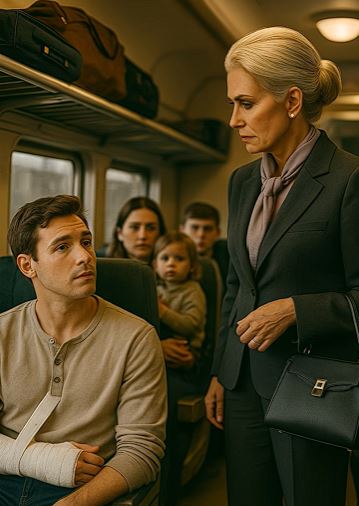
She tapped his shoulder like she owned the damn train. He was reading, earbuds in, legs tucked in tight—not sprawled, not rude. Just… there.
I was two rows down, watching. The woman had that kind of energy you feel before you hear—tight jaw, sunglasses indoors, the purse clutch of someone ready to escalate. She didn’t ask him to move. She demanded. Said, “That’s the priority seat. My back is killing me.”
Here’s the thing. That section wasn’t labeled priority. No signage. No visible injury. And this guy? Mid-thirties, long sleeves despite the summer heat, eyes sunken. Looked like he hadn’t slept in days. He politely said, “Sorry, I really need to sit too.”
She scoffed. Loud. “Unbelievable. Men think they’re entitled to everything.” Then—loud enough for everyone—“I hope you’re proud of yourself.”
That’s when he stood up. Slowly. Pulled off one earbud and rolled up his sleeve.
There was a fresh PICC line in his arm. Medical tape, bruising, the whole deal. He didn’t say a word—just let her look.
She went dead quiet. But the damage was done. Half the car was staring. And me? I wasn’t sure whether to feel fury or heartbreak because what happened next—
The woman sat down anyway. In his seat.
Didn’t apologize. Didn’t even make eye contact. She just dropped into the seat like she’d won something, like her pride wouldn’t let her back down.
The man—he just sighed. Not angry. Not dramatic. Just tired. You could feel it in his posture, like someone used to being misunderstood.
He didn’t argue. Just turned and walked further down the car, gripping the metal handrail with the same arm that had the PICC line. He leaned against the wall near the doors.
That should’ve been the end of it. But something about it gnawed at me.
I stood up. Walked over.
“Hey,” I said quietly. “You okay?”
He looked startled for a second, then nodded. “Yeah. Just… it’s fine.”
His voice was gravelly, like he hadn’t spoken in hours.
“I don’t think it’s fine,” I said. “That was awful.”
He smiled, faintly. “She’s probably having a rough day.”
“You’re literally undergoing treatment for something,” I said. “You don’t have to excuse that kind of behavior.”
He gave a little shrug. Then he said, “Bone marrow transplant. I just got discharged last week. Supposed to avoid crowded spaces, but my ride canceled. Needed to get to the clinic downtown.”
I blinked. “You shouldn’t even be on a train like this.”
He grinned again, still tired. “Yeah, well. Life’s messy.”
I nodded. Didn’t know what else to say. But then—get this—the woman, who had been scrolling on her phone like nothing happened, suddenly got a phone call.
She answered, loud again. “Yes, yes, I’m almost there. No, I told you, I had to get a seat. My back, you know.” Pause. “I know he made a scene. Some young guy tried to shame me. The world’s gone crazy.”
She was talking about me.
Now I was furious. I looked around the car. People were pretending not to listen, eyes darting to their laps. I couldn’t believe the silence.
And then… a tiny voice broke it.
“Mom,” said a teenage girl across the aisle, “you need to give him his seat back.”
We all turned. She looked maybe fifteen, nose in a paperback, earbuds dangling. She pulled one out.
“You’re always telling me to have empathy,” she said. “That man’s obviously sick.”
The woman’s face froze. You could see her trying to process the public call-out, trying to mask the shame.
“Sit somewhere else, Amira,” she snapped. “You don’t know the full story.”
But Amira didn’t budge. “I saw enough.”
There was silence again. Until the woman finally stood up. Wordless. She didn’t even look at the man. Just moved down the car, away from all of us.
Amira motioned to him. “Please. Sit.”
He hesitated. Then walked slowly back, gripping the pole.
As he eased down into the seat, I noticed how carefully he moved. Every joint seemed stiff. His hands trembled.
“Thank you,” he said to Amira.
She gave a little nod and went back to her book.
I ended up sitting across from him.
“My name’s Tariq,” he said eventually.
“Lina,” I said.
We talked quietly for the next few stops. He told me he was 38, had been a teacher before his diagnosis—acute leukemia. Single. Used to coach a high school debate team. Missed his students more than anything.
“I was gonna teach one more year,” he said. “Then the bloodwork happened.”
“Damn,” I said.
He smiled again. “Yeah. Damn is right.”
The train pulled into downtown, and we both got off. I helped him carry his tote bag. It was heavy—full of ice packs and meal replacement shakes.
As we crossed the platform, I noticed the same woman—still on the phone, now pacing. She looked over once. Her face tightened when she saw him walking upright beside me.
Maybe she expected him to be weaker. Or dead. I don’t know.
We left her behind.
Tariq thanked me again before we parted ways.
“People forget kindness,” he said. “But they remember cruelty. Weird how that works.”
I watched him disappear into the crowd, limping slightly.
And I figured that was it. A chance encounter. End of story.
But I kept thinking about him.
A week later, I called my friend who works at the clinic he mentioned. She remembered him. Said he came in once a week for follow-ups.
I asked if I could drop something off for him. She said yes.
So I packed a small bag—some crossword books, protein snacks, soft socks, and a card that said: You are seen. And you matter.
A week after that, I went again.
And again.
Eventually, Tariq and I started meeting for coffee after his appointments. He never asked for anything. He just liked to talk.
He told me about the class trip to D.C. he missed. The student who mailed him a postcard anyway. The dream he had to start a tutoring center for kids who struggled like he once did.
And little by little, color started coming back into his face.
Three months in, his doctor said his numbers looked good.
Six months in, he started teaching part-time at a local community center.
Nine months in, we were at a park bench, and he looked at me and said, “You know, I think you saved me a little that day.”
I laughed. “Nah. That was Amira.”
He smiled. “Both of you, maybe.”
And here’s the kicker.
One afternoon, we ran into Amira. She was at the library, volunteering. She looked older somehow, more grounded. She recognized us immediately.
“I told my mom about you,” she said. “She never admitted she was wrong, but she stopped taking the train for a while.”
Tariq nodded. “People learn when they’re ready.”
Amira tilted her head. “I think she felt ashamed. Which… maybe she needed to.”
We agreed. And we thanked her again.
And somewhere in that conversation, it became clear: a moment that seemed small—just a teenager speaking up—had changed more than one life.
Tariq now runs a tutoring program at the center full-time. And I help out on weekends. He and I aren’t dating, if you’re wondering. But we’re close.
Closer than I ever expected from a random train ride.
Sometimes the people who look the weakest are the ones holding on the hardest. And sometimes, the loudest people in the room are just masking their own hurt.
But kindness? Quiet kindness? That’s what echoes.
So if you see something—say something.
Not to get praise. But because someone like Tariq might be hanging on by a thread. And you might be the one who helps them hold on.
Like, share, and tag someone who believes small actions matter. You never know who needs that reminder today.