Give me his address.
My voice was ice. My assistant, Sarah, flinched.
Leo Garcia, the night janitor, was gone. Again. The third time this month, and the excuse was always the same.
Family emergency.
I didn’t buy it. In my world, you show up. You perform. Excuses are just a failure of will.
Thirty minutes later, my black sedan crawled down a street that didn’t feel like it was in the same city.
The pavement ended. The dirt began.
Barefoot kids stopped kicking a ball to stare. I felt their eyes on the flawless paint, the tinted windows, a spaceship landing in their world.
My world was glass towers and steel frames. This was something else entirely. My knuckles were white on the leather steering wheel.
I finally found it. A small blue house, the color of a faded sky. The number was barely visible.
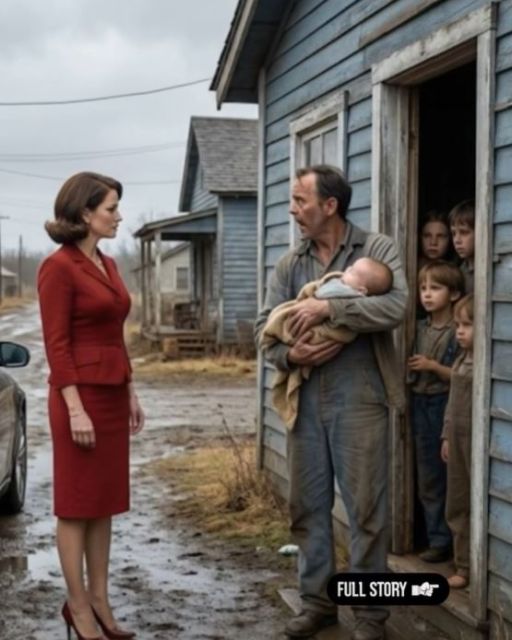
I stepped out of the cool, conditioned air. The heat hit me like a wall. My heels sank into the soft dirt.
I walked to the cracked wooden door. I was here to resolve a problem. That’s all.
I knocked. A sharp, impatient sound.
Nothing.
Then I heard it. A baby’s cry from inside. The frantic shuffle of feet.
The door creaked open.
And my entire reality tilted on its axis.
The man standing there was not the janitor I knew. Not the quiet, immaculate man who polished my marble floors.
This man was a ghost. His eyes were bruised with exhaustion. His shirt was stained.
In his arms, he cradled a tiny, fragile baby.
And hiding behind his legs, clinging to his pants, was another small child with wide, fearful eyes.
My authority, my anger, my carefully constructed world – it all just evaporated on that doorstep.
And for the first time in years, I had absolutely no idea what to say.
My mouth opened, then closed. The speech I’d rehearsed about responsibility and commitment felt like a foreign language.
Leo just stared at me, his face a mask of weary confusion. “Ms. Vance?” he finally whispered.
The baby in his arms let out a weak whimper. He started rocking him gently, a practiced, automatic motion.
The little girl behind him tightened her grip on his trousers. Her name, I would learn, was Sofia.
“May I come in?” The words came out softer than I intended.
He hesitated for a fraction of a second, then nodded, stepping back to let me pass.
I walked from the bright, harsh sunlight into a dim, cluttered room. It smelled of baby powder and something I couldn’t place. Worry, maybe.
The furniture was old and mismatched. A sofa with a worn blanket thrown over it, a small television with a cracked screen.
But it was clean. Impeccably clean.
It struck me then that this man cleaned my sterile, empty offices all night, only to come home to this overwhelming, beautiful chaos.
“I’m sorry about work,” he said, his voice low. “It’s just… Mateo…”
He looked down at the tiny bundle in his arms. Mateo.
“He gets these fevers,” Leo continued, his gaze still fixed on his son. “They come on so fast.”
I just nodded, my eyes scanning the room. I saw a stack of medical bills on a small kitchen table. I saw a hand-drawn picture taped to the wall, a smiling stick figure family.
“Your wife…?” I asked, trailing off, not sure how to phrase it.
A shadow passed over Leo’s face. It was an answer more profound than words.
“Maria passed away six months ago,” he said, his voice thick. “When Mateo was born.”
The air left my lungs. The entire foundation of my anger crumbled into dust.
My problem wasn’t an unreliable employee. My problem was that I was a fool.
Sofia peeked out from behind her father’s leg again, her thumb in her mouth. She looked at me with an unnerving, adult-like solemnity.
“Who are you?” she asked in a small voice.
“I’m… Leo’s boss,” I said, and the title felt absurd and meaningless.
“Are you going to fire my papa?”
The question was a tiny dagger to the heart. I looked from her worried face to Leo’s, who looked like he was bracing for the blow.
He expected it. He was a man drowning, and he expected me to be the one to finally push his head under the water.
“No,” I said, the word coming out firm and clear, surprising even myself. “No, I’m not going to fire your papa.”
A flicker of relief in his eyes was so potent it almost brought me to my knees.
I had come here to exert power. Now, all I wanted was to fix something. It was the same instinct, just aimed in a new direction.
“What do you need, Leo?” I asked. It was my default setting. Identify the problem, find the solution, write the check.
“I don’t need anything, Ms. Vance,” he said, his pride kicking in. “I just need a little more time. I’m trying to find a new babysitter.”
“The last one quit,” he explained, exhaustion creeping back into his voice. “She said Mateo’s episodes were too much for her.”
He walked over to a small bassinet in the corner and gently laid the sleeping baby down.
I saw it then. A small machine with a tube next to the bassinet. A nebulizer.
This wasn’t just about fevers. This was bigger. More complicated.
“His lungs aren’t strong,” Leo said, noticing where I was looking. “The doctors said he just needs time to grow. But when he gets sick, he can’t breathe.”
A family emergency.
The words echoed in my head, now heavy with a meaning I couldn’t have comprehended an hour ago.
This wasn’t an excuse. It was a terrifying, recurring reality.
“I can give you an advance,” I offered. “Pay for a nurse, maybe?”
He shook his head, a stubborn set to his jaw. “Thank you, but I can’t. I have to do this myself. For them.”
He looked at his children with a fierce, protective love that I recognized. It was the same drive I had for my company, for my success.
His empire was this tiny, faded blue house. His fortune was the two small heartbeats within its walls.
I stayed for another hour. I didn’t know why.
I watched Leo make Sofia a sandwich, cutting the crusts off with painstaking care.
I listened as he explained that his mother used to help, but she’d had a fall and was now in a nursing home two states away.
He never complained. He just stated the facts of his life as if he were reading a weather report.
My world of deadlines and profit margins felt a million miles away. It felt trivial.
As I was about to leave, my eyes landed on a small, cluttered shelf. It was a shrine of sorts.
There were a few candles, a small cross, and a framed photograph.
In the photo, a young woman with a vibrant, joyful smile stood next to Leo. She was beautiful. She was radiating life.
That must be Maria.
Next to the photo was something else. A laminated card, slightly faded, with a clip on the back.
My heart stopped.
It was an employee ID badge. For Vance Enterprises.
My company.
The name on the badge read Maria Garcia. Department: Accounting.
I couldn’t breathe. My mind raced, flipping through a mental archive of spreadsheets and personnel files.
Garcia. Garcia. Why did that feel so familiar?
Then it hit me like a physical blow. Five years ago. There was a major corporate restructuring. A consolidation.
We had laid off the entire accounting department from one of our smaller acquisitions. Over a hundred people.
It was a cold, calculated business decision. A move to streamline operations and maximize shareholder value.
I signed the order myself.
I remembered staring at the list of names, seeing them only as numbers, as redundancies. As necessary sacrifices for the health of the company.
Maria Garcia was on that list. She had been a number.
Now she was a smiling face in a photograph, a ghost in this house, a gaping hole in this family’s life.
I felt dizzy. I had to get out of there.
“I have to go,” I said abruptly. My voice was tight.
Leo looked concerned. “Ms. Vance, are you alright?”
“I’m fine,” I lied. “I’ll… I’ll call you, Leo. Don’t worry about work. Just take care of your family.”
I practically ran to my car, my hands shaking.
The drive back to my pristine, empty penthouse was a blur. The city lights seemed harsh and mocking.
I got to my office before sunrise. I didn’t need Sarah to find the files. I knew exactly where they were.
I pulled open the heavy drawer labeled “Archives” and found the box for the restructuring.
My hands trembled as I lifted the lid. There it was. The master list.
And there was her name. Maria Garcia. Termination effective June 1st. Reason: Departmental Redundancy.
I dug deeper. I found her employee file.
Start date. Positive performance reviews. A few commendations for her meticulous work.
And then I saw the note from her direct supervisor. “Maria has requested to discuss her upcoming maternity leave.” The request was dated May 15th.
Two weeks before I fired her.
She had been pregnant. Pregnant with Sofia.
We had terminated her employment, and with it, her health insurance, just when she and her unborn child needed it most.
I leaned back in my leather chair, the silence of my office pressing in on me.
I hadn’t just signed a piece of paper. I had thrown a stone into a pond, and the ripples had become a tidal wave that had wrecked this family.
I had prided myself on my foresight, my ability to see the big picture. But I had been blind.
I had been staring at the forest and had refused to see the trees. The people.
The next morning, I drove back to the little blue house. This time, I didn’t park with arrogance. I parked with humility.
I brought two bags of groceries and a teddy bear for Sofia. It felt like a hopelessly inadequate gesture.
Leo opened the door, looking surprised to see me again.
“Ms. Vance,” he said, confusion in his eyes.
“Please, Leo. Call me Eleanor.”
I stepped inside. The house was quiet. Mateo was sleeping peacefully. Sofia was coloring at the table.
I took a deep breath. “Leo, I have something I need to tell you.”
I sat at his small kitchen table, the very same one where his medical bills were piled high. And I told him everything.
I told him about the restructuring. I told him I was the one who signed the order.
I told him I had found Maria’s file. That I knew she had been pregnant.
I didn’t make excuses. I didn’t try to soften the blow. I just laid the ugly truth out between us.
When I was finished, he was silent for a long time. He just stared at his hands.
I expected anger. I expected yelling, accusations. I deserved them.
But when he finally looked up, his eyes weren’t full of rage. They were just filled with a profound, bottomless sadness.
“She loved that job,” he said quietly. “She was so proud to work there.”
He told me how hard it had been. How they had burned through their savings. How Maria had to take a part-time job with no benefits while she was pregnant.
He told me that the stress had been immense. That the doctors said it might have contributed to the complications when Mateo was born.
He didn’t say it was my fault. He didn’t have to.
“We did what we had to do,” he said, his voice heavy. “We always did.”
His lack of bitterness was more damning than any tirade. It was the quiet resignation of a good man who had been fighting a rigged game and didn’t even know who had written the rules.
“I can’t change what I did,” I said, my voice cracking. “But I can try to make it right.”
This time, when I offered to help, it wasn’t a transaction. It was an atonement.
The next day, my top lawyers were restructuring Leo’s debt. My personal doctor was at his house, examining Mateo.
We discovered Mateo had a treatable condition, but it required consistent care and a specialist his previous insurance wouldn’t cover. I made sure he got it.
I didn’t stop there. This was never just about Leo. It was about all the other Marias. All the names on all the lists.
Back at my company, I called a meeting with the entire board. I tore up our old policies.
I announced the creation of the Maria Garcia Foundation. A new branch of the company dedicated solely to employee welfare.
It would provide subsidized childcare, emergency medical grants, and flexible work schedules for parents and caregivers.
It wasn’t a charity. It was a pillar of the company. My board thought I was insane. My shareholders were furious.
I didn’t care. I was building something different now.
I offered Leo a new position. Not as a janitor, but as a consultant for the foundation. Who better to understand what employees actually needed?
He was hesitant at first, but I told him it was his chance to make sure no other family went through what his did. He accepted.
A year later, I found myself back on that same dirt road.
The little blue house was no longer faded. It had a fresh coat of paint. There was a small, neat garden out front.
I walked up the new wooden steps and knocked on the door.
Sofia threw it open, squealing with delight. “Eleanor!” She hugged my legs tightly.
I wasn’t “Ms. Vance” anymore.
Leo came out, smiling. He looked like a different man. The exhaustion was gone from his eyes, replaced by a calm confidence.
Mateo, now a healthy, babbling toddler, toddled over and reached for me. I lifted him into my arms, his small hand patting my cheek.
We spent the afternoon in the backyard. I didn’t wear heels. I wore sneakers.
We ate sandwiches, and I didn’t even notice if the crusts were cut off.
Leo told me about the families the foundation had helped. About the single mother who could now afford treatment for her son. About the employee who could take time off to care for his aging father without fear of losing his job.
He was a natural leader. He had turned his pain into a purpose.
As the sun began to set, casting a warm glow over the yard, I looked at this family. This beautiful, resilient family that I had almost destroyed.
I had spent my entire life accumulating wealth, building an empire of glass and steel. I thought that was my legacy.
But I was wrong.
My legacy wasn’t the skyscraper with my name on it. It was the sound of a healthy child’s laughter. It was the peace of mind of a father who could provide for his family. It was the quiet knowledge that a simple act of seeing, truly seeing another person, could change the world.
I had gone to that little blue house to solve a business problem. Instead, I found my own humanity waiting for me on the doorstep.
I learned that the most valuable assets we have are not listed on any stock exchange. They are empathy, compassion, and the courage to right our own wrongs. True strength isn’t about never falling; it’s about how you choose to lift others up.