I went into a flower shop to buy some for my wife and daughter. I had just chosen one when I noticed an old man near the entrance.
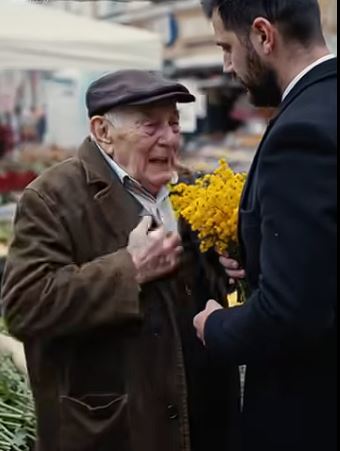
He was wearing an old-fashioned overcoat, ironed striped trousers, clean shoes, and under his coat — a simple shirt.
He didn’t look like a homeless person. Just a poor man. But with a surprisingly neat and dignified appearance.
A young saleswoman approached him. She didn’t even look at him, she just said sharply:
— What are you doing here, old man? You’re disturbing the customers.
The old man didn’t protest. He just said quietly:
— Excuse me, young lady… How much does a sprig of mimosa cost?
The girl sighed, irritated:
— What, have you gone crazy? You obviously don’t have any money. What’s the point of asking?
Then, the old man took out three crumpled ten-lei bills from his pocket and asked in a timid voice:
— Maybe you can find something for thirty lei?
The saleswoman looked at the money, smiled contemptuously, then took a wilted mimosa twig from a basket — broken, pale.
— No, take this. And now leave.
The old man took the twig carefully and tried to straighten it slightly. At that moment, I saw a tear roll down his cheek, and his face was shadowed by such deep pain that my heart clenched.
I was hurt by the injustice that had been done to him, so I decided to teach the saleswoman a lesson she would never forget.
I stepped forward, not bothering to hide my anger.
“Excuse me,” I said loudly, so she’d have to look up. “I’d like to speak to the manager.”
She blinked at me, surprised and suddenly polite. “He’s not here right now,” she muttered.
“Then I’ll wait,” I replied, folding my arms. “And in the meantime, I’ll be buying every single flower in this shop.”
She stared at me like I’d grown two heads. “What?”
“You heard me,” I said. “Wrap everything. Every mimosa, every rose, every lily. Everything.”
She gave a nervous laugh. “Sir, we have… thousands of lei worth of flowers.”
“I’m aware.”
The old man looked at me, alarmed. “Please… you don’t have to do this because of me.”
I turned to him and smiled. “I’m not doing this because of you. I’m doing it for you.”
The girl was now scrambling to calculate totals, her fingers shaking as she entered numbers into the register. I handed her my credit card, not even blinking.
I asked the old man gently, “What’s your name, sir?”
He hesitated for a moment before answering, “Matei.”
“Alright, Matei,” I said, handing him the brightest, freshest bouquet I could find. “This one’s on me. Actually, all of them are.”
His lips quivered. “Why would you do this for a stranger?”
I shrugged. “Because no one deserves to be treated like you were just now. And I’m hoping you’ll help me with one more thing.”
He looked at me, curious. “What’s that?”
“Hand out these flowers with me.”
Matei’s eyes widened. “You want me to help you give them away?”
I nodded. “Exactly. Let’s go brighten people’s days.”
We carried bundles out of the store. I left a handful on the counter, looked the saleswoman dead in the eye, and said, “This is what kindness looks like. You might want to learn.”
Then I walked out with Matei beside me, his eyes still misty, his thin hands wrapped around those flowers like they were treasure.
We went to a nearby park and started handing them out — to mothers pushing strollers, to tired-looking students, to elderly couples on benches.
People were confused at first. But when they realized we didn’t want money or anything in return, they lit up. It was like watching a wave of light ripple across the city.
Matei was suddenly transformed. His shoulders straightened, his face opened up. He told each person a little story — something warm, something personal — about why flowers matter.
I found myself listening more than talking. There was wisdom in his words, quiet poetry in how he spoke.
After about an hour, we sat down on a bench, both of us holding the last few sprigs.
“You didn’t have to do any of this,” he said again. “You don’t even know me.”
I smiled. “Maybe not. But maybe I needed this too.”
He gave me a knowing look. “Rough day?”
I hesitated. Then I said, “Wife’s recovering from surgery. Daughter’s been distant lately. Life’s been… heavy.”
Matei nodded slowly. “I lost my wife last year,” he said quietly. “Mimosa was her favorite flower. Every year on our anniversary, I’d bring her one. Nothing fancy. Just a sprig. That’s all she ever wanted.”
I swallowed hard. “That’s why you were there today.”
He nodded, looking away. “Today would’ve been our forty-sixth anniversary.”
There was silence between us. The kind that says more than words ever could.
I reached into the bag and gave him the last mimosa — a fresh, full one. “Then this one’s from her. Or to her. However you want to see it.”
He took it with trembling hands. “Thank you,” he whispered.
As we sat quietly, a little boy walked up with his mother. The boy couldn’t have been more than five. He pointed at Matei and asked his mom, “Is he Santa?”
His mom smiled, embarrassed. “No, sweetheart, he’s just a kind man.”
The boy looked up at Matei. “Can I have a flower too?”
Matei smiled — a full, glowing smile — and handed him the mimosa. “Of course, little one. But you have to promise to give it to someone you love.”
The boy nodded seriously, then ran off to his mom, flower in hand.
We watched them go, both quiet again.
I thought that was the end of it.
But a few days later, I got a call on my office line — I’m a regional director for a logistics company, and usually the calls are dull.
But this one wasn’t.
“Is this Mr. Raul Ilinca?” the voice asked.
“Yes,” I said.
“This is Danica from Bucharest Local News. We heard a story about you and a man named Matei giving away flowers in the park. We’d like to do a small piece on it.”
I was stunned. “Wait — how did you hear about it?”
“Apparently, one of the women you gave flowers to works in media. She shared the story on her blog. It’s gone viral.”
Sure enough, when I checked, there it was. A post titled “A Flower, A Stranger, And A Lesson I Didn’t Expect.”
Over 200,000 shares in two days.
I agreed to the interview but told them I wanted Matei to be the real focus.
They found him — apparently he was living in a small rented room, barely making ends meet on a meager pension.
The interview was emotional. He spoke about his wife, about the mimosa, and how he never expected that one small moment would bring all this attention.
Donations started pouring in. Someone set up a fund for him. Within a week, Matei had enough money to live comfortably for the rest of his life.
He used part of it to sponsor flower deliveries for elderly widows around the city — anonymously.
“I don’t want them to feel forgotten,” he said. “Even if they don’t know who sent them.”
I saw the saleswoman from the flower shop again, actually.
She came to one of the interviews, standing off to the side. I almost didn’t recognize her. No makeup, a bit pale, eyes lowered.
After it ended, she approached me.
“I wanted to say I’m sorry,” she said. “I was having a bad week… but that’s no excuse.”
I nodded. “We all mess up. What matters is what you do after.”
She bit her lip. “I quit that job. It wasn’t me. I’m studying to be a caregiver now. For the elderly.”
That hit me harder than I expected.
“Good for you,” I said sincerely.
She paused before walking away. “Thank you. For showing me how much a flower can mean.”
Matei and I kept in touch after that.
Every year, on his anniversary, we’d go buy mimosa together — the freshest ones we could find — and leave them anonymously at women’s shelters, hospitals, and retirement homes.
People always wondered where they came from.
We never said.
Eventually, Matei passed. Peacefully, in his sleep, just a few days after his 91st birthday.
At his funeral, there were more flowers than I’d ever seen in my life. People came from all over — people who’d received those anonymous bouquets, people who’d read the blog post, people who never even met him but felt like they had.
I gave the eulogy.
I told them about that first day. About the wilted mimosa. About how sometimes, the smallest act of dignity can ripple into something far bigger than we imagine.
And I ended with this:
“Don’t wait for the world to be kind. Start with yourself. A single flower can change a day. A single choice can change a life.”
To this day, whenever I see mimosa, I smile.
Because I know that somewhere, somehow, Matei’s still handing them out — reminding people that kindness doesn’t cost much, but it means everything.
And if you’re ever wondering what to do with your pain, your grief, or even your anger… give something. Anything. Especially when it seems like no one’s watching.
You never know whose life you might touch.
Please share this story if it moved you, and don’t forget to like — because sometimes, we all need a reminder that a little kindness can go a long, long way.