The smile on my brother’s face died right there, under the fluorescent lights of the city law office.
It slid off like water, leaving a tight, pale mask I hadn’t seen before.
He was staring at a second folder. One he didn’t know existed.
But I’m getting ahead of myself.
To understand that moment, you have to understand the one a week earlier, in the hushed hallway of a church. I was still in my funeral dress. My brother, David, cornered me by the coat rack.
He leaned in close, a conspirator’s whisper.
“The house is mine,” he said. Not a question. “You have a week to get your things.”
I’d just spent two years in that house turning my life upside down. Two years of night shifts and doctor’s visits. Two years of watching my mother fade while my savings account did the same.
David visited three times. Always in a suit. Always checking his watch.
“We haven’t read the will,” I said, my voice feeling thin.
“A formality,” he snapped. “Sons inherit. You know Dad. Be grateful I’m not just throwing your stuff in the street.”
He wasn’t bluffing.
Two days later, my key scraped against the lock. It didn’t turn.
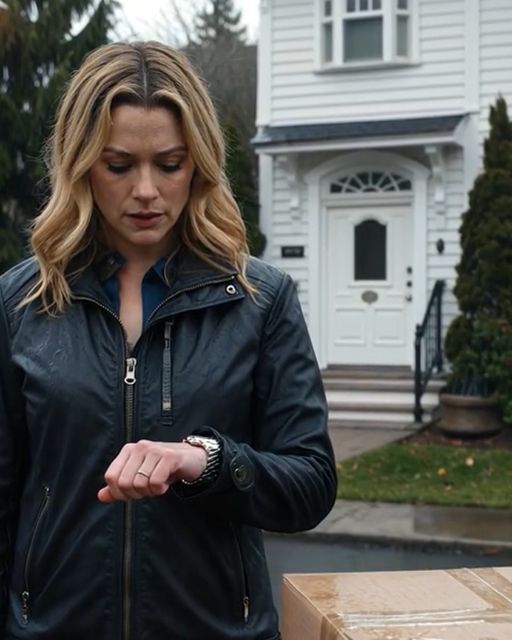
That cold New England rain was coming down, the kind that soaks you to the bone in seconds. I stood on the porch, a ghost at my own front door.
Then I saw the boxes.
Stacked by the garage, the cardboard already soft and sagging with rain. My clothes. My books. The recipe cards in Mom’s familiar scrawl.
My whole life, dissolving in the driveway.
Through the living room window, I saw his wife, Claire. She was holding a glass of wine, smiling at her phone. She met my eyes, gave a tiny, perfect little lift of her glass, and turned away.
I called him. His voice was ready. Practiced.
“Legally, it’s my property,” he said. “Twenty-four hours. Then it all goes to the dump.”
“David, I grew up there.”
“And now you don’t,” he said. “Maybe you should have built a life instead of playing nurse.”
He hung up.
I sank down onto the wet grass next to the ruins of my last two years. My fingers found the one thing still dry in my pocket. Mom’s old watch.
That’s when I felt it.
An envelope tucked inside a pair of her gardening gloves. Thick cream paper. My name written in her shaky hand.
For Anna, when the time comes.
I didn’t open it. Not there. I called my supervisor from the nursing home. She came in her old minivan, no questions asked, and took me and my few salvageable boxes back to her apartment.
Hours later, wrapped in a stranger’s blanket, I broke the seal.
Her letter told me she saw everything. The way our father looked at my brother like an investment and me like an expense.
But she wasn’t helpless. She had made a plan.
There was a name. A woman in a downtown office. “She has everything ready,” Mom wrote. “The arrangements I couldn’t give you while I was here.”
Then, one last line.
“Whatever your brother says, do not sign anything.”
A few days later, I was sitting in that office.
The lawyer, Ms. Roth, told me my mother had been her client for eight years. Secret meetings. Careful planning for this exact day. She told me to stay quiet at the reading. Let David have his moment.
He called the night before. His voice was suddenly warm. Oily.
He wanted to “clear the air.” He had an offer. Ten thousand dollars, cash. All I had to do was sign a paper saying I wouldn’t contest the estate.
Ten thousand dollars. For two years of my life. For every night I slept in a chair by her bed while he slept in his big house in a nice suburb.
“No,” I said. “I’ll see you tomorrow.”
The warmth vanished. “You’re making a mistake,” he hissed. “You’ll walk away with nothing.”
Which brings us back to that long wooden table.
David sat there, smug in his perfect suit. Claire beside him, scrolling on her phone. My grandmother was there, too. A surprise. She took the seat next to me.
Ms. Roth opened the first folder.
It was my father’s will. Exactly as David had always said it would be. The house, the assets, everything to his son.
He shot me a look. A tiny, triumphant smirk. The look that said, “I told you so.”
Then Ms. Roth closed the folder.
She reached for a second one. A slim, identical folder with my mother’s name on it.
She placed it in the center of the table.
David froze.
“Separate?” he stammered. “She didn’t have anything separate. It was all joint.”
Ms. Roth didn’t answer him. She slid a single, handwritten page from the folder and smoothed it flat on the wood.
My grandmother’s hand found mine under the table.
“Your mother asked that I read her own words first,” the lawyer said, her voice cutting through the silence.
She lifted the page, took a breath, and began to read.
“To my children, David and Anna,” the voice began, but the words were my mother’s. I could hear them in her quiet, steady tone.
“David, my son. I have always loved you. But love is not blindness.”
David shifted in his chair. A flicker of annoyance crossed his face.
“I watched you grow up believing the world owed you something simply for being you. Your father encouraged this. He saw his own ambition in you, and in his eyes, that made you worthy of everything.”
“This is ridiculous,” David muttered, looking at Ms. Roth.
The lawyer didn’t pause. “He saw his legacy in brick and mortar, in bank accounts and titles. He never understood that a true legacy is what you leave behind in people’s hearts.”
The letter continued. “Anna, my daughter. My quiet, steady girl. I saw you. I saw you when you gave up your apartment to move home. I saw you learning to change my bandages. I saw you reading to me when my eyes grew too tired.”
Tears pricked at my own eyes. I squeezed my grandmother’s hand.
“I am sorry I was not stronger. Sorry I could not change your father’s mind or shield you from his coldness. But a quiet life does not mean a powerless one. I did what I could, in the ways I could.”
“And so, I made my own arrangements. Not out of spite, but out of a deep and abiding need for fairness. For balance.”
The letter ended. “What is right is what is right. I trust you both to find your way.”
Ms. Roth placed the letter down. The room was utterly still.
David looked from the letter to Ms. Roth, his jaw working. “Fine. A sentimental note. What does that have to do with anything? The estate is mine.”
“Not entirely,” Ms. Roth said calmly. She opened the second folder. “Your mother had her own estate.”
Claire finally looked up from her phone. “Her own? She was a housewife. She had nothing.”
My grandmother spoke then, her voice frail but sharp as a needle. “My daughter received an inheritance when her father, my husband, passed away. Your father, David, convinced her to put most of it into joint accounts. But she was smarter than he gave her credit for. She kept a portion for herself.”
David laughed, a short, ugly bark. “What? A few thousand in a savings account? Anna can have it. My gift.”
“Not quite,” Ms. Roth said, sliding a document across the table toward him. “It appears your mother used her inheritance twenty years ago to purchase the plot of land your house is built on.”
The silence in the room became a ringing in my ears.
“The deed to the one-acre lot at 45 Willow Creek Lane is in her name alone,” the lawyer clarified. “And now, according to her will, it belongs solely to Anna.”
David stared at the paper. His face went from pale to a blotchy, dangerous red.
“The land? That’s impossible. The property is one thing.”
“Indeed,” Ms. Roth agreed. “You, David, have inherited a three-bedroom house. And you, Anna, have inherited the ground it sits on. As well as the driveway, the yard, and all legal access points.”
The implication sank in.
David owned a building he couldn’t get to. He couldn’t sell it, because who would buy a house without the land? He couldn’t live in it without trespassing on my property.
Claire’s wine-glass-lifting smirk was gone, replaced by a slack-jawed panic. “So we own a box? A useless box?”
“A very well-built box, I’m sure,” Ms. Roth said mildly.
David shot to his feet. The chair scraped loudly against the floor.
“This is a joke! A vindictive, crazy joke! We’ll sue. We’ll fight this in court!”
“You are welcome to try,” the lawyer said, unfazed. “Your mother’s paperwork is impeccable. The deed was legally recorded two decades ago. It will stand up to any scrutiny.”
He turned on me then, his eyes burning with a fury I had never seen. “You did this. You manipulated her!”
“I didn’t even know,” I whispered, the truth sounding weak even to my own ears.
“Your mother was a very private, very determined woman,” my grandmother said, her voice anchoring me. “She saw this day coming for a very long time.”
“So what now?” Claire asked, her voice shrill. “We have a house we can’t use?”
“I’m sure Anna would be willing to discuss leasing you the land,” Ms. Roth suggested. “For a fair market price, of course.”
The thought was absurd. David, my proud, dismissive brother, paying me rent just to walk up his own driveway.
He slammed his hand on the table. “Never. I’ll tear the house down before I give her a single penny!”
“That would also be difficult,” Ms. Roth continued, her composure a perfect wall of granite. “As you would need to bring the demolition equipment onto Anna’s land to do so.”
Every door was closed. Every escape route was blocked. My quiet, gentle mother had built a perfect, inescapable cage of justice.
David stared at me, his face a mess of confusion and hate. The confident man who had thrown my life into the rain was gone. In his place was a cornered animal.
But my mother wasn’t finished.
Ms. Roth cleared her throat. “There is one more item in your mother’s estate.”
David sank back into his chair, looking defeated. “What else? The garden shed? The birdbath?”
“The mortgage,” the lawyer said simply.
A different kind of confusion settled on the room. “The mortgage was paid off years ago,” David said, shaking his head.
“The first mortgage, yes,” Ms. Roth agreed. “But records show a second mortgage was taken out against the property ten years ago. A substantial one.”
David went still. I could see the memory dawning in his eyes.
“It was for your first business, David,” my grandmother said softly. “The one that failed. Your father co-signed the loan. He was so sure you were the next big thing.”
“The company went under,” David mumbled. “The debt was settled.”
“It was not,” Ms. Roth corrected, sliding a second set of documents over. “When your business collapsed and you defaulted, the bank was preparing to foreclose. Your father’s pride wouldn’t let that happen. But he didn’t have the liquid assets to cover the debt.”
She let the words hang in the air.
“So your mother stepped in,” she finished. “She used the largest portion of her inheritance to buy the debt from the bank. She became the lien holder. She did it to save your father the humiliation, and to save the family home.”
The documents sat on the table. Legal, binding, and utterly devastating.
David didn’t own the house he had been so proud of. He had inherited a shell. A building on land that wasn’t his, carrying a massive debt that was now owed, through the estate, directly to me.
He didn’t speak. He just stared at the papers, at the proof of his own failure and my mother’s silent sacrifice. The sacrifice he had never known about, never been grateful for.
The money his father had secured for him had nearly cost them everything. The money his mother had saved, the mother he ignored, was what had saved him. And now, that same act of quiet love was his undoing.
Claire made a small, choking sound. “How much? How much is the debt?”
Ms. Roth named the figure. It was staggering. It was more than the house was worth.
David finally looked at me. The hatred was gone. The fury was gone. All that was left was a hollow, pleading emptiness. The look of a man who had lost everything, and was only just now realizing what it was all worth.
“Anna,” he said, and my name was a broken thing in his mouth.
I thought about the boxes in the rain. I thought about him telling me I should have “built a life.” I thought about his smug smirk just a few minutes earlier.
I could have destroyed him. I could have taken the house, the land, everything. I could have called in the debt and left him with nothing, just as he had planned to do to me.
But I looked at my grandmother, and I thought of my mother’s letter. “Not out of spite, but out of a deep and abiding need for fairness.”
My mother hadn’t done this for revenge. She had done it to give me a choice. To give me a voice.
I took a deep breath. “I don’t want the money, David.”
He flinched, as if expecting a blow.
“I don’t want the house, or the land,” I continued, my voice clearer and stronger than it had been in years.
Claire looked at me with disbelief. Hope and suspicion warring on her face.
“Here is what is going to happen,” I said, looking directly at my brother. “You are going to sell the house.”
He started to protest, but I held up a hand.
“I will sign over the deed to the land for one dollar. I will forgive the entire mortgage debt. You will walk away with the full market value of the home, free and clear.”
David stared at me, uncomprehending. “Why?”
“Because that money isn’t for you,” I said. “Every penny from the sale of that house is going to be donated to the Hillside Gardens Nursing Home. It will be used to build a new memory care wing, dedicated in Mom’s name.”
The place he had visited three times. The place where I had spent hundreds of nights.
“And that’s not all,” I said. “You and Claire will volunteer there. One hundred hours each. You’ll sit with the residents. You’ll read to them. You’ll learn their names. You will see what a real legacy looks like.”
For the first time, Claire looked truly horrified. Not at the loss of the money, but at the prospect of the work.
David just looked broken. He nodded slowly, not meeting my eyes. “Okay, Anna. Okay.”
Six months later, I stood on a patch of fresh sod, watching a small crowd applaud as a red ribbon was cut. The new “Eleanor Miller Serenity Wing” was officially open.
I saw my grandmother, smiling, sitting in a new wheelchair bought with funds from the donation.
And in the doorway, I saw David. He wasn’t wearing a suit. He was in jeans and a simple shirt, pushing a resident in a wheelchair, listening patiently to a long, rambling story. He looked up and our eyes met across the lawn.
He gave me a small, hesitant nod. It wasn’t an apology, not yet. But it was a start.
I didn’t need the house or the money. My mother had left me something far more valuable. She had left me my strength, my dignity, and the quiet power of her love. True inheritance isn’t something you can count or spend. It’s the character and kindness passed down to you, a quiet plan for a better life, waiting for you when the time comes.