I heard the sound before I saw the blood.
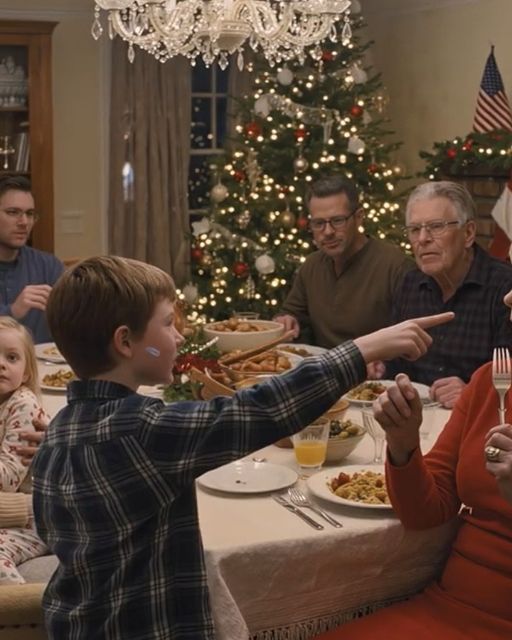
A sharp crack, then a sick, muffled thud. It was my daughter’s head hitting the edge of their long mahogany dining table.
My mother-in-law’s hand was still twisted in her hair.
Ava collapsed. A small, crumpled heap on the glossy hardwood floor, right in front of the perfect Christmas tree with its twinkling lights. She was four.
A red streak bloomed across the pristine white tablecloth.
My father-in-law raised his glass of scotch. “That’s what happens when you’re careless.”
My husband actually laughed. A small, nervous sound.
“Mom’s right,” he said. “She needs to be more careful.”
Around that table, the knives and forks kept moving. His aunt asked for the gravy. His brother sliced into a piece of prime rib.
No one even pushed their chair back.
I was on my knees in a puddle of ice water, pressing dinner napkins to my daughter’s bleeding forehead. The world had gone silent except for her small, hiccuping sobs.
Then another sound cut through the quiet.
A wooden chair scraping violently against the floor.
It was my son, Leo. He was seven. His fists were clenched so tight his knuckles were white.
His voice sliced through the faint Christmas music.
“Grandma, stop,” he said. “I saw you push her.”
Every fork froze. Every fake smile dropped.
The air in the room turned to glass.
My husband went pale. My mother-in-law’s face drained of all color, a pasty white her expensive makeup couldn’t hide.
Leo didn’t stop.
“You did it on purpose,” he said, his small voice echoing in the sudden, vast silence. “Just like you did to me on the stairs at Thanksgiving.”
He looked right at her.
“You told me you’d do it to Ava if I ever told anyone about the bruises.”
Hours later, the only holiday lights I saw were the cold, fluorescent tubes humming above us in the emergency room.
I held my daughter while a social worker gently asked my son to tell her everything, one more time.
That was the night their perfect family shattered.
And the night the woman I used to be quietly died.
Ava got five stitches just above her eyebrow. The doctor, a kind woman with tired eyes, told me it would likely leave a scar.
She looked at me, then at Leo, who was sitting ramrod straight in a plastic chair, his gaze fixed on his sister.
“He’s a very brave boy,” she said, her voice low.
I just nodded, my throat too tight to form words.
My husband, Mark, finally showed up as they were putting the last butterfly bandage on Ava’s cut.
He didn’t look at me. He looked at the social worker’s business card on the small table beside me.
“You called them?” he whispered, his voice laced with a fury I knew was not his own. It was his mother’s.
“She pushed our daughter into a table, Mark. Leo told us everything.”
“He’s a child. He exaggerates. You’re blowing this all out of proportion.”
I looked at him then, truly looked at the man I had married. I saw the fear in his eyes, the deep, ingrained terror of his own mother.
I saw the boy he must have been, the one who learned to laugh when he was hurt, to agree when he was wronged.
In that moment, I didn’t feel pity. I felt nothing but a cold, clear certainty.
“Get out,” I said.
He flinched as if I’d slapped him. “What? We need to go home. We need to fix this.”
“No,” I said, pulling a sleeping Ava closer. “We are not going back there. You can fix it with your mother. We’re done.”
That night, I didn’t go back to our house, the one his parents owned. I went to a cheap motel off the highway with a flickering neon sign.
I put my sleeping children into the stiff, clean bed. Ava had a small, purple bruise blooming around her stitches.
Leo didn’t sleep. He just watched me, his face old and serious.
“Is Dad mad at me?” he asked.
I sat on the edge of the bed and pulled him into my arms. He felt so small.
“No, sweet boy. He’s not mad at you. The grown-ups are just confused right now.”
“I’m not confused,” he said into my shoulder. “Grandma is mean.”
I held him tighter. “I know. And we’re not going to see her anymore.”
The next morning, I used the last of the money in my account to see a lawyer. A woman named Susan, recommended by the social worker.
She had a no-nonsense office and didn’t waste time on pleasantries.
I told her everything. The Christmases, the ‘accidents,’ the casual cruelty disguised as discipline. The way they all looked the other way.
She listened, taking notes without a flicker of emotion on her face.
“They have money,” she said when I finished. “And they will use it to paint you as an unstable, vindictive liar.”
My heart sank. “So what do we do?”
“We fight,” she said, a small, grim smile touching her lips. “We fight with the truth. It’s all we have.”
The calls started that afternoon. First from Mark, pleading.
“Come home. Mom is beside herself. She says you’ve stolen her grandchildren.”
Then from his father, Richard, his voice cold and commanding.
“You are making a grave mistake. You will regret this.”
The worst was from my mother-in-law, Eleanor. She didn’t shout. Her voice was syrupy sweet, dripping with venom.
“You poor, confused girl. Don’t you worry. We’ll get you the help you need. And we’ll take care of the children until you’re well again.”
The threat was clear. They were going to try and take my children.
I found a small, two-bedroom apartment in a town thirty miles away. It smelled of old paint and damp carpets.
It was nothing like the pristine, sterile house I’d left, but when I unlocked the door, it felt like a palace. It was ours. It was safe.
We had two folding chairs, a mattress on the floor for me, and one for the kids to share. We ate macaroni and cheese off paper plates.
For the first time in years, I could breathe.
Ava started having nightmares. She would wake up screaming, her hands flying to her head.
Leo grew quieter. He stopped talking about what happened. Instead, he drew pictures. Dark, scribbled pictures of a big house with a monster inside.
I enrolled him in therapy with a child psychologist. Me, I found my therapy in late-night job searches and budgeting.
I was no longer the woman who hosted perfect dinner parties. I was the woman who learned to fix a running toilet from a YouTube video at 2 a.m.
The legal battle was a slow, grinding machine. They filed for emergency custody, citing my ‘erratic behavior’ and ‘parental alienation.’
They had testimonials from family friends, his aunt, his brother. All of them painting a picture of a perfect family torn apart by a hysterical woman.
My husband’s sworn affidavit was the worst. It described me as “prone to emotional outbursts” and “easily influenced.”
He claimed Leo’s story was something I had coached him to say.
Reading it felt like swallowing glass. This was the man who had once vowed to protect me.
Susan was my rock. “It’s standard procedure for them,” she said. “Throw mud and hope some of it sticks. We just keep telling the truth.”
But it was my son’s word against an entire family’s. A family with deep pockets and a respected name in their community.
I started to feel the walls closing in. The fear was a constant, sour taste in my mouth.
One evening, about two months into our new life, a plain manila envelope was slipped under my apartment door.
There was no return address. My hands trembled as I opened it.
Inside was a single photograph. It was old, faded from the seventies.
A young boy, no older than Leo, sat on a set of stairs. He had a cast on his arm and a massive black eye.
He was smiling for the camera, a painful, forced smile.
I recognized him instantly. It was my husband, Mark.
On the back, written in shaky, spidery handwriting, were three words.
“The bottom stair.”
I remembered a story Eleanor always told at parties, a funny little anecdote.
It was about how clumsy Mark was as a child, how he’d tripped and fallen down the stairs, breaking his arm. “Such a little drama queen, even then,” she’d laugh.
The bottom stair. Just like Leo at Thanksgiving.
My blood ran cold. This wasn’t just about me and my children. This was a pattern. A cycle stretching back decades.
But who had sent it?
The answer came two days later, with a phone call from a blocked number.
“Meet me,” a voice rasped. It was thin and weak, but I knew it instantly.
It was my father-in-law, Richard.
Susan advised against it, but I knew I had to go. We met at a crowded, noisy coffee shop halfway between our towns.
The man who sat across from me was a shadow of the one who’d raised his scotch glass as my daughter bled on his floor.
He looked smaller, diminished. The tailored suit hung off his frame. His hands shook as he gripped a paper cup of coffee.
“I can’t let her do it again,” he said, not looking at me. “I watched her do it to Mark. I watched her break his spirit, piece by piece.”
“Why?” I whispered. “Why did you let her?”
He finally met my gaze. His eyes were filled with a profound, soul-deep shame.
“Money,” he said, the word tasting like ash. “Her father left her everything. The business, the house, the accounts. On the condition that she control it all.”
He explained that his life, their life, was an allowance she gave him. He was a prisoner in a gilded cage.
“I became a coward,” he said. “I learned to look away. I told myself it was for Mark, to give him a good life. But it was for me. For my comfort.”
He pushed a small, worn leather journal across the table.
“I started writing things down years ago. I don’t even know why. Just to prove to myself I wasn’t crazy.”
His voice broke. “When I saw your boy… when I heard his voice cut through the silence in that room… it was the voice I should have had, forty years ago.”
“That night,” he continued, “I went into her locked office. I knew where she kept the old photo albums.”
He had sent the picture.
“It’s not enough,” I said, my voice hard. “A photo and a diary? They’ll say you’re a bitter old man trying to get her money.”
“I know,” he said, pulling another envelope from his coat. “Which is why I also copied these.”
He slid the envelope to me. It contained financial records. Statements from a hidden account.
Large, regular payments made to a specific doctor. A child psychiatrist.
“She took Mark to him for years,” Richard explained. “To ‘fix’ his behavioral problems. To ‘correct’ his stories. The doctor was on her payroll. He diagnosed Mark with all sorts of things, medicated him. It was all to discredit him, to make sure no one would ever believe him if he spoke out.”
This was the twist. It wasn’t just about physical cruelty. It was about systematic psychological abuse, documented and paid for.
The deposition was held in a sterile conference room. Eleanor sat across from me, looking regal and composed. Her lawyer was slick and aggressive.
Mark sat beside her, looking like a ghost.
They questioned me for hours, twisting my words, painting me as a scorned wife looking for a payday.
Then it was Susan’s turn. She presented the photograph of young Mark.
Eleanor scoffed. “He was a clumsy boy. It was an accident.”
Then Susan produced Richard’s journal. She read an entry detailing the ‘accident’ with chilling precision.
Eleanor’s lawyer objected, calling it hearsay.
“Then let’s talk about Dr. Alistair Finch,” Susan said calmly, producing the financial statements.
She laid out the evidence of the payments, the decades-long conspiracy to silence a child by labeling him mentally ill.
She looked directly at my husband. “Mark, do you remember Dr. Finch?”
Something in Mark’s face finally, irrevocably broke. A lifetime of buried memories, of being told he was wrong, that his reality wasn’t real, came flooding to the surface.
He looked at his mother, but not with fear. He looked at her with the dawning horror of a man seeing his captor clearly for the very first time.
He stood up, his chair scraping loudly against the floor.
“It was her,” he said, his voice shaking but clear. “She pushed me. She always pushed me.”
Eleanor’s perfect mask crumbled into a rictus of fury. The game was over.
The custody case was dropped. I was granted a swift divorce and more than enough support to give my children a stable life.
Eleanor’s empire of lies collapsed. Faced with a lawsuit from a now-free Mark and public disgrace, her perfect world imploded.
Our new life is quiet. We have a small house with a little backyard.
Ava’s scar is a faint, silvery line now. She calls it her ‘brave mark.’
Leo is seven again. He plays, he laughs, he gets into trouble for tracking mud in the house. The dark scribbles are gone, replaced with drawings of superheroes and our little family.
Richard comes to visit sometimes. He and Leo are building a birdhouse. He’s teaching my son how to use a hammer, how to be gentle and strong at the same time. He’s trying to heal, one small act of kindness at a time.
Mark is in therapy. He calls every week. The conversations are stilted, difficult. He is a man dismantling his entire life and trying to rebuild it from the rubble. I don’t know if he will ever be a part of our lives, but for the first time, he’s trying to be a man his children can one day respect.
Sometimes, at night, I think about that Christmas dinner. I think about the woman I was, the one who kept quiet to keep the peace.
She had to die so that I could live. So my children could live.
The greatest lesson I learned is that silence is not peace. It is the soil where abuse grows. Truth, even when spoken by the smallest voice, is a light powerful enough to burn down the darkest forest and let the sun shine in. It’s a messy, painful, beautiful light. And it’s the only thing that can ever truly set you free.