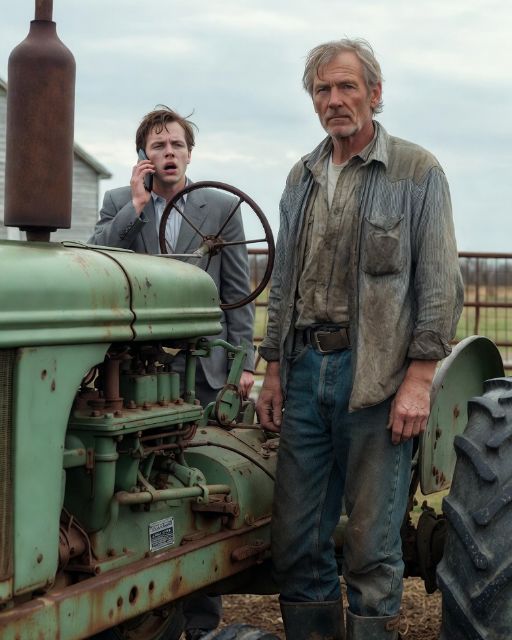
This man in a cheap suit came to our farm today. He wanted the land for some new housing project. My dad, Frank, just stood there in his muddy boots, listening. The man sneered at our old house, the rusty fence. He offered a number so low it was an insult.
“Take it, old man,” the lawyer said. “Or we’ll take it in court. What’s a dirt-kicker like you going to do?”
My dad didn’t say a word. He just walked over to his old green tractor, the one he’s had for forty years. He wiped a patch of grease off the engine block with his thumb, showing the small, metal plate bolted there. The lawyer squinted to read the faded words stamped into it.
His face went white.
He pulled out his phone, his hands shaking. “Sir,” he stammered, “I’m at the Miller farm… yes… the tractor. The plate on the engine says ‘Property Of…’.” The lawyer stopped talking and just listened, his jaw hanging open. He looked at my dad, then back at the tractor. All I could hear from the phone was his boss shouting, “You’re where? You fool, that’s not a farmer. That’s a federal…”
The line cut off, or maybe the lawyer, whose name was Arthur Vance, just hung up.
He stood there, frozen, the phone still clutched in his hand. The summer breeze rustled the cornstalks, the only sound for a long moment. My dad just looked at him, his expression unchanged. He had a way of being still that made other people feel noisy.
“I… I apologize, Mr. Miller,” Vance finally choked out. The sneer was gone, replaced by a pale, waxy fear.
My dad just nodded slowly. He didn’t offer a handshake. He didn’t say a word.
Vance practically ran back to his fancy car, which looked completely out of place on our gravel driveway. He fumbled with the keys, dropped them, and then scrambled to pick them up. He spun his tires kicking up dust as he sped away, leaving a cloud of dirt hanging in the air.
I turned to my dad, my mind racing with a million questions. I was seventeen, and all my life, my dad was just… Dad. A quiet man who worked the land, who could fix anything with a bit of wire and grit, and whose hands were permanently stained with the earth.
“Dad?” I asked. “What was that? What does that plate mean?”
He walked over to the porch and sat down heavily on the top step, the wood groaning under his weight. He patted the spot next to him. I sat. For a long time, he just stared out at the fields, the same fields his father and his grandfather had worked.
“That tractor was a gift, son,” he said finally, his voice low and gravelly. “From a good friend.”
He told me he hadn’t always been a farmer. Before he met my mom, before I was born, he’d done a tour in the army. He was a mechanic, a specialist in heavy vehicle recovery. His job was to go out into the worst places and pull back broken-down tanks and transports. It was dangerous, thankless work.
“I wasn’t a hero,” he said, looking at his own calloused hands. “I was just good with a wrench.”
He was stationed overseas in a place full of dust and conflict. His commanding officer was a young, sharp-as-a-tack Captain named Alistair Finch. Finch was from a wealthy, influential family, but he was all soldier. He led from the front and he never asked his men to do something he wouldn’t do himself.
One day, their convoy got hit. It was a bad one. The lead vehicle was disabled, and they were taking heavy fire. Captain Finch was inside, pinned down, with a serious leg injury. The radio was out. The situation was falling apart.
Everyone was yelling to fall back, to leave the vehicle. But my dad, he just saw a problem that needed fixing. He grabbed his toolkit and crawled under fire towards the crippled transport.
He told me he wasn’t thinking about bravery. He was just thinking about the engine, the sheared bolt on the axle, the way the transmission was jammed. He worked for what felt like an eternity, with bullets ricocheting off the metal just inches from his head. He managed to get the vehicle moving just enough to pull it behind cover.
He and another soldier pulled Captain Finch out. His leg was bad, but he was alive.
As they were waiting for the medical transport, Finch grabbed my dad’s arm. He looked him in the eye and said, “Frank Miller. I won’t forget this.”
And he didn’t.
They both finished their tours and went their separate ways. My dad came home, bought this farm next to his family’s land, and settled into a quiet life. Alistair Finch stayed in the military, rising through the ranks. He became a Colonel, then a Brigadier, and eventually a four-star General. He became General Alistair Finch, a name that carried immense weight in Washington and beyond. A living legend.
About ten years into his farming, my dad’s old tractor gave up for good. He didn’t have the money for a new one. A week later, a flatbed truck rolled up our driveway carrying that green machine. It was brand new, custom-built, tougher than anything on the market.
Bolted to the engine was that little metal plate. It didn’t say ‘Property of the US Army’. The lawyer couldn’t read it from a distance. Up close, it read: ‘Property of Frank Miller. A Debt Paid. – Gen. A. Finch.’
My dad had never called him. Never asked for a thing. Finch had just heard through the grapevine of veterans he kept in touch with.
“He’s not a federal agent, son,” my dad said, a faint smile on his lips. “He’s just a friend who happens to have a lot of other friends in high places.”
I sat there, stunned. My quiet, humble father had a guardian angel, and he was a four-star general.
We thought that would be the end of it. We were wrong.
A week later, another car came up our driveway. This one was even fancier, a sleek black sedan. A man in a perfectly tailored suit got out. He was older, with silver hair and a cold, dismissive air about him. This wasn’t a scared junior lawyer. This was the boss.
“Mr. Miller,” he said, his voice smooth as silk but with an edge of steel. “I am Wallace Sterling, CEO of Sterling Development. It seems my associate, Mr. Vance, made a poor first impression.”
My dad didn’t get up. He just watched him from the porch step. “He said what he came to say.”
Sterling gave a thin smile. “He did. And in doing so, he made me aware of your… connection. General Finch is a remarkable man. A true patriot.” He paused, letting the words hang in the air. “He is also retired.”
My heart sank. This man knew, and he didn’t care.
“Retirement can dull a man’s influence,” Sterling continued, walking closer. “People forget. New friends are made. I have many friends in Washington myself. Friends who are still very much active.”
This was a threat. A quiet, corporate one, but a threat nonetheless.
“This project is worth hundreds of millions,” Sterling said, his eyes scanning our farm with disdain. “It will proceed. But out of respect for the General’s past service to men like you, I am here to make you a new offer. One that will ensure your comfort for the rest of your days.”
He slid a briefcase onto the porch railing and opened it. It was filled with cash. More money than I had ever seen in my life.
“Five million dollars,” Sterling said. “Cash. Tax-free. All you have to do is sign the deed and disappear.”
I looked at my dad. His face was like stone. He hadn’t even glanced at the money. He looked at Sterling, a man who thought everything and everyone had a price tag.
“My father built this house,” my dad said, his voice quiet but firm. “My grandfather cleared this land. My wife is buried on that hill over there. You tell me, Mr. Sterling. What part of that is for sale?”
Sterling’s smile vanished. “You are making a grave mistake, farmer. A very grave one.”
He snapped the briefcase shut and turned to leave. “You will be hearing from my real lawyers. Not the junior league.”
As he drove off, I felt a knot of real fear in my stomach. Sterling was a different kind of enemy. He wasn’t just a bully; he was powerful and connected in a way we couldn’t fight.
That night, my dad went into his old roll-top desk and pulled out a dusty address book. He flipped through the pages for a long time before stopping on one. He picked up the phone and dialed.
“Al?” he said into the receiver. “It’s Frank Miller… Yeah, it’s been a while. I’m good. Listen, Al, I’m sorry to bother you, but I’ve got a problem.”
He explained the whole situation, from Vance’s visit to Sterling’s briefcase of cash. He didn’t ask for help, not directly. He just laid out the facts, man to man. I could hear the faint, authoritative voice on the other end of the line.
When my dad hung up, he looked tired, but the worry in his eyes had lessened. “He said he’d look into it,” was all he told me.
The next two weeks were silent and tense. Every car that passed on the main road made us jump. We expected a summons, an eviction notice, something. But nothing came.
The quiet was more nerve-wracking than the threats.
Then, one morning, the local news was on. There was a breaking story. Wallace Sterling, CEO of Sterling Development, had been arrested. The charges were staggering: fraud, bribery, illegal dumping of toxic waste.
It turned out his grand housing project was a complete sham. He was using shell corporations and bribing zoning officials to get permits to build on unsuitable land. Worse, his company had been cutting costs for years by burying industrial waste on their construction sites. The project on our land, and the land of our neighbors he was trying to force out, was planned for the same purpose. He wasn’t going to build houses; he was going to bury poison.
The reporter mentioned that the investigation was kick-started by an anonymous tip to the Environmental Protection Agency, a tip that was supported by an astonishing amount of evidence, seemingly gathered overnight by a team of highly efficient private investigators.
My dad and I just looked at each other. A team of highly efficient investigators. General Finch’s work was quiet, precise, and devastating. He hadn’t just called off the dogs. He’d blown up the whole kennel.
But the story had another twist.
A few days later, Arthur Vance, the first lawyer, showed up at our farm again. He looked terrible. His cheap suit was wrinkled, and he looked like he hadn’t slept in a week. He wasn’t there to threaten us. He was there to beg.
He explained that Sterling had made him a part of the scheme. He had doctored environmental reports and forged documents. Now that Sterling was going down, he was taking everyone with him. Vance was facing disbarment and prison time.
“I’ll do anything,” he pleaded, tears in his eyes. “I have a family. I was just following orders. I can testify against him, tell them everything.”
My dad listened patiently. When Vance was done, my dad just looked at him.
“You came to my home,” he said, his voice even. “You insulted my life’s work and my family. You threatened to take everything from me, not because it was right, but because you thought you were strong and I was weak.”
Vance started to stammer another apology.
My dad held up a hand. “But you have a family,” he said. “And a man’s family shouldn’t pay for his mistakes.”
He went inside and made a phone call. I don’t know who he called or what he said. But he told Vance to go to the district attorney’s office the next morning and tell the complete truth. To ask for a man whose name my dad had written on a slip of paper.
Vance did. He became the state’s star witness against Wallace Sterling. His testimony was crucial. Because he cooperated fully, he received a lighter sentence – community service and probation, but no jail time. He lost his license to practice law, but he didn’t lose his family.
A month later, when the dust had finally settled, a simple pickup truck, not a fancy car, rolled up our driveway. An older man with a straight back and clear, sharp eyes got out. He was wearing jeans and a simple flannel shirt, but he carried himself with an authority that was unmistakable.
General Alistair Finch.
He and my dad shook hands, a firm, knowing grip. They didn’t say much. They didn’t need to.
They spent the afternoon together. They didn’t talk about Wallace Sterling or government investigations. They talked about old friends and old times. And then, they worked on the old green tractor together, side by side, just two old soldiers, fixing an engine.
Before he left, the General turned to me. “Your father is the richest man I know,” he said. “Never forget that.”
I never have. I learned a lot that summer. I learned that strength isn’t about shouting the loudest or having the most money. True strength is quiet. It’s the integrity you hold onto when no one is looking. It’s the loyalty you show to the people who earned it. And I learned that a person’s worth can’t be measured by the size of their house or their bank account, but by the content of their character and the ground they refuse to give up. The world has its share of bullies in expensive suits, but it also has quiet, good men like my father, whose roots run deeper and stronger than any developer could ever imagine.