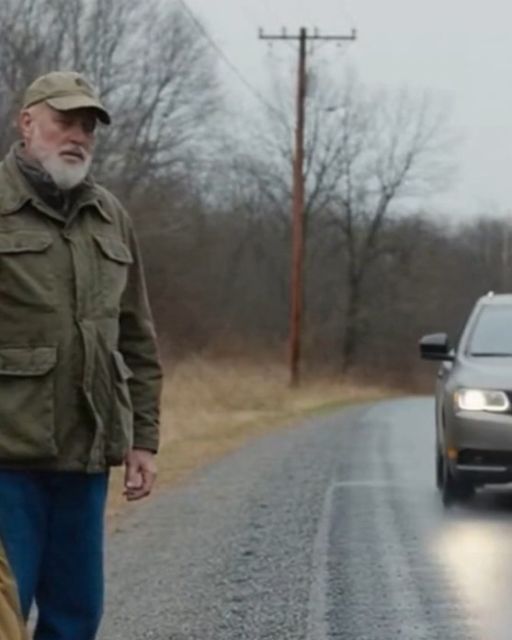
I was just leaving the VA clinic, my knee screaming from the damp air, when a spotless black truck pulled over. The kid behind the wheel couldn’t have been more than twenty.
“Sir?” he said, leaning over. “You look like you could use a lift. I’d be honored.” He had one of those honest, open faces. He saw the “Army Veteran” cap on my head.
Normally I’d say no. You learn to be cautious. But I was tired, and the bus was another thirty minutes out. I got in. His name was Leo. He was polite, called me Arthur, and asked all the right questions about my service. Too right. He knew my division. He even knew the name of the base I was on in Kandahar.
My stomach tightened. “How’d you know that, son?”
He just smiled. “My family has a lot of respect for you guys.”
We sat in silence for a few minutes. Then he asked the question that made the hair on my arms stand up. “Did you know a guy named Finn over there? Finn O’Connell?”
My breath caught in my throat. Finn was my brother, in all but blood. He didn’t make it home. I just nodded, unable to speak. How could this random kid know Finn’s name?
He pulled up to my house and I scrambled to get out, my mind reeling. I mumbled a thank you, not even looking at him, and shut the door. I needed to be away from him, to think.
As he pulled away from the curb, I saw his custom license plate for the first time.
F1NN-S0N.
The world stopped. Finn died at nineteen. He never had a son.
But then I remembered the photo Finn carried everywhere. The worn-out picture of his mom with the new boyfriend she’d met right before our deployment. The man who was part of our unit.
The man who deserted his post the night Finn’s convoy was ambushed.
I stumbled inside, the door slamming shut behind me. The sound echoed in the empty house. My knee was forgotten. All the pain was in my chest now, a hot, familiar anger I hadn’t felt in years.
His name was Marcus Thorne. A guy who transferred into our unit just a month before we shipped out. He was older, quieter than the rest of us kids. He’d swept Finn’s mom, Sarah, off her feet. Finn had been wary, but he wanted his mom to be happy.
Marcus was supposed to be on overwatch that night. He had the high ground, the eyes for the whole platoon. But when the first RPG hit, he wasn’t there. Radio silence. He was gone.
The official report called it desertion in the face of the enemy. We called it betrayal. We believed his cowardice cost Finn his life. He vanished, and we were left to pick up the pieces and carry a coffin home.
And now, his son was driving around in a fancy truck with Finn’s name on his license plate. The audacity of it felt like a punch to the gut.
I didn’t sleep that night. I just paced the living room, the floorboards groaning under my weight. I kept seeing Finn’s laughing face, then the cold, hard stare of Marcus Thorne. And then the kid, Leo. He had his father’s dark hair, but his eyes… his eyes were different. There was no malice in them. Just a deep, searching sadness.
I had to find him. I didn’t know what I was going to do or say, but I couldn’t let this go.
The next morning, I drove my old beater car back to the VA clinic. I parked across the street and waited. It felt like a stakeout from a bad movie. Hours crawled by. My coffee went cold. I was about to give up when I saw it. The spotless black truck, pulling into the lot.
Leo got out. He wasn’t there for an appointment. He was carrying a bag of groceries and walked them over to an elderly man sitting on a bench. He helped the man to his feet and walked with him to his car, patient as a saint.
This wasn’t the son of a monster I had imagined. It just made me more confused. And angrier.
I got out of my car and walked over as he was coming back. My heart was hammering.
“Leo,” I said. My voice was rougher than I intended.
He turned, and his face lit up for a second before he saw the look on mine. The smile faded. “Arthur. It’s good to see you again, sir.”
“Cut the ‘sir’ crap,” I snapped. “Your license plate. Explain it.”
He looked down at the asphalt, his shoulders slumping a little. “I was hoping we could talk about that.”
“Talk? What is there to talk about?” I took a step closer. “You think you can drive around with his name on your truck? You have no right.”
“Finn O’Connell was a hero,” Leo said quietly, meeting my eyes. “My father… he wasn’t.”
The admission caught me off guard. “Your father was Marcus Thorne.” It wasn’t a question.
Leo nodded. “Yes. He was.”
“He was a coward. He ran. He got my best friend killed.” The words I had bottled up for fifteen years came pouring out. I didn’t care who heard.
Leo didn’t flinch. He just stood there and took it. “That’s the story I grew up with, too.”
He reached into his truck and pulled out a worn leather satchel. “I’ve been coming here for weeks, hoping to find someone from the unit. Someone who knew Finn. I need to understand.”
I just stared at him, my anger warring with a flicker of something else. Pity, maybe. “Understand what? Your father was a traitor.”
“Maybe,” he said. “But it’s not that simple. Nothing ever is.” He looked at me, his gaze pleading. “Please, Arthur. Just give me ten minutes. Let me buy you a coffee. If you still want to hate me after that, I’ll understand. I’ll even change the plate.”
Something in his voice broke through my rage. It was the sound of a kid carrying a weight that wasn’t his. I thought of Finn, how he always gave people the benefit of the doubt. Against my better judgment, I nodded.
We ended up at a small diner down the road. The place smelled of stale coffee and grease, but it was quiet. We sat in a booth by the window, the cracked vinyl cool against my back.
Leo didn’t beat around the bush. “My father passed away two years ago.”
I felt nothing at the news. Good riddance.
“He was never the same after he came back,” Leo continued, stirring his coffee. “He and my mom—Finn’s mom, Sarah—they split up right away. He was a ghost. He worked dead-end jobs, drank too much. He never talked about Afghanistan. Ever.”
“He had nothing to be proud of,” I said, my voice flat.
“I know,” Leo said. “I grew up ashamed of him. Sarah, she never forgave him. She told me he was a coward. I believed her. I hated him for it.”
He paused, taking a deep breath. “When he died, I was cleaning out his tiny apartment. I found a box. Inside were his service records, some old photos, and a journal.”
He pushed the leather satchel across the table. “He wrote in it every day he was over there. Right up until…” He trailed off. “The night of the ambush.”
My hands trembled slightly as I unbuckled the satchel. Inside was a small, dusty black notebook. I opened it. The handwriting was tight, almost frantic.
“He wasn’t a good man, Arthur,” Leo said softly. “But he wasn’t a simple coward, either. He was just… a man. A flawed one.”
I didn’t want to read it. I didn’t want to give Marcus Thorne a voice. But I couldn’t stop myself. I started flipping through the pages. He wrote about the heat, the dust, the fear. He wrote about missing Sarah. He wrote about Finn.
“Finn keeps trying to get me to open up,” one entry read. “He’s a good kid. Too good for this place. He sees the best in everyone, even me.”
Another entry made my blood run cold. It was dated two days before the ambush.
“Something’s not right on the north ridge. I keep seeing glints of light around dusk. Like a lens. Command says it’s nothing, just kids with mirrors. But it feels wrong. The patrols in that sector are too predictable. It’s a perfect kill box.”
I looked up at Leo. “He reported this?”
“Twice,” Leo confirmed. “It’s in the journal. They told him to stick to his post and follow the chain of command.”
My mind raced back to that time. Our CO was a hard-liner, by the book. He didn’t like people questioning his strategy, especially not a newcomer like Marcus.
I turned to the last entry. It was dated the day of the attack. The writing was nearly illegible, scrawled in a hurry.
“They’re going out tonight. Same route. I saw the glint again. It’s a spotter, I know it. They won’t listen. I can’t just sit here and watch them die. If I move from my post, I can get a better angle, maybe take him out before the convoy even gets close. It’s against orders. God forgive me. I have to protect Finn. For Sarah.”
The diner faded away. I was back on that dusty road, the smell of cordite in the air. The chaos. The shouting. The awful, deafening silence when it was all over.
Marcus hadn’t deserted to save his own skin. He had deserted to try and save theirs. He broke protocol. He made a judgment call. And he was wrong. The ambush was more sophisticated than one spotter. He failed.
“He never made it to the ridge,” Leo said, his voice thick with emotion. “The attack started while he was on his way. He was cut off from the unit. By the time he found a way back, it was over. Everyone thought he’d run. He was so broken by guilt, by his failure… he never told anyone the truth. He just accepted the brand of coward.”
A profound silence settled between us. The anger that had been my constant companion for fifteen years began to dissolve, replaced by a deep, aching sorrow. It wasn’t just for Finn anymore. It was for the broken man who carried his failure in silence. It was for the son who grew up in the shadow of that shame.
“Why the license plate?” I finally asked, my voice barely a whisper.
“My whole life, my father’s name was a curse,” Leo explained. “After reading his journal, I realized the only thing he ever tried to do right, he failed at. Horribly. But his intention… it was to protect Finn. I wanted to do something that honored the man Finn was, and the man my father tried to be, just for a moment. It’s not for him. It’s for Finn. A reminder of a debt that can never be paid.”
We sat there for a long time. I read more of the journal. Leo told me more about his father’s lonely life. I told him about Finn, about his stupid jokes and his unwavering loyalty. We were two strangers, bound together by a tragedy that had shaped both our lives in ways we never understood.
“There’s one more thing,” Leo said as we were leaving. “Finn’s mom. Sarah. She still lives in town. She doesn’t know any of this. She deserves to.”
The thought of facing Sarah with this new truth was terrifying. For fifteen years, her narrative was simple: the man she loved was a coward who got her son killed. The truth was messier. It was harder.
A week later, I found myself standing on Sarah O’Connell’s doorstep, with Leo beside me. He was holding the journal. I had to be there. I owed it to Finn. And maybe, I owed it to Marcus, too.
Sarah opened the door. She looked older, of course, but her eyes were the same fiery green I remembered. They widened when she saw me, then narrowed with confusion when she saw Leo. She recognized him. The resemblance to Marcus was undeniable.
“Arthur?” she said, her voice trembling. “What is this?”
“Sarah, we need to talk to you,” I said gently. “About Finn. And about Marcus.”
She tried to shut the door, but Leo put a hand out. “Please,” he said. “Just five minutes. For Finn’s sake.”
Reluctantly, she let us in. We sat in her living room, which was a shrine to Finn. Photos of him were everywhere. A smiling kid in a baseball uniform. A proud young man in his Army dress greens.
With painstaking care, Leo told her the story, just as he had told me. He handed her the journal. At first, she refused to touch it. But as I recounted what I remembered from that time—the CO’s stubbornness, Marcus’s warnings being dismissed—her anger began to soften into doubt.
She finally took the journal. Her hands shook as she opened it to the last page. She read the final, desperate words her son’s killer—no, his failed protector—had written.
A single tear traced a path down her cheek. Then another. Soon, she was sobbing, a deep, ragged sound of a grief held for fifteen years, a grief built on a lie.
It wasn’t a lie of malice, but a lie of circumstance. A lie born from the fog of war.
We stayed with her for hours. We cried together. We shared stories of Finn. For the first time, Sarah talked about Marcus not as a monster, but as the quiet, troubled man she had once loved. Healing didn’t happen all at once, but it was a start. A crack of light in a dark room.
The next weekend, the three of us drove out to the national cemetery. The rows of white headstones stood in silent, perfect formation under the blue sky.
We found Finn’s marker. Leo knelt and placed a small, polished stone on top of it, a sign of remembrance. He looked at the name carved into the marble.
“I’m sorry,” he whispered. “My father was sorry.”
Sarah placed a hand on his shoulder. “I know,” she said.
I stood back, watching them. The son of the man who failed, and the mother of the man who was lost. They were connected by this strange, painful legacy. But it wasn’t a legacy of shame anymore. It was one of truth.
The official record would never change. To the Army, Marcus Thorne would always be a deserter. But for the three of us standing there, the story was finally complete. The truth, in all its messy, heartbreaking complexity, had set us free.
We learn in the service that you can’t leave a man behind. But we had. We had left Marcus Thorne behind, buried under a simple, ugly label. We never looked for the whole story. The greatest betrayals are sometimes the stories we tell ourselves, the simple ones that let us divide the world into heroes and cowards, because the truth is just too painful to carry. Finn’s true legacy wasn’t just his sacrifice; it was the grace that allowed the rest of us, all these years later, to finally find our way back to the truth. And in that truth, we found a peace we thought was lost forever.