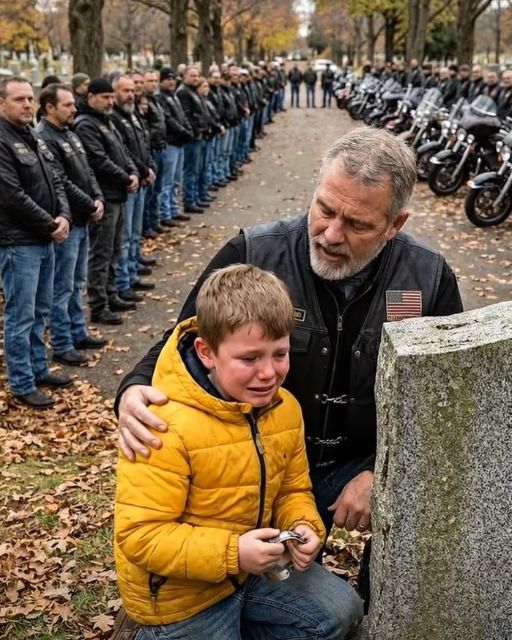
The shout ripped out of my throat before I could stop it.
“Hey!”
The figure hunched over my daughter’s grave flinched, scrambling backward through the wet grass like a startled animal.
My blood was pure fire. This was sacred ground. My ground. Hers. I started moving, my boots heavy on the gravel path, ready to tear this person apart.
But then he looked up.
And the anger just evaporated.
He was a kid. Maybe sixteen, all sharp angles and wide, terrified eyes. He wasn’t a vandal. He was just… a boy.
His hands were caked in mud. He’d been trying to clear the dirt from the base of the headstone. With his bare fingers.
“What are you doing here?” My voice was low now, tight. The rage was gone, replaced by a thick, heavy confusion.
He just shook his head, words caught in his throat.
I took a step closer. The white lilies I brought every week suddenly felt flimsy and pointless in my grip. This felt different. Wrong.
He was muttering something, too quiet to hear. Over and over again. An apology.
And that’s when my eyes locked onto his wrist.
Something glinted there, half-hidden by the cuff of his jacket.
My world tilted. The sound of the wind in the pines, the cold air on my skin, it all just vanished.
It was a bracelet. Woven thread, blue and green, with a single silver charm. A small, crooked star.
My daughter made that.
She called them her “loyalty charms.” She’d spent a whole weekend making them for her closest friends, just days before the crash. I had one just like it sitting in a dusty box on my nightstand.
The air punched out of my lungs. My knees threatened to give way.
The boy saw me staring. The terror in his eyes finally broke, and tears streamed down his dirt-streaked face.
“I was there,” he whispered, the words fractured. “I was driving the other car.”
He choked on a sob. “I’m so sorry.”
And in that instant, three years of unanswered questions and bitter, lonely grief didn’t end.
They just changed.
He wasn’t a stranger. He was the other half of the story. And he’d been carrying it all by himself, right here, the whole time.
My mind raced, trying to connect dots that weren’t there. The police report had been brutally clear. It was a single-vehicle accident. Isla and her best friend, Maya, on that dark stretch of River Road. They said Maya had been driving. Too fast for the curve.
There was no other car.
“There was no other car,” I said, the words coming out flat, lifeless.
The boy, whose name I still didn’t know, shook his head violently. His whole body trembled. “There was. There was. They just… they made it go away.”
My legs finally gave out. I sank onto the damp bench beside the path, the lilies falling from my hand. The world was a blur of green and grey.
“Who?” My voice was a stranger’s.
“My friend,” he stammered, pulling at the sleeve of his jacket. “His name is Owen. It was his father’s car.”
He looked at me, his eyes pleading for me to understand, to believe.
“I didn’t know her,” he said, his gaze dropping to the bracelet on his own wrist. “Not really. I just saw her at school sometimes.”
This was the part that made no sense. Isla only gave those bracelets to people in her inner circle. Maya had one. Her friend Sarah had one. Why him?
“Then how did you get that?” I pointed a shaking finger at his wrist.
He took a deep, shuddering breath, like a diver about to go under. “After… after we hit them. Owen panicked. He just kept driving.”
“I made him stop. I made him turn around.”
“I got out and ran back. His headlights were off. It was so dark.”
He was back there now, I could see it. His eyes were unfocused, looking at a memory I couldn’t share.
“I found her car first. It was wrapped around that old oak tree.” He pointed vaguely toward the road beyond the cemetery gates.
“The driver’s side was… it was bad. Maya was already gone.” He swallowed hard. “I’m sorry. I’m so sorry.”
I just sat there, a statue carved from ice.
“But your daughter… Isla… she was on the passenger side. She was still…” He couldn’t say the word. “She was trying to get her seatbelt off.”
“I opened the door. I told her help was coming.”
“She looked at me. I don’t think she really saw me. She was just… reaching.”
Tears were flowing freely down his face now, carving clean paths through the grime.
“Her hand brushed mine. And the bracelet… it must have snagged on my watch or something. It came off in my hand.”
He held up his wrist, showing me the frayed threads. “By the time I realized I had it, I heard sirens. Owen was screaming at me to get back in the car. He dragged me away.”
“His dad is… important. A lawyer. He made calls. By the time the police got there, we were miles away. Our car was in a private garage, getting fixed by the next morning.”
“They made it look like the girls just lost control. They said Maya was a new driver. They closed the case.”
The story settled in the pit of my stomach like a block of lead. It was monstrous. It was unbelievable.
And yet, looking at this broken child, I believed every word.
The bracelet wasn’t a gift. It was an accident. A piece of my daughter that had clung to the first person who tried to help her, a person who was then forced to become a ghost.
“What’s your name?” I asked. The question felt impossibly small.
“Caleb,” he whispered.
For a long time, we just sat in the fading light. The cemetery grew quiet as the last of the visitors left. It was just me, my daughter’s grave, and the boy who held the truth.
“Why?” I finally asked. “Why come here?”
“I had to,” he said, his voice raw. “I couldn’t… I couldn’t just forget. I come every week. Sometimes on Sunday. Sometimes late at night when no one’s around.”
“I just wanted to make sure the weeds were gone. To tell her I’m sorry.”
He had been serving his own sentence. A secret penance at the site of the crime. For three years, while I was drowning in a sea of unanswered ‘what ifs’, he was drowning in the truth.
I thought about Maya’s parents, the Hendersons. They’d left town six months after the funeral. The whispers had been too much. The quiet judgment in the grocery store. The way people looked at them, as if their daughter’s supposed recklessness was a reflection of their parenting.
They had been mourning their child and defending her memory at the same time. And it had all been a lie.
A cold, hard anger began to replace the shock. It wasn’t the blind rage from before. This was different. It was focused. It had a name. Owen. And his father.
I stood up. My joints creaked. I felt a hundred years old.
“Come on,” I said to Caleb.
He looked up, startled. “Where are we going?”
“To get a coffee,” I said. “You’re going to tell me everything again. Every single detail you remember.”
We sat in a cheap diner booth twenty minutes later. The fluorescent lights were harsh, the coffee was bitter, but it was a world away from the ghosts in the cemetery.
Caleb talked. He told me about Owen’s drinking that night. How he’d been showing off his father’s new sports car. How he’d clipped the back of Isla’s sedan on the curve, sending them into a spin.
He described the sound of the impact. The smell of gasoline. The terrifying silence that followed.
He told me about the threats from Owen’s father. How he’d been told that if he ever spoke a word, they would ruin his family. They’d make sure his mom lost her job at the hospital. They’d find a way to pin something on his older brother.
He was a fifteen-year-old kid, terrified and alone, trapped in a powerful man’s web of lies.
I listened, and as I did, my purpose became clear. My grief had been a heavy blanket, smothering me. Now, it was a tool. A weapon.
Isla had called them “loyalty charms.” Loyalty. It was about standing by your friends. It was about doing the right thing, even when it was hard.
I had spent three years being loyal to my grief. It was time to be loyal to my daughter. And to Maya.
The next day, I made two calls. The first was to a lawyer, a bulldog of a man I’d done some construction work for years ago. The second, and much harder call, was to the Hendersons.
I found their number through an old neighbor. When Mrs. Henderson answered, her voice was cautious, weary.
I told her who I was. I told her I needed to see them. That I had news about the accident. About Maya.
The silence on the other end of the line was deafening.
“We’re in Oakhaven,” she finally said. “It’s about a three-hour drive.”
“I’ll be there this evening,” I said.
Caleb agreed to come with me. He was terrified, but he knew it was the only way forward. He sat in my passenger seat, twisting the blue and green bracelet around and around his wrist.
Walking up to the Hendersons’ small, neat house was one of the hardest things I’ve ever done. We were two families, bound by the same tragedy, but torn apart by a lie.
They opened the door and saw Caleb standing behind me. Mr. Henderson’s face hardened instantly. He didn’t know who Caleb was, but he saw a teenage boy, the same age as the girls. It was a visceral reminder of what he’d lost.
We sat in their living room, surrounded by pictures of a smiling, vibrant Maya.
And for the second time in two days, Caleb told his story. He didn’t falter. He looked Maya’s parents in the eyes and confessed his silence. He apologized for his cowardice, for the three years of pain it had caused them.
Mrs. Henderson wept silently. Mr. Henderson just stared, his hands clenched into white-knuckled fists on his knees.
When Caleb was finished, the room was heavy with the weight of it all.
“They let us believe our daughter killed her best friend,” Mr. Henderson said, his voice a low growl of disbelief and pain. “They let us carry that.”
He looked at Caleb, and I saw a flicker of the same rage I had felt at the cemetery. But then it softened, just as mine had. He wasn’t looking at a villain. He was looking at a child who had been victimized, too.
“You were a kid,” Mrs. Henderson said, her voice thick with tears. “He threatened your family. I understand.”
And in that moment, something shifted. It wasn’t forgiveness, not yet. It was something more fundamental. It was understanding. The start of a bridge across an impossible chasm.
The legal battle was ugly, just as we knew it would be. Owen’s father was every bit as ruthless as Caleb had described. He threw money and power at the problem, trying to discredit Caleb, trying to paint him as a troubled youth seeking attention.
But he hadn’t counted on us. He hadn’t counted on two grieving families, now united, with nothing left to lose. He hadn’t counted on Caleb’s quiet, unshakeable testimony.
And he hadn’t counted on the bracelet.
Our lawyer presented it as a piece of evidence. A tangible link between Caleb and Isla in those final moments. A symbol of the truth that had been buried for so long.
The story broke in the local news. The narrative of the tragic accident was rewritten overnight. The community’s sympathy, once misdirected, now found its proper target.
In the end, Owen’s father’s web of lies collapsed. Faced with a sworn testimony and mounting public pressure, Owen confessed. The truth, in all its sordid detail, finally came out.
Justice was served, in the way the courts serve it. But our healing came from something else.
It came from clearing Maya’s name. It came from the Hendersons being able to finally mourn their daughter without the stain of blame.
It came from Caleb, who, by facing his greatest fear, was finally able to set down a burden that was never his to carry. He started volunteering at a center for at-risk teens, using his story to help others.
A few months later, on a crisp autumn afternoon, I stood at Isla’s grave. The sun was warm on my back.
I wasn’t alone.
The Hendersons were there, placing a bouquet of bright yellow sunflowers next to my lilies. Caleb was there, too, no longer hunched in the shadows but standing tall beside me.
We didn’t say much. We didn’t need to. We were a strange, broken little family, pieced together by tragedy and truth.
I looked at the crooked star charm on the bracelet Caleb still wore. He said he would wear it always, to remember. Not to remember the guilt, but to remember the cost of silence, and the power of speaking up.
Isla’s “loyalty charms” had been meant for her friends. But in the end, her bracelet had created a loyalty she could never have imagined. A loyalty to the truth. A loyalty between strangers who had found their way back to the light, together.
My grief for my daughter would never truly go away. It was a part of me now, woven into my soul. But it was no longer the bitter, corrosive thing it had once been. The unanswered questions were gone, replaced by a quiet, sad peace.
I finally understood that forgiveness isn’t always about letting someone off the hook. Sometimes, it’s about untangling the knots of anger and lies inside yourself so you can finally breathe again. It’s about choosing to build something new from the wreckage, rather than just staring at the ruins. And the truth, no matter how long it’s been buried, will always, always find its way to the surface. It just needs one brave person to start digging.