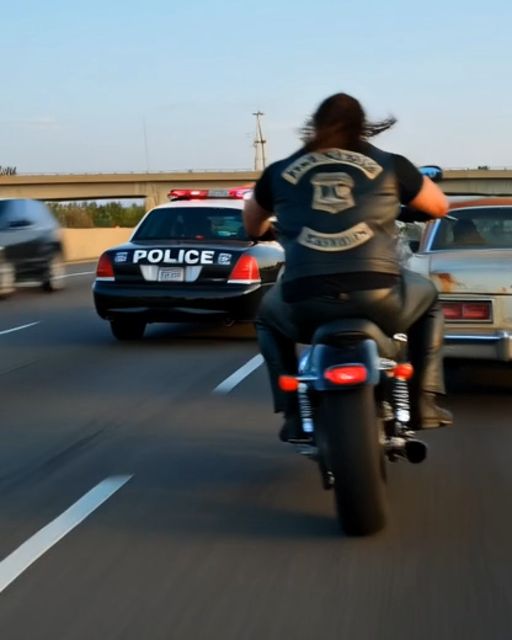
I was enjoying my coffee when I saw the massive biker, a leather-clad giant with an “Iron Skulls MC” patch, furiously tailgating a beat-up sedan. This wasn’t road rage; he was violently trying to force the car off the road.
Adrenaline surged. I slammed my coffee down, threw my patrol car into drive, lights flashing, siren wailing. “Pull over! Now!” I roared into the PA.
But the biker ignored me, speeding up, weaving dangerously, relentlessly pursuing the terrified driver of the sedan. I figured he was chasing a rival gang member or someone who owed him money.
He swerved hard, forcing the sedan into a tight corner. The car spun out, screeching against a fire hydrant.
The biker was off his machine before the dust settled, running towards the passenger side. I drew my weapon, yelling at him to freeze, expecting him to drag someone out and beat them.
He ripped open the passenger door, frantic, ignoring me completely. That’s when I saw it: not a person, but a small, plastic pet carrier, tipped on its side, vibrating with frantic mewling.
He carefully righted the carrier, his massive hands surprisingly gentle as he peered inside. He looked up at me, his eyes blazing with a raw, desperate fear.
“Officer,” he gasped, his voice raspy. “You have to help me. They kidnapped him. They’re going to use him as bait.”
I looked at the cat carrier. Then at the terrified driver of the sedan, cowering behind the wheel. “Who kidnapped what?” I demanded, still confused, weapon still raised.
The biker slowly lifted the carrier, turning it so I could see inside. There was a tiny, terrified tabby kitten, no bigger than my hand, mewling weakly.
And around its fragile neck was a tiny, glowing device.
“He’s not just a cat,” the biker whispered, his voice trembling now. “This kitten… he’s a protected… vessel.”
I lowered my weapon a fraction of an inch, my mind struggling to connect the dots. A biker gang giant, a terrified suit in a sedan, and a kitten with glowing jewelry.
“My name is Marcus,” the biker said, his voice steadier now, though his eyes never left the carrier. “And that man,” he nodded towards the sedan, “is not a random person. He works for them.”
We brought them both down to the station. The driver of the sedan was a man named Finch, dressed in an expensive but now disheveled suit. He was cool, collected, and said nothing except “I want my lawyer.”
Marcus, on the other hand, sat in the interrogation room, the cat carrier placed on the table like a holy relic. He refused to be separated from it.
My captain, a man who had seen everything twice, took one look at the situation on the monitor and just told me to “handle it.” So I went in with two cups of terrible station coffee.
I slid one across to Marcus. He nodded his thanks, his huge, tattooed hands wrapping around the small styrofoam cup.
“Okay, Marcus,” I said, sitting down. “Start from the beginning. And tell me what a ‘protected vessel’ is.”
He took a deep breath, his broad shoulders slumping. “My wife, Elena,” he began, his voice thick with a grief that felt fresh and raw. “She was a neuroscientist. Brilliant. The best.”
He explained that Elena had been working on a revolutionary project for a massive tech corporation. It was a bio-organic storage unit, a way to map and store a conscious mind.
“Not just data, not just files,” he said, looking at me intensely. “Everything. Memories. Feelings. The little quirks that make a person who they are. A soul, she called it.”
The project was her life’s work, but she grew to fear the company she worked for. They saw it as a product, a way to sell a kind of immortality to the highest bidder. She saw it as something sacred.
Then, she got sick. A diagnosis that was a death sentence.
In her final months, she perfected a single prototype. A small one. She didn’t want her work to be turned into a weapon or a toy for the rich. She wanted to leave something behind for him.
“She put everything in there,” Marcus whispered, his finger tracing the plastic of the carrier. “Her love for me. Our first date. The sound of her laugh. Her favorite song. She put herself… her essence… into that device.”
He gestured to the kitten’s glowing collar. “And she put the device on Pip.”
Pip. The tiny kitten in the carrier.
“Pip was her comfort in those last days,” Marcus continued. “She said he was the perfect guardian. Innocent. Unassuming. No one would ever suspect.”
After Elena passed away, the corporation came calling. They wanted their “property” back. The prototype. Marcus refused. It wasn’t property; it was the last piece of his wife he had left.
So they sent men like Finch. They’d been trying to get Pip for weeks. Today, Finch had succeeded, snatching the carrier from Marcus’s porch while he was out getting groceries.
Marcus had come home to an empty space where the carrier should have been. He saw Finch’s sedan speeding away and got on his bike without a second thought.
I stared at him, at this mountain of a man who looked like he could break me in half, and all I saw was a heartbroken husband trying to protect his wife’s memory.
“The device,” I asked softly. “What does it do? Can you access the memories?”
He shook his head. “Elena designed it to be passive. It just holds her. A comfort. A presence. Trying to access it or remove it would wipe it clean. A failsafe against them.”
Finch’s lawyer showed up. He was sharp, expensive, and had Finch out on bail within an hour for a minor charge of “theft of an animal.” The kidnapping charge wouldn’t stick without more proof.
The lawyer made it clear they would be back, with court orders and a claim of intellectual property. They would take the kitten, and by extension, the device.
I watched Finch walk out, a smug look on his face. The system was working for him. My gut twisted. This wasn’t right.
I went back to Marcus. “They’re not going to stop,” I said. “You can’t go home.”
He looked defeated. “I have nowhere else to go. My club… they wouldn’t understand this.”
I thought about my small, quiet apartment. I thought about the rulebook I’d sworn to uphold. Then I thought about that smug look on Finch’s face and the raw grief in Marcus’s eyes.
“Yes, you do,” I said, making a decision that would change my career, and my life. “You’re coming with me.”
Hiding a six-foot-five biker and a technologically-advanced kitten in my one-bedroom apartment was not something they taught you at the academy.
Marcus was surprisingly tidy. He slept on the couch, which looked like a doll’s bed underneath him, and spent his days talking quietly to Pip’s carrier.
I was working the case officially, but hitting brick walls. The tech corporation was a fortress of lawyers and non-disclosure agreements. They painted Marcus as an unstable, grieving spouse holding valuable corporate assets hostage.
Unofficially, I was digging. I spent my nights researching Elena’s work, trying to find a loophole, a way to protect him.
A few days later, I came home to find Marcus pale and agitated. “He was here,” he said, his voice a low growl.
“Who?”
“Finch. Or someone like him. The lock on the door was tampered with. I heard them at the window. They’re watching us.”
My blood ran cold. They had found us. My apartment wasn’t safe anymore.
“We need to move,” I said, my mind racing. “But we need a better plan than just running.”
That’s when Marcus remembered something. “Elena’s lab,” he said. “Her personal one, at the old university. It’s been abandoned for years, but she kept it. She said she left something there. An ‘insurance policy’.”
It was a long shot, but it was all we had.
Under the cover of darkness, we drove to the outskirts of the city, to the old, ivy-covered campus. Marcus carried Pip’s carrier like it was a sleeping baby.
The lab was in the basement of the science building, thick with the smell of dust and old chemicals. It was like a time capsule. Notes were still pinned to a corkboard, beakers sat on a counter, and a single computer was on a desk, covered in a thin layer of grime.
“Her insurance policy has to be here somewhere,” Marcus murmured, scanning the room.
I started looking through her desk, sifting through papers and old research notes. I found a leather-bound journal. Most of it was scientific formulas and complex diagrams, but the last few pages were different.
It was a letter. To Marcus.
“My dearest Marcus,” it began. “If you are reading this, it means they have come for my work, and for you. I am so sorry.”
My heart ached as I read her words. She wrote about her love for him, her regret for leaving him in this fight. Then she explained the device.
She confirmed what Marcus had said. It was a passive vessel, designed only to hold her essence. But she had lied about one thing. There was a way to activate it.
“I built in a backdoor, a trigger,” she wrote. “I couldn’t bear the thought of my work, our memories, being locked away or erased. It’s a broadcast function. One-time use. It won’t just let you see the memories, my love. It will make anyone nearby feel them.”
She explained that the trigger was a specific sequence of sonic frequencies, broadcast from the old computer in the lab. A song. Their song.
Just as I finished reading the last line, the lab door slammed open.
Finch stood there, flanked by two other men in dark suits. He had a small, high-tech device in his hand, a scanner of some kind.
“The device gives off a unique energy signature,” Finch said with a cold smile. “Faint, but traceable if you know what you’re looking for. The game is over, Marcus. Give it to us.”
Marcus instinctively shielded the cat carrier, placing himself between them and Pip.
“You don’t understand what you’re trying to take,” Marcus pleaded, his voice desperate.
“Oh, I understand perfectly,” Finch sneered. “I understand it’s a multi-billion dollar prototype. It’s the future of the company. It’s my promotion. Your sentimental attachment is irrelevant.”
His men started to move forward. I drew my service weapon. “Stay back! You’re all under arrest for breaking and entering, for starters.”
Finch just laughed. “Your weapon is meaningless here, Officer. My employers have friends in very high places. This will all be swept under the rug. You, however, will be ruined for interfering.”
He was probably right. But I wasn’t backing down.
“Marcus,” I said, my voice low and urgent, keeping my eyes on Finch. “The computer. The song.”
Marcus’s eyes widened in understanding. He looked at me, a silent question in his eyes. This was it. The one and only chance to share his wife’s final gift. It wouldn’t be his alone anymore.
He nodded, a single, decisive movement.
While Finch was distracted by my drawn weapon, Marcus lunged for the old computer. He slammed his fist on the tower, and the ancient machine whirred to life with a groan.
“What are you doing?” Finch yelled, realizing his mistake. “Stop him!”
His men rushed Marcus, but it was like watching mosquitos attack a bear. Marcus shoved one man into a rack of test tubes and held the other back with one arm while his other hand flew across the keyboard.
He pulled up an old media file. He hit play.
For a second, nothing happened. Then, a soft, simple piano melody began to fill the dusty lab.
Finch froze. His men stopped struggling. The glowing device around Pip’s neck began to pulse, brighter and brighter, in time with the music.
And then it hit us.
It wasn’t a sound. It was a feeling. A tidal wave of pure, unfiltered emotion.
I felt a rush of warmth, of overwhelming love. I saw a first date in a small Italian restaurant, hands touching nervously across a checkered tablecloth. I felt the joy of adopting a tiny kitten, its little purr a motor against a cheek.
I felt the dizzying pride of a scientific breakthrough, the ‘eureka’ moment in the dead of night. I smelled rain on hot asphalt during a summer storm. I tasted cheap coffee on a Sunday morning in bed.
It was Elena. We were all feeling her life, her love for the man standing in the middle of the room.
Marcus had tears streaming down his face, a beautiful, broken smile on his lips. He was with her again, for a fleeting moment.
Then the memories shifted. I felt the cold dread of a doctor’s sterile office. The fear. The pain. The desperate race against time.
And I felt her anger. Her disgust at the men in suits who saw her soul as a spreadsheet. I felt her specific, focused contempt for Finch, who had tried to bully and threaten her in her final weeks. We all felt her looking at him, seeing nothing but a hollow man, driven by greed.
Finch screamed. It was a raw, terrified sound. He clutched his head, dropping his scanner. He was being flooded with a lifetime of genuine human emotion, and his empty soul couldn’t handle it.
His two men were on their knees, one sobbing openly, the other staring into space, completely overwhelmed.
The song ended. The light on Pip’s collar dimmed back to its soft, steady glow. The silence in the lab was absolute, broken only by Finch’s gasping sobs.
The broadcast had done more than just incapacitate them. Elena’s failsafe, in its final act, had also sent a complete data packet of all her research, her personal logs, and evidence of the corporation’s illegal tactics to a dozen major news outlets and federal agencies. She had made sure they couldn’t bury this.
The aftermath was swift. Finch and his men were arrested, but this time, it stuck. The corporation was buried in federal investigations and a public relations nightmare from which it would never recover.
The technology Elena had created was now the subject of a global ethical debate. But the original, the prototype, was declared the personal property of Marcus, a last will and testament of a unique kind.
A few weeks later, Marcus and I were sitting on a park bench. Pip, now a little bigger and bolder, was chasing a stray leaf on a small harness. The glowing collar was gone, replaced by a simple one with a little bell. The device was now in a small, secure box Marcus kept with him at all times.
“Thank you, Sam,” he said, his voice quiet. He’d started calling me by my first name. “You didn’t have to get involved. You could have lost everything.”
“Some things are worth the risk,” I replied, watching Pip pounce. “And besides, I have a giant biker for a friend now. Who’s going to mess with me?”
He let out a deep, rumbling laugh. It was the first time I’d heard him sound truly happy.
We sat there in comfortable silence, two unlikely friends brought together by a chase, a kitten, and a love that transcended even death.
I learned something profound in all of this. We so often look at the surface of things – the leather jacket, the expensive suit, the job title – and we make up our minds about who people are. But we’re almost always wrong.
Beneath the surface, everyone is carrying something precious and fragile. A memory, a deep love, a secret grief. The real treasures of this world aren’t stored in vaults or on computer chips. They’re stored in the heart. And sometimes, if you’re lucky, you get to see a little glimmer of that soul, and it changes you forever.