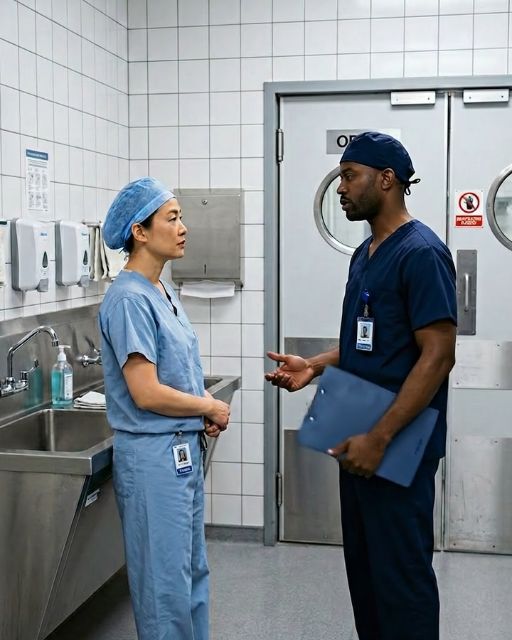
I’m a cardiac surgeon. I’ve been doing this for 15 years. I’ve learned to keep my emotions out of the OR.
Yesterday, a woman was rushed into the ER. Massive heart failure. The attending physician paged me immediately. “Dr. Chen, we need you now. She’s crashing.”
I scrubbed in, walked to the prep room, and looked at the chart. Female, 38 years old. Name: Rachel Kowalski.
I froze.
Rachel. That name. I knew that name.
I told the team I couldn’t do it. “Get Dr. Martinez,” I said. “I’m recusing myself.”
The head nurse looked at me like I’d lost my mind. “Dr. Chen, Martinez is in Denver at a conference. You’re the only cardiothoracic surgeon on duty. She’ll die if you don’t operate in the next twenty minutes.”
I walked into the room anyway, just to confirm it wasn’t her. Just to prove to myself I was being paranoid.
But when I saw her face, even unconscious, even pale and swollen from the trauma, I knew.
It was her.
Rachel from Mrs. Patterson’s third-grade class. Rachel who shared her peanut butter crackers with me every day because my mom forgot to pack my lunch. Rachel who held my hand when I cried after my dad left. Rachel who moved away the summer before fourth grade and never wrote back.
I hadn’t thought about her in decades.
Now she was dying on my table.
The anesthesiologist was prepping her. I stood there, paralyzed. My hands were shaking.
“Dr. Chen?” the nurse said. “We need to start.”
I couldn’t do it. I couldn’t cut into her. What if I made a mistake? What if my emotions clouded my judgment? What if she died because I hesitated for one second too long?
I turned to leave.
That’s when I saw it.
On her left wrist. A small scar. Shaped like a crescent moon.
I gave her that scar.
We were seven. We were playing pirates in her backyard. I swung a stick too hard and it caught her wrist. She bled everywhere. I cried harder than she did. She told me it was okay. She told me it would be our secret. She told me we’d be friends forever.
And then she was gone.
The monitors started screaming. She was flatlining.
The nurse grabbed my shoulder. “Doctor, NOW!”
I looked at Rachel’s face. I thought about the last thing she ever said to me, thirty years ago, standing in her driveway with a moving truck behind her.
“Promise me you’ll do something important when you grow up, Danny.”
I made a choice.
I stayed.
The surgery took six hours. It was the hardest operation of my life. Every incision felt personal. Every stitch felt like a prayer.
When I finally closed her up, the team erupted in applause. She was stable. She was alive.
I sat in the hallway outside her room, still in my scrubs, waiting for her to wake up.
Three hours later, a nurse tapped me on the shoulder. “She’s awake, Dr. Chen. She’s asking for you.”
I walked in. Rachel was sitting up slightly, tubes still in her arms, but her eyes were open. Sharp. Aware.
She looked at me for a long moment.
Then she smiled. Weak, but real.
“I knew it was you,” she whispered.
My throat tightened. “How?”
She lifted her wrist. The crescent scar.
“I saw your name on my intake form before I passed out,” she said. “I thought… maybe. But I wasn’t sure.”
I sat down next to her bed. “Rachel, I almost didn’t operate on you. I almost walked away.”
She reached out and grabbed my hand. Her grip was surprisingly strong.
“But you didn’t,” she said. “You stayed.”
I nodded, unable to speak. The weight of what had almost happened pressed down on my chest.
“Why did you move away?” I asked. The question had been buried for thirty years, and suddenly I needed to know.
Rachel’s smile faded. She looked down at her hands.
“My parents got divorced that summer,” she said quietly. “My mom took me and my brother to Colorado. My dad stayed here. It was ugly, Danny. Really ugly.”
“You never wrote back,” I said. “I sent you three letters.”
Her eyes filled with tears. “I never got them. My mom was so angry at my dad that she threw away anything that reminded her of this place. Including mail from friends I’d left behind.”
Something broke loose in my chest. All those years, I thought she’d forgotten me.
“I tried to find you when I got older,” Rachel continued. “But you’d moved too. Your mom remarried, right? Changed your last name?”
“Temporarily,” I said. “I changed it back to Chen when I turned eighteen.”
We sat in silence for a moment. The machines beeped steadily around us.
“I came back here two years ago,” Rachel said. “After my second divorce. I needed a fresh start.”
“Second?” I asked.
She laughed, then winced. “Don’t make me laugh. It hurts.”
“Sorry,” I said, but I was smiling too.
“Yeah, second,” she said. “Turns out I’m terrible at picking partners. But I’m great at my job. I’m a social worker. I help kids in foster care.”
Of course she was. Rachel had always had the biggest heart.
“That’s amazing,” I said.
“You became a doctor,” she said. “You kept your promise.”
I thought about that day in her driveway. How small we both were. How infinite the future had seemed.
“I became a doctor because of you,” I admitted. “After you left, I felt so powerless. I couldn’t fix my parents’ problems. I couldn’t make you stay. But I thought maybe I could fix other things. Save other people.”
Rachel squeezed my hand tighter. “You saved me, Danny.”
A knock on the door interrupted us. A young girl, maybe six years old, peeked her head in. Behind her was an older woman in her sixties.
“Aunt Rachel?” the little girl said tentatively.
Rachel’s face lit up. “Mira! Mrs. Patterson! Come in!”
I stood up quickly, startled. Mrs. Patterson. Our third-grade teacher.
The older woman walked in, and I recognized her immediately. She’d aged, her hair completely white now, but her kind eyes were the same.
“Daniel Chen,” she said, looking at me with surprise. “Is that really you?”
“Mrs. Patterson,” I said, my voice cracking slightly.
She pulled me into a hug. “Rachel told me she thought you might be her surgeon. I had to come see for myself.”
The little girl, Mira, climbed carefully onto Rachel’s bed. Rachel wrapped an arm around her.
“Mira is one of my foster placements,” Rachel explained. “She’s been with me for six months now.”
“Are you going to be okay?” Mira asked, her voice small and worried.
“I’m going to be perfect,” Rachel said. “Thanks to Dr. Chen.”
Mrs. Patterson looked between us, her eyes knowing. “You two were inseparable in my class. I always wondered what happened to you both.”
“Life happened,” Rachel said. “But maybe we got a second chance.”
Over the next few days, I checked on Rachel constantly. More than I needed to professionally.
We talked about everything. Our lives. Our mistakes. The people we’d become.
She told me about her work with foster kids. How she’d taken in Mira after the girl had been through four different homes in two years.
“I remember what it felt like to be scared and alone,” Rachel said. “When my parents split up, when I moved away from everything I knew. I don’t want any kid to feel that way.”
I told her about my own journey. Medical school. The grueling residency. My failed engagement three years ago.
“She said I cared more about my patients than her,” I admitted. “She wasn’t wrong.”
“Maybe you just hadn’t found the right person to care about,” Rachel said softly.
The day before her discharge, Rachel’s condition took an unexpected turn. Her heart started showing signs of rejection. The tissue wasn’t responding the way it should.
I ran every test I could think of. I consulted with specialists across the country.
Finally, one of them asked me a question that stopped me cold.
“Has the patient experienced severe emotional trauma recently? Sometimes the heart responds to psychological stress in ways we don’t fully understand.”
I went to Rachel’s room. She was awake, staring at the ceiling.
“Tell me what’s wrong,” I said. “And don’t say nothing. Your heart is literally telling me something’s wrong.”
Rachel was quiet for a long moment.
“I got a call yesterday,” she said finally. “From child services. Mira’s biological aunt has come forward. She wants custody.”
“That’s good, isn’t it?” I asked. “Family is usually the best option.”
“Not this family,” Rachel said bitterly. “The aunt is the sister of the man who abused Mira in the first place. She didn’t believe Mira then. She won’t protect her now.”
“Can you fight it?”
“I’m a single foster parent with a history of failed marriages and now a major health crisis,” Rachel said. “They’re going to say I’m not stable enough. They’re going to give Mira back to that family, and I can’t stop it.”
She started to cry. The monitors started beeping frantically.
I held her hand. “Rachel, you need to calm down. Your heart can’t take this stress.”
“I can’t lose her, Danny,” Rachel sobbed. “She’s everything to me. I know we’ve only been together six months, but she’s mine. In every way that matters, she’s my daughter.”
I made a decision then. One that had nothing to do with medicine.
“I’ll help you,” I said.
“How?” Rachel asked.
“I don’t know yet,” I admitted. “But you saved me once, a long time ago, just by being my friend when I needed one. Let me return the favor.”
I spent the next three days making calls. I talked to family court judges I’d met through hospital charity events. I reached out to a lawyer friend who specialized in family law.
And I did something I never thought I’d do. I called my ex-fiancee.
“Daniel?” she said, surprised. “Is everything okay?”
“I need a favor,” I said. “You work in child advocacy, right?”
She did. And despite our history, she agreed to help.
Together, we built a case. We documented Mira’s progress with Rachel. We got statements from teachers, therapists, and Mrs. Patterson. We showed the court that Mira was thriving.
Then I did something even more unexpected.
I filed a petition to be considered as a co-guardian with Rachel. To show the court that she wasn’t alone. That Mira would have a stable, two-parent household.
Rachel stared at me when I told her.
“Danny, you can’t do that,” she said. “You barely know Mira. You’re just reconnecting with me. This is too much.”
“I know what I’m doing,” I said. “And I’m not doing it just for you. I’m doing it because it’s right. Because that little girl deserves someone to fight for her. Because thirty years ago, you taught me what it means to care about someone other than yourself.”
The hearing was two weeks later. Rachel was out of the hospital by then, recovering at home.
We stood before the judge together. Mira sat with Mrs. Patterson in the gallery, holding the older woman’s hand.
The biological aunt’s lawyer argued their case. The judge listened carefully.
Then it was our turn.
My ex-fiancee stood up and presented our evidence. She was brilliant. She was passionate. And I realized why I’d loved her once, even if it hadn’t worked out.
When she finished, the judge looked at Rachel and me.
“This is highly unusual,” the judge said. “You two have only recently reconnected. Dr. Chen, you’re proposing to become a legal guardian to a child you’ve known for less than a month?”
“Yes, Your Honor,” I said. “I’ve spent my entire career trying to save lives. But I’ve realized that saving a life isn’t just about surgery and medicine. Sometimes it’s about giving someone a chance. A home. A future.”
The judge was quiet for a long moment.
“Miss Kowalski,” the judge said. “You’ve shown remarkable dedication to this child. And Dr. Chen, your willingness to step up speaks volumes about your character.”
My heart was pounding.
“I’m granting custody to Miss Kowalski,” the judge said. “With Dr. Chen approved as a co-guardian. I’m also ordering supervised visits with the biological aunt, but residence will remain with Miss Kowalski.”
Rachel burst into tears. I put my arm around her.
Mira jumped up and ran to us. Rachel scooped her up, holding her tight.
“We did it,” Rachel whispered to me. “We actually did it.”
Six months later, I was standing in Rachel’s kitchen, making pancakes. Terrible pancakes, but I was learning.
Mira sat at the table, drawing a picture. She’d started calling me Uncle Danny. I loved it more than I expected.
Rachel walked in, still moving a bit carefully but stronger every day. Her hair was pulled back in a ponytail. She looked beautiful.
“How are the pancakes?” she asked.
“Honestly? Terrible,” I admitted.
She laughed and took over. I didn’t mind.
Mrs. Patterson was coming over later for dinner. She’d become a regular fixture in our lives. A grandmother figure for Mira. A connection to our past.
“I’ve been thinking,” Rachel said as she flipped a pancake. “Remember what you said? About how you became a doctor because you felt powerless?”
I nodded.
“I think we spend our whole lives trying to fix the things that broke us as kids,” she said. “But maybe the real healing comes when we stop running from those broken places and start building something new there instead.”
She was right. We’d both been running for thirty years. From pain. From loss. From the fear of being hurt again.
But we’d found our way back to each other. And in doing so, we’d found something neither of us expected. A family.
“Thank you,” I said quietly. “For sharing your crackers with me all those years ago. For being my first friend. For showing me what kindness looks like.”
Rachel smiled and kissed my cheek. “Thank you for giving me that scar. For coming back into my life. For saving me in every way a person can be saved.”
Mira held up her drawing. It was the three of us, holding hands. Above us, she’d drawn a crescent moon.
Sometimes the most important surgery you’ll ever perform isn’t the one where you hold a scalpel. It’s the one where you open your heart, despite the risk, despite the fear, and choose to let people in.
Sometimes the people we’re meant to save are also the ones who save us right back.