The bell above the door chimed. I ordered black coffee and took a seat by the window.
That’s when I heard it.
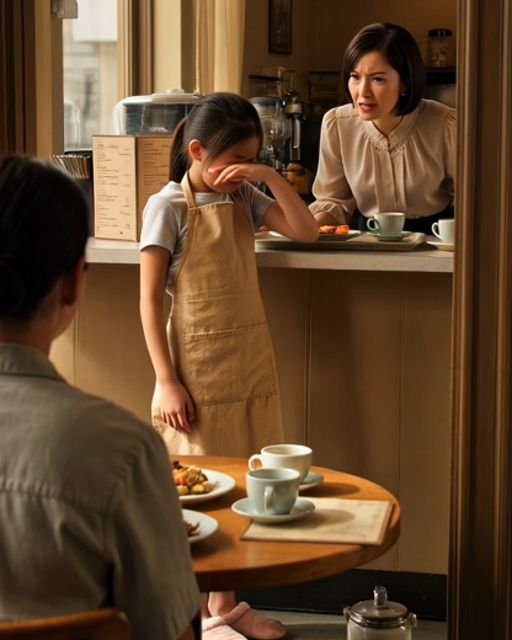
“Stupid girl. Do you know how much that costs?” A woman’s voice, sharp as broken glass. I turned toward the counter. A little girl – maybe eight, nine tops – stood there in an apron that hung past her knees. Her hands were shaking.
“I’m sorry, I’m sorry,” she whispered.
No one else looked up. The other customers just kept eating. I watched her wipe her eyes with the back of her hand, watching the woman’s face turn red.
I ordered another coffee just to stay longer. To watch.
Over the next hour, I saw that girl refill water glasses, clear tables, take orders. In an eight-year-old’s body doing work that should’ve been illegal. The woman—I assumed owner or manager—barked at her constantly. When the girl moved too slow: “Useless.” When she mixed up an order: “How are you this dumb?”
But what got me was her bedroom slippers. Pink, threadbare. She was wearing bedroom slippers to work.
I asked my server who the kid was. She wouldn’t say much. “It’s… complicated. Her mom works here sometimes.”
Complicated. That word made my blood boil.
I asked to speak to the owner. The woman from behind the counter appeared, hostile, defensive before I’d even opened my mouth.
“That little girl,” I said quietly. “How long has she been working here?”
Her jaw clenched. “She’s family. She helps out. It’s fine.”
It wasn’t fine. None of it was fine.
I finished my coffee and walked out. But I didn’t go far. I sat in my truck for twenty minutes and dialed the number I should’ve dialed the moment I saw those bedroom slippers.
The dispatcher’s voice was calm, professional. It made my own voice sound shaky. I told her what I saw. The little girl, the yelling, the slippers.
I gave them the address of the diner, “The Corner Spoon.”
I stayed in my truck, parked across the street. I felt like a spy, but I had to see it through. What if they didn’t come? What if they came and the woman lied her way out of it?
About fifteen minutes later, a squad car pulled up, no lights, no siren. It was quiet, discreet. Two officers got out. One was older, with graying hair and a weary look. The other was younger, looking sharp and alert.
They went inside. The bell chimed.
From my vantage point, I couldn’t see much. Just the silhouettes of the officers talking to the woman at the counter. I saw her arms wave frantically. I saw the little girl shrink back into a corner near the kitchen.
My heart pounded in my chest. I had a knot in my stomach the size of a fist. Had I done the right thing? Of course I had. A child was in trouble.
After what felt like an eternity, the door opened. The officers came out, followed by the woman. She wasn’t in handcuffs. My stomach dropped.
But then she turned, and her eyes, blazing with a fire I’d never seen before, found me. They locked right onto me in my truck. She knew. She knew it was me.
She marched across the street, dodging a slow-moving sedan. She pounded on my window with her fist. I had no choice. I rolled it down a crack.
“Are you happy now?” she screamed, her voice cracking. “You have no idea what you’ve just done. No idea.”
Tears were streaming down her face, but they weren’t tears of remorse. They were tears of pure, unadulterated rage and despair.
The older officer walked over and gently put a hand on her shoulder. “Ma’am, let’s not make this worse. Sarah, please.”
He called her Sarah. Her name was Sarah.
He looked at me, his expression unreadable. “You’re the one who called this in?”
I nodded, my throat dry. “Yes, sir. That little girl…”
“We’re handling it,” he said, his tone flat. “Social services has been notified. They’ll be meeting them at their home.”
He led the woman, Sarah, back to the diner. She kept looking back at me, her face a mask of anguish.
The diner door closed. A few minutes later, Sarah and the little girl came out. The girl was holding her mom’s hand, her face buried in her mom’s coat. They got into a beat-up old car and drove away.
The police followed them.
I sat there for a long time, the engine off, the silence in my truck deafening. The woman’s words echoed in my head. “You have no idea what you’ve just done.”
The next few days were hell. I couldn’t sleep. I couldn’t eat. Every time I closed my eyes, I saw the little girl’s shaking hands and her mother’s furious, tear-streaked face.
I kept telling myself I did what anyone should have done. I protected a child.
But did I?
On Thursday, I drove by The Corner Spoon. A piece of cardboard was taped to the door. “CLOSED DUE TO FAMILY EMERGENCY,” it said in black marker.
My guilt deepened. A family emergency that I had created.
I couldn’t shake the feeling that I’d only seen a snapshot of a much larger, more painful picture. The waitress’s word came back to me. “Complicated.”
I spent the weekend trying to distract myself, but it was no use. On Monday morning, I knew I had to do something. I couldn’t just walk away. I felt responsible.
I started asking around. I went to the library and looked up the diner’s ownership records. It was registered to a man named Arthur Finch, not to Sarah.
That was the first piece that didn’t fit.
I decided to try and find the other waitress. The one who had seemed sympathetic. I didn’t know her name. I just had a vague memory of her face.
I went back to the diner. It was still closed. I sat in my truck across the street again, feeling like a fool. What was I even doing?
Just as I was about to give up and go home, I saw her. The waitress. She was walking toward the diner with a key in her hand.
I got out of my truck and hurried across the street. “Excuse me,” I said, my voice catching her by surprise.
She turned, her eyes wide with recognition. “You’re the man from the other day.”
“I am,” I said. “I know this is weird, but I need to understand. I feel like I’ve made a terrible mistake.”
Her face softened. She looked tired, her shoulders slumped. “Her name is Brenda. And you probably did.”
She unlocked the diner door. “Come on in. I’m just here to grab my last paycheck.”
We sat in one of the booths, the diner eerily quiet and dark.
“Her name is Maya,” Brenda said, her voice low. “The little girl. And Sarah is her mom.”
“Is she… is she a bad mom?” I asked, dreading the answer.
Brenda let out a short, bitter laugh. “Sarah? She’s the best mom I’ve ever seen. She’s just at the end of her rope.”
She then told me the whole story.
Maya had a rare form of juvenile arthritis. It was aggressive and painful. There was an experimental treatment, a series of infusions, that wasn’t covered by their insurance. It was their only real hope of stopping the disease before it caused permanent damage.
The cost was astronomical.
Maya’s father had walked out a year ago, unable to handle the stress and the medical bills. Sarah was left to do it all on her own. She worked as a server at The Corner Spoon during the day and cleaned offices at night. She barely slept.
“The owner, Mr. Finch, is a real piece of work,” Brenda explained. “He knows Sarah is desperate, so he pays her under the table, way below minimum wage. But it’s cash, and she needs every penny.”
The day I was there, Maya had a bad flare-up in the morning. She couldn’t go to school. Sarah couldn’t afford a sitter, and she couldn’t afford to miss a day of work. So she brought Maya with her.
“Maya hates seeing her mom so stressed,” Brenda said, her eyes welling up. “She just wanted to help. So she started trying to bus tables, refill waters. She’s a sweet kid.”
And the yelling? The harsh words?
“Sarah’s terrified,” Brenda whispered. “She’s so stressed she’s about to snap. Every time she looks at Maya, she sees the pain her daughter is in, and she sees the bills piling up. She’s not angry at Maya. She’s angry at the world. It just… it comes out all wrong.”
The bedroom slippers. It hit me like a ton of bricks. Of course. Maya had been home, probably in bed, when her mom had to rush her to the diner. There was no time to think about proper shoes.
“Your call… it was the final straw,” Brenda continued. “Social services got involved. They saw the situation, saw that Sarah was overwhelmed. They didn’t take Maya away, thank God. But they mandated that Sarah attend parenting classes and find proper childcare. She lost her night job because she had to be home. And Mr. Finch fired her from here the next day. Said she was too much trouble.”
I felt sick. Physically sick.
I hadn’t saved a child. I had potentially destroyed her only chance. I had taken a desperate woman and pushed her right off the cliff.
“How much?” I asked, my voice hoarse. “How much for the treatment?”
Brenda told me the number. It was more money than I’d ever seen in my life. A down payment on a house.
“They have a deadline,” she added. “To get into the next treatment cycle. It’s in three weeks.”
I left the diner that day a different man. The self-righteous anger I’d felt was gone, replaced by a deep, crushing shame. I had judged without understanding. I had acted without knowing the facts.
I went home and I couldn’t sit still. I paced my small apartment for hours. I had to fix this. I had to.
I wasn’t a wealthy man. I worked in construction, a project manager. I had some savings, but not nearly enough.
But I knew people. I knew good people.
The next morning, I called in a few favors. I started a crowdfunding page online. I wrote out the whole story, starting with my own mistake.
“I walked into a diner and made a snap judgment,” I wrote. “I saw what I thought was a bad mother, and I called the police. I was wrong. I was so, so wrong. I saw a moment of desperation, and I mistook it for cruelty. Now, a mother named Sarah is out of a job, and her daughter, Maya, might miss her only chance at a life without pain. I can’t fix my mistake on my own, but maybe, together, we can.”
I was terrified to post it. It was an admission of my own foolishness, my own arrogance. I clicked the button and held my breath.
The first donation was for twenty dollars, from one of my crew members. Then another for fifty. Then a hundred from my boss.
I shared it on our local town’s social media page. I told Brenda, and she shared it with the other restaurant workers in the area. The story started to spread.
People weren’t just donating. They were sharing their own stories of being single parents, of struggling with medical bills, of being misjudged.
The local news picked up the story. They interviewed me. It was the most nerve-wracking thing I’d ever done. I didn’t hold back. I told them how wrong I’d been.
The reporter then went to find Sarah. She was hesitant to talk at first, but when she saw the outpouring of support, she agreed. She spoke with such dignity and love for her daughter, her exhaustion and fear plain for everyone to see. She never once blamed me. She just talked about Maya.
And that’s when things exploded.
Donations poured in from all over the country. People were moved by Sarah’s strength and by the honesty of the situation. It was a story about a community righting a wrong. About people helping one of their own.
In two weeks, we had surpassed the goal. We had enough for the entire course of treatment, with extra to help Sarah get back on her feet so she could focus solely on Maya.
The day the fundraiser closed, I went to see her. I found her address through Brenda. I knocked on the door of her small apartment, my hands shaking.
She opened it. For a moment, we just stood there. The anger was gone from her eyes. All I saw was a tired, grateful mother.
“I’m so sorry,” I said, the words feeling small and inadequate.
She shook her head. “Don’t be. You… you made a mistake. But then you did something amazing. You gave my daughter her future back.”
She invited me in. Maya was sitting on the sofa, drawing in a coloring book. She wasn’t wearing slippers. She was wearing bright new sneakers.
She looked up at me and smiled, a real, genuine smile. “Are you Michael?” she asked.
“I am,” I said.
She tore a page out of her coloring book and handed it to me. It was a drawing of a smiling sun.
“Thank you,” she said.
I stayed for a while. Sarah made coffee. We talked, not about the diner or my call, but about Maya, about her favorite things, about her hopes for the future. For the first time, I wasn’t seeing a situation. I was seeing a family.
A few months later, I got an email from Sarah. It was a picture of Maya on a swing set at a park. She was laughing, her legs pumping high in the air. She was just being a kid. The treatment was working.
The Corner Spoon eventually reopened under new ownership. Arthur Finch had sold it after the bad press. The new owners even offered Sarah her job back, with a proper wage and flexible hours, which she gratefully accepted.
Sometimes I go in for a coffee. Sarah and I always share a quiet nod of understanding. We went through something strange together, and we came out the other side.
I learned something profound from all of this. It’s easy to see a moment in someone’s life and think you have them all figured out. It’s easy to judge, to point a finger, to assume the worst. But a single moment is never the whole story. The real test of our character isn’t in never making a mistake, but in what we do to make it right. Compassion isn’t just a feeling; it’s an action. It’s taking the time to look past the surface and see the struggling human being underneath.