My mother’s favorite thing was her antique jewelry box. When she died, she left it to me. The day of the reading, my sister Sloane snatched the will, saw the box was mine, and laughed. “She was losing her mind,” Sloane said. “This is worth a fortune. It’s mine.”
Before I could even speak, she had her lawyer on the phone, contesting everything. The box was taken and locked away as evidence. I was devastated. It wasn’t about the money. It was the last piece of my mom I had left.
The legal battle dragged on for six agonizing months. Sloane’s argument was that our mom wasn’t of sound mind. She’d do anything to win.
Yesterday, the judge finally ruled. In Sloane’s favor.
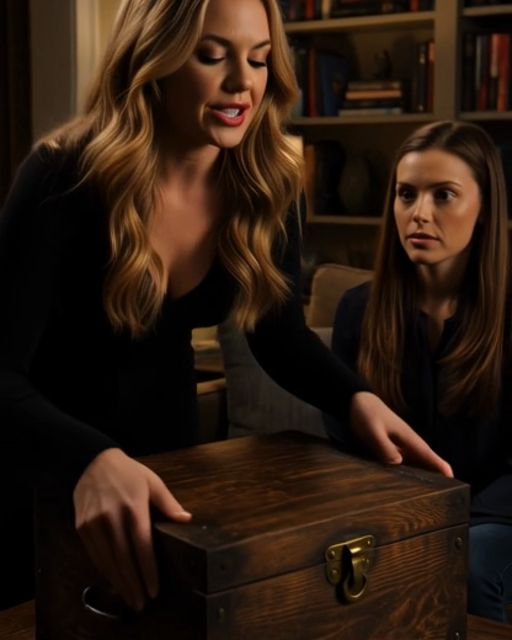
She came to my house that night, not to apologize, but to gloat. She placed the heavy wooden box on my coffee table with a smug smile. “Just wanted you to see its contents one last time before it goes to the auction house.” She opened the lid to show me the glittering diamonds and pearls, her eyes gleaming with greed.
I just stared at her. Then I smiled. “Go ahead, Sloane. Take it. It’s all yours.”
Her smile faltered, confused by my calmness. She scooped the heavy necklaces and rings into her purse, leaving the empty, velvet-lined box behind. What she doesn’t know, and what the lawyers never found, is that our mother was a brilliant woman. And she knew her daughter perfectly.
She knew Sloane would only see the jewels. She would never think to check for the false bottom. The one where our mother kept the deeds and papers to every single thing she wanted me to have.
After the sound of her car engine faded into the night, I sat alone in the silence. The house felt too big, too quiet. The ornate, carved wooden box sat on the table, looking hollow and violated.
My hands trembled as I reached for it. I ran my fingers over the familiar patterns, the same ones Mom’s hands had traced a thousand times. A wave of grief, fresh and sharp, washed over me.
This wasn’t a victory lap. It was a moment of profound sadness. My sister and I were broken, maybe for good.
I took a deep breath and turned the box over. On the underside, near the left hinge, was a tiny, almost invisible notch in the wood. Mom had shown it to me when I was a teenager, swearing me to secrecy.
“Some things are more valuable than they look, sweetie,” she’d said with a wink. “And some people only look for the sparkle.”
Using my thumbnail, I pressed firmly into the notch. There was a faint click, a sound no louder than a sigh. I turned the box upright again and lifted the velvet tray that had held the jewelry. It came away easily now, revealing a hidden compartment beneath.
My breath caught in my throat. It wasn’t full of cash or gold bars. It was full of papers, yellowed with age, and tied neatly with faded silk ribbons.
The first bundle I picked up was the deed to our childhood home. The one I was sitting in right now. The one Sloane had assumed would have to be sold to pay for her legal fees and her lavish lifestyle. It was in my name, signed and notarized a full year before Mom’s health had even started to decline.
My heart pounded against my ribs. There was more.
Beneath the deed was a thick stack of share certificates for a modest, but stable, portfolio of stocks. They were also in my name. And a document transferring ownership of Mom’s car, a reliable sedan that I loved.
Finally, at the very bottom, was a thick, sealed envelope. My name was written on the front in Mom’s elegant, looping handwriting.
I carefully broke the wax seal. Inside were not more legal documents, but a dozen pages of letter paper, filled with that same familiar script.
“My dearest Clara,” it began.
“If you are reading this, then things have likely gone as I feared they would. I hope with all my heart that I am wrong, that Sloane found her conscience and that you are sharing this moment. But I know my girls.”
A single tear rolled down my cheek and splashed onto the page.
“Your sister sees the world in terms of price tags, Clara. It is not entirely her fault. I think life scared her, and she decided money was the only armor she could trust. She loves shiny things because they distract her from the things that are truly valuable, and therefore, truly terrifying to lose. Things like love. And memory.”
“I couldn’t bear the thought of this house being sold. This is where you took your first steps. It’s where I bandaged your knees and where your father and I danced in the kitchen. Its value is not in its brick and mortar, but in our lives.”
“The things in this compartment are for you. They are your security, your foundation. Use them to build a life of peace and happiness, not one of excess. That is all I have ever wanted for you.”
The letter went on, but there was one last part that made me stop breathing for a second.
“As for the jewelry,” Mom wrote, “I have a little secret. They say all that glitters is not gold. Sometimes, it’s just very, very good glass.”
I read the line again. And again. A slow, disbelieving laugh bubbled up from my chest.
Mom had replaced every single diamond, pearl, and ruby with fakes. Perfect, dazzling, and utterly worthless replicas.
The real collection, she explained, had been sold off piece by piece over the last two years. The proceeds were what funded the stock portfolio she’d left me. She had, in essence, converted Sloane’s inheritance into my own.
It was a masterstroke. A plan so perfectly tailored to our personalities, it was both devastating and brilliant.
The next morning, I called my own lawyer, a kind, older man named Mr. Abernathy. I explained the situation, my voice steady for the first time in months. He listened patiently, a low chuckle rumbling through the phone when I told him about the jewelry.
He confirmed what I suspected. The documents were ironclad. They predated the will and Sloane’s claims of our mother’s incompetence by a wide margin. The house, the car, the stocks – they were all mine, free and clear. There was nothing Sloane could do.
“Your mother was a very clever woman, Clara,” he said. “And she loved you very much.”
For the next few weeks, I lived in a strange sort of limbo. I filed the paperwork, secured my assets, and tried to process the dual reality of my relief and my sorrow. The house felt like mine again. I started tending to Mom’s garden, the scent of her roses a comforting presence.
I didn’t hear a word from Sloane. I imagined her on a spending spree, celebrating her court victory. It gave me a bitter pang in my heart.
The call came on a Tuesday afternoon. It wasn’t Sloane, but a man with a clipped, professional voice. He introduced himself as a senior appraiser from a prestigious auction house in the city.
“I’m calling regarding the collection brought in by a Ms. Sloane Davenport,” he said, his tone icy. “We have completed our evaluation.”
I stayed silent, letting him speak.
“Ma’am, these are fakes,” he said bluntly. “High-quality cubic zirconia and paste, but fakes nonetheless. We have a policy of reporting attempted fraud to the authorities.”
My blood ran cold. “Fraud?”
“Your sister provided documentation suggesting this was the Davenport family heirloom collection, valued in the seven figures. She was attempting to secure a significant advance against the auction proceeds. The discrepancy is… substantial.”
He wasn’t asking me for anything. He was just informing me. It was a professional courtesy before things got very, very messy for my sister.
That evening, Sloane showed up at my door. The smug confidence was gone, replaced by a terrifying, pale fury. She didn’t wait for me to invite her in; she pushed past me.
“What did you do?” she hissed, her eyes wild.
“I didn’t do anything, Sloane,” I said softly, closing the door.
“They’re fake! The auction house called me a fraud! They think I tried to scam them! This is your fault!” She was pacing my living room like a caged animal.
“Mom replaced them years ago,” I said simply. “She sold the real ones to fund an investment portfolio.”
Sloane stopped dead. She stared at me, her mind clearly struggling to connect the dots. “What portfolio? What are you talking about?”
I didn’t answer. I just looked at her.
The realization dawned on her face, a slow, sickening wave of understanding. Her eyes darted around the room, at the familiar furniture, the photos on the mantle, the house she had tried to take.
“The box,” she whispered, her voice cracking. “It was in the box.”
She sank onto the sofa, the fight draining out of her completely. She looked smaller than I had ever seen her, all the sharp edges worn down by defeat.
“She gave it all to you,” she said, not as a question, but as a statement. “Everything.”
I nodded. “She left you the jewels, Sloane. That’s what you said you wanted. You fought for them.”
Hot, angry tears streamed down her face. “But they’re worthless!”
“Are they?” I asked quietly. “You had them for two weeks. You thought you were rich. Did it make you happy?”
Her silence was the only answer I needed.
We sat there for a long time, the setting sun casting long shadows across the room. The only sound was her ragged breathing.
“I don’t understand,” she finally choked out. “Why would she do that to me?”
I went to the antique box, which I now kept on the mantle. I took out the last few pages of Mom’s letter, the part I had read over and over. I handed them to her.
Sloane took them with a shaking hand and began to read.
“My dearest Sloane,” the letter for her began, tucked behind my own. “I know you will find this one day. I have asked Clara to give it to you when the time is right.”
“I am not punishing you, my love. I am trying to save you. I have watched you chase money your whole life, believing it would make you safe. But it has only made you lonely. It has put a wall between you and the people who love you, most of all your sister.”
“The jewels were your test. And I knew you would fail it. Because I failed you first. I was the one who praised you for your ambition, who marveled at your drive, but who forgot to teach you that your worth is not in your bank account. Your worth is in your heart, which I know is good and kind, even if you hide it well.”
“I have left you something far more valuable than diamonds. I have left you a choice. You can continue down this path, angry and alone. Or you can turn around and see that the real treasure, the family I tried to build, is still waiting for you. Your sister is waiting for you.”
“The inheritance I leave for you both is not in deeds or in jewels. It is in each other. Please, don’t squander it.”
Sloane finished reading and the letter fell from her limp fingers. She was sobbing now, deep, gut-wrenching sobs of a lifetime of pain and regret.
I didn’t go to her. I didn’t rush to comfort her. I just let her grieve for the mother she had misunderstood and the life she had misjudged. This was her moment, her reckoning.
When her tears finally subsided, she looked up at me, her face blotchy and raw. “She really loved me,” she whispered in disbelief.
“She always loved you,” I replied. “We both did.”
It wasn’t a magic fix. The wounds between us were deep and old. But it was a start. Sloane had to deal with the legal mess at the auction house, which I helped her navigate. It was humiliating for her, but it was also humbling.
She had to sell her fancy car and move out of her expensive apartment. For the first time in her adult life, she was not just broke, but broken.
A few months later, she asked if she could come and help me in Mom’s garden. She showed up in old clothes, her hands unmanicured for the first time I could remember.
We didn’t talk much at first. We just worked, pulling weeds, turning the soil, and pruning the roses. We were side-by-side, our hands in the same earth, under the same sun.
One afternoon, she uncovered the old stone birdbath that had been overgrown with ivy. “I remember this,” she said, her voice soft. “Dad put this here. We used to pretend it was a wishing well.”
“I remember,” I said, smiling at the memory.
She looked at me, her eyes clear of the greed that had clouded them for so long. “Can I make a wish now?”
“Go ahead,” I said.
She closed her eyes for a long moment. When she opened them, a single tear traced a path through the dirt on her cheek.
“What did you wish for?” I asked gently.
She gave me a small, watery smile. “For more time.”
And in that moment, I knew she finally understood.
Our mother’s true legacy wasn’t the house or the money or even the box. It was this. This fragile, precious chance to find our way back to each other. It was the understanding that the most valuable things in life are never the ones you can lock away in a safe. They are the memories you make, the forgiveness you offer, and the love that endures, long after all the glitter has faded.