It was a horrible afternoon. Wind ripping through everything, screaming like a banshee. My son, Finn, was trying to push a cart full of groceries home. Just ten years old, fighting every gust. I watched from the window, heart in my throat.
Then the wind won. The cart flipped. Groceries spilled, apples rolling into the street. Finn stumbled. No one stopped.
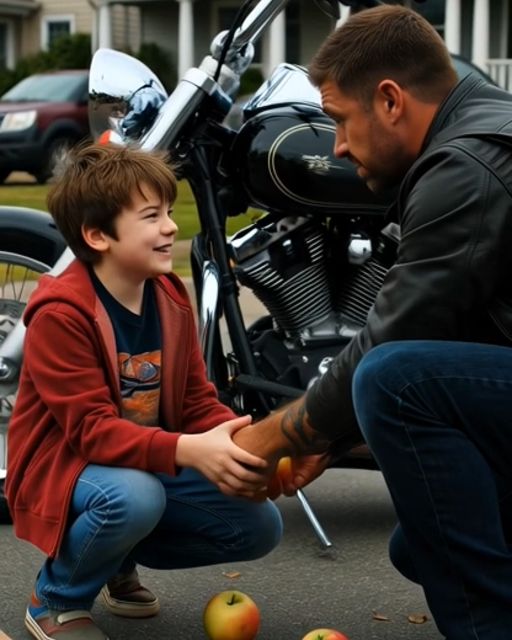
A deep rumble cut through the chaos. A huge Harley. A man jumped off, all leather and chrome. He grabbed the cart, helped Finn gather the scattered food. My breath caught. A good Samaritan. I was rushing out the door, ready to thank him.
That’s when I saw it. As he bent down, his sleeve rode up. A small, distinctive tattoo on his forearm. A coiled snake.
Exactly like the one I’d seen on my ex-husband’s best friend. Rhys. The man whom he betrayed. He helped my ex empty our bank accounts fifteen years ago, and then my ex bailed on him and vanished.
Rhys looked up. His eyes met mine. They widened just a fraction. Finn, oblivious, smiled at him. “Thank you, mister!”
Rhys straightened, wiping something from his brow. He didn’t say a word. Just pushed the cart back into Finn’s shaking hands. Then he looked at me again. His gaze was cold. Almost a warning.
And then Finn said, “Mom, he asked where Dad was.”
I looked from my son’s innocent face to the man who’d just reappeared from my deepest nightmares. His next words were a low growl, meant only for me. “Tell him I’m still looking for him.”
The rumble of his Harley was a roar that seemed to shake the very foundations of our little apartment building. I pulled Finn inside, my hand trembling as I bolted the door.
My mind was a hurricane, just like the wind outside. Fifteen years. Fifteen years of rebuilding, of scraping by, of raising Finn on my own. Fifteen years of telling myself that the past was dead and buried.
And now, here was a ghost in black leather.
Finn was chattering away about the cool motorbike. He didn’t see the terror in my eyes. How could he? His father, David, was a faded photograph on the mantelpiece, a collection of stories I’d carefully curated. The hero who had to go away for work.
Not the man who smiled at me over breakfast and then vanished by lunchtime, taking every penny we had. Leaving me with a lease I couldn’t pay and a baby on the way.
Rhys was his shadow in that memory. His best friend since kindergarten. The one who stood beside him at our wedding. The one who, I was sure, had helped him plan the whole thing. David was charming, but Rhys was the clever one.
I spent the night with the lights on. Every creak of the floorboards, every rattle of the window pane was him. Rhys. Coming back to finish what they started. But what was there left to take? We had nothing.
The next day, I took Finn to school, my eyes scanning every street corner, every parked vehicle. I felt hunted. I considered calling the police, but what would I say? That a man from my past helped my son with groceries and it scared me? They would think I was crazy.
I worked at a small diner downtown, pouring coffee and wiping tables. It was an honest living. It was our life. That afternoon, the bell above the door chimed, and my heart fell into my shoes.
It was him.
Rhys slid into a booth at the back, away from the other customers. He didn’t look threatening. He looked tired. Older. The lines around his eyes were deeper than I remembered. He just sat there, watching me.
My boss, Martha, nudged me. “You got a customer, Sarah.”
My feet felt like lead. I grabbed a menu and a glass of water, my hands shaking so badly the ice rattled. I placed them on his table without making eye contact.
“What can I get you?” I asked, my voice a squeak.
“I’m not here for coffee, Sarah,” he said. His voice was gravelly, low. “We need to talk.”
“We have nothing to talk about,” I whispered, turning to leave.
“It’s about David,” he said, stopping me cold. “And it’s about your son.”
I froze. I slowly turned back to face him. His eyes weren’t cold like they were yesterday. They were filled with an urgency that unsettled me more than any threat could.
“Sit down,” he said softly. “Please. Just for five minutes.”
I glanced at Martha, who was watching with a frown. I gave her a weak, reassuring nod and slid into the vinyl seat opposite him. Up close, I could see the faint scars on his knuckles. The smell of engine oil and worn leather clung to him.
“You think I helped him, don’t you?” he started, his gaze unwavering.
I just stared. What was there to say?
“You think we ran off together with your money. You think I got my cut and we laughed about it.”
My silence was my answer.
He let out a short, bitter laugh. “David played us both, Sarah. He played everyone.”
I wanted to get up and walk away. I wanted to scream at him to leave me alone. But I was rooted to the spot, compelled by the raw pain in his voice.
“He came to me a week before he left,” Rhys continued, leaning forward. “He said you two were having trouble. He said he wanted to surprise you. A grand gesture.”
My brow furrowed. I couldn’t remember us having any particular trouble. We were fine. Or so I thought.
“He told me he was buying a house for you both, a real family home, out in the country. He said he wanted to keep it a secret from you until the papers were signed. He needed to move the money from your joint account to a new one, a holding account, to make the purchase. He said he needed my help to do the transfers online without you seeing them and spoiling the surprise.”
He looked down at his hands on the table. “I was his best friend. Since we were six years old. I trusted him. Of course, I helped him. I thought I was helping build your future.”
The story was so absurd, so outlandish, I almost laughed. But the look on his face was one of profound, ancient regret.
“The day he disappeared,” Rhys said, his voice cracking slightly, “he was supposed to be at my garage, helping me fix an engine. He never showed. I called him. No answer. I called you. You were hysterical. That’s when I knew.”
“Knew what?” I breathed.
“That he hadn’t just left you. He’d set me up to take the fall. He left a paper trail a mile wide pointing straight at me. My name on the transfer authorizations. My computer’s IP address. It took me two years and every cent I had to clear my name. The police questioned me for weeks. Your family, my family… they all thought I was a monster.”
I stared at him, my world tilting on its axis. The coiled snake tattoo was visible again.
He saw me looking at it. “I got this after,” he said quietly. “To remind myself what happens when you trust a snake. David wasn’t just my friend. He was my brother. And he poisoned everything.”
I didn’t know what to believe. My entire narrative for the last fifteen years, the one that fueled my survival, was that they were two villains in a story where I was the victim. But if he was telling the truth… then he was a victim too.
“Why?” I finally managed to ask. “Why are you here now? Why are you looking for him?”
“It’s not about the money,” he said, shaking his head. “I gave up on that a decade ago. It’s about something else. Something I found out a few months ago.”
He hesitated, and for the first time, I saw fear in his eyes. Real fear.
“I ran into an old cousin of his,” Rhys explained. “Someone David had kept in touch with, off and on. He told me David wasn’t doing well. He’s sick, Sarah. Very sick.”
I felt a strange, hollow pang in my chest. I had wished him ill a thousand times over the years, but hearing it for real felt different.
“It’s a genetic thing,” Rhys went on, his voice dropping even lower. “A rare condition that affects the heart. His father had it. It’s manageable if you catch it early. But if you don’t…” He trailed off, letting the words hang in the air.
The diner suddenly felt very cold. I could hear the clatter of cutlery, the murmur of conversations, but it all sounded like it was coming from a great distance.
“It’s hereditary, Sarah,” he said, his eyes locking onto mine. “It passes from father to son.”
The breath left my body in a rush. Finn.
He saw the understanding dawn on my face. “Yesterday,” he said, “when I saw your boy struggling with that cart… he was out of breath. He looked pale. It was probably just the wind, but I couldn’t take the chance. I had to find you. I have to find David.”
My carefully constructed world shattered into a million pieces. This wasn’t about revenge. This wasn’t about the past. It was about Finn’s future.
“We need his medical history,” Rhys said, his voice firm but gentle. “We need to know what markers to test for. We need to know if Finn is at risk.”
Tears were streaming down my face now. I wasn’t crying for the stolen money or the lost years. I was crying from the terrifying, overwhelming love a mother has for her child.
Rhys pushed a crumpled napkin across the table. “I’m sorry, Sarah. I’m so sorry to bring all this back up. But I couldn’t live with myself if I didn’t warn you.”
That night, for the first time in fifteen years, Rhys and I were on the same side. He came over to my apartment after my shift. He sat awkwardly on my worn-out sofa, a giant of a man looking out of place amongst Finn’s toys.
He told me everything he knew. The cousin had given him a general area where David might be. A small, forgotten town in the mountains, a few states over. A place he used to talk about wanting to disappear to when they were kids.
“He won’t have money,” Rhys said. “Whatever he took, he would have burned through it years ago. David was never good with money. Only with taking it.”
A plan began to form. A desperate, crazy plan. I had a few days off. I had a little savings, money I was putting aside for a new bike for Finn.
Two days later, Finn was with Martha, who agreed to watch him after I told her a carefully edited version of the story. I was in the passenger seat of Rhys’s old, beaten-up pickup truck, the Harley left behind in his garage.
The miles flew by in a blur of awkward silence and necessary conversation. We were two strangers bound by the worst moments of our lives. I learned that he owned a small motorcycle repair shop. That he never married. That the betrayal had cost him more than just money; it had cost him his ability to trust.
And he learned about Finn. I showed him pictures on my phone. Finn at his first day of school. Finn with a birthday cake. Finn with a silly grin and a missing front tooth.
I saw something soften in Rhys’s face. “He looks like you,” he said. “He has your eyes.”
The town was even more run-down than I’d imagined. One main street with boarded-up shops and a single blinking traffic light. We checked into a dingy motel. The search felt hopeless. We were looking for a ghost.
For two days, we showed David’s old photo around. No one recognized him. My hope was starting to fade, replaced by a cold dread.
On the third day, Rhys had an idea. “Did he have any hobbies?” he asked. “Anything he was passionate about?”
I thought back. “Books,” I said immediately. “He loved old books. He could spend hours in a dusty, second-hand bookstore.”
There was only one in town. It was a cluttered little place run by a woman with glasses perched on the end of her nose. We showed her the photo.
She squinted at it. “He looks… familiar. Thinner, maybe. And grayer. But the eyes are the same.” She tapped her chin. “A man like that comes in sometimes. Quiet fellow. Always looks at the history section. Pays in cash.”
My heart hammered against my ribs. “Do you know where he lives?”
She gave us a vague direction. “Up the old logging road. There’s a little cabin up there. He mentioned he was caretaking it.”
The road was barely a road at all. The truck bounced and groaned its way up the mountain. We found the cabin tucked away in a grove of pine trees. It was small, with peeling paint and a sagging porch. Smoke curled from the chimney.
Rhys parked the truck a short distance away. “You should wait here,” he said.
“No,” I replied, my voice steady. “I’m coming with you.” This was my ghost to face, too.
We walked up to the door. I could hear a faint cough from inside. Rhys knocked.
The man who opened the door was a scarecrow. Thin, pale, with hollowed-out cheeks and the haunted eyes I remembered. It was David.
He stared at Rhys, his mouth falling open. Then his gaze shifted to me, and all the color drained from his face. He looked like he’d seen the two ghosts he feared most in the world.
“Rhys,” he rasped. “Sarah.”
There was no anger left in me. Just a profound sadness. The man who had been a titan of betrayal in my mind was just a sick, lonely person living in a shack.
“We know you’re sick, David,” Rhys said, his voice flat.
David sagged against the doorframe. “How?”
“It doesn’t matter how,” I said, finding my voice. “We have a son. Finn. He’s ten years old.”
I held out my phone, showing him a picture of our boy. A tear slid down David’s cheek. It was the first sign of real emotion I’d seen from him.
“He needs to be tested,” I said, my voice breaking. “I need your medical history. I need to know what to look for.”
David stared at the picture of the son he’d never met. He stumbled back into the cabin and collapsed into a chair, his head in his hands. He sobbed, deep, ragged sounds of a man broken by a lifetime of regret.
He gave us everything. The name of the condition, his doctors’ names, his entire family medical history. He told us he was sorry, words that felt small and useless after fifteen years, but they sounded genuine. He explained that the money was gone in less than two years, spent on bad investments and a life he couldn’t sustain. All that was left was guilt.
We left him there in his cabin in the woods. There was nothing more to say. The past was finally, truly, laid to rest.
The journey home was different. The silence wasn’t awkward anymore. It was comfortable. We had faced the dragon together and won.
Finn got tested the next week. The days waiting for the results were the longest of my life. Rhys called every single day to check in.
The call from the doctor finally came. I answered with a shaking hand. Finn didn’t have it. He was perfectly healthy. The genetic lottery had spared him.
I cried with relief until I couldn’t breathe. My first call was to Rhys. I could hear him let out a long, shuddering breath on the other end of the line. “Thank God,” he whispered.
Life settled back into its rhythm, but it was a new rhythm. Rhys became a tentative part of our lives. He’d stop by the diner for coffee. He came over and helped Finn build the new bike I bought him. I saw the way Finn looked at him, with a kind of hero worship. For the first time, I didn’t correct him.
One evening, Rhys and I were sitting on my porch while Finn chased fireflies in the yard.
“I misjudged you completely,” I said softly. “I saw that tattoo and I saw a villain.”
He looked at his forearm, at the coiled snake that had once terrified me. “Sometimes,” he said, “the things that look like a threat are really a warning. A reminder of a lesson you had to learn the hard way.”
I realized then that life is never as simple as we think. The lines we draw between good and evil, hero and villain, are so often blurred. We build stories in our minds to make sense of the pain, but the full truth is always more complicated, more human. The real treasure wasn’t the money David stole; it was the son he gave me. And the unexpected peace came not from revenge, but from a place of forgiveness and understanding, brought to my door by a man in a leather jacket with a snake tattooed on his arm. He wasn’t the hero I thought I saw at first, nor the villain I feared. He was just a man who, like me, had been broken by the past, and was trying to put the pieces back together. And in helping each other, we both became whole again.