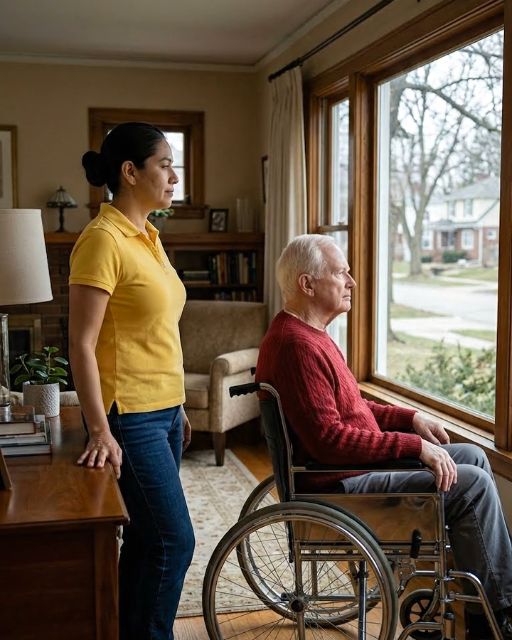

My stepmom found my journal where I’d written that I wished she would die. She threw it at me and said, “You’re just like your dirty mother! Leave if you want!” I didn’t leave because I was unemployed and had nowhere to go, sitting there in the hallway with the wind knocked out of me. I crawled into my small bedroom, clutched my pillow, and cried myself to sleep. But soon I woke up hearing her screaming, a sound so high and jagged it cut right through the drywall of our thin-walled house.
I bolted upright, my heart hammering against my ribs like a trapped bird. I expected more insults, or perhaps she was having another one of her legendary meltdowns over a dish left in the sink. But this wasn’t an angry scream; it was a sound of pure, unadulterated terror. I scrambled out of bed, my feet hitting the cold linoleum, and ran toward the kitchen where the light was flickering.
There she was, Beatrice, slumped against the refrigerator, her face a pale shade of gray I had never seen on a living person. She was clutching her chest, her breathing coming in shallow, desperate gasps that sounded like a saw hitting a knot in wood. “I can’t… I can’t breathe, Maya,” she choked out, her eyes wide and pleading. All the anger I had felt an hour ago, all the dark wishes I had scribbled in that notebook, vanished in an instant.
I grabbed the cordless phone from the counter, my fingers trembling so hard I nearly dropped it. I dialed 911, my voice cracking as I gave our address in the outskirts of Manchester. I stayed on the floor with her, holding her hand even though she had just called me the most horrible names imaginable. She squeezed my fingers with a strength born of panic, her fingernails digging into my skin.
The ambulance arrived in what felt like hours but was likely only ten minutes. I watched them load her onto the stretcher, the blue lights strobing against the brickwork of our quiet street. I didn’t have a car, and I certainly didn’t have money for a taxi, so I just stood in the driveway in my pajamas as the sirens faded. I felt a strange, hollow coldness in my chest, wondering if my hateful words had somehow manifested into this nightmare.
I spent the rest of the night pacing the living room, staring at the journal that still lay splayed on the floor. The words “I wish she would die” looked ugly and childish under the harsh glow of the ceiling fan. I realized that hating someone is an easy hobby when things are going well, but it feels like a heavy burden when they are actually slipping away. I finally found some spare change in the sofa cushions, enough for a bus fare to the hospital once the sun started to peak over the horizon.
When I reached the intensive care unit, the air smelled of antiseptic and stale coffee. I found Beatrice behind a curtain, hooked up to a dozen monitors that beeped in a rhythmic, mechanical chorus. She looked small in that hospital bed, stripped of her expensive clothes and her sharp, biting tongue. A doctor approached me, looking tired and carrying a clipboard that seemed to hold the weight of the world.
“Are you the daughter?” he asked, and for the first time in three years, I didn’t correct him. He told me that she had suffered a massive pulmonary embolism and that she was lucky I had been there to call for help. He said she would need weeks of recovery and someone to care for her around the clock. My stomach dropped because I knew she had no one else; she had alienated her own siblings years ago.
For the next two weeks, I became her shadow in that hospital room. I fed her lukewarm broth, helped the nurses turn her, and sat by her side while she slept. We didn’t talk about the journal or the fight we had the night of the attack. It was as if a silent truce had been signed in the presence of death. I was still unemployed and broke, but I felt a strange sense of purpose that my life had been lacking.
One afternoon, Beatrice looked at me with clear eyes, the grayness finally replaced by a faint flush of life. “Why are you still here, Maya?” she asked, her voice raspy from the oxygen mask. I didn’t have a clever answer, so I just told her that she was the only family I had left, for better or worse. She turned her head away, but I saw a single tear track through the hospital gown’s collar.
When she was finally discharged, the real work began back at our small house. I had to manage her medications, cook heart-healthy meals, and help her walk from the bed to the bathroom. My own resentment started to flicker back to life as the days became a repetitive blur of caregiving. I felt like a servant in a house where I had been told I wasn’t wanted.
One evening, while Beatrice was napping, I decided to pack my things. I had managed to land a small part-time job at a local café, and I had enough for a deposit on a tiny shared room across town. I felt guilty leaving her while she was still weak, but I couldn’t forget the way she had looked at me that night in the hallway. I went to the kitchen to find my journal, intending to burn it and leave the past behind.
I found the notebook on the kitchen table, but it was closed and tucked inside a new leather cover. I opened it, expecting to see my hateful scribbles, but the page had been torn out. In its place was a letter written in Beatrice’s shaky, recovering handwriting. My heart raced as I began to read the words she had struggled to put down on paper.
“Maya,” the letter began, “I found your journal because I was looking for a reason to hate you as much as I hated myself.” She went on to explain that she had known my mother, not as a ‘dirty’ woman, but as her best friend who had trusted her to look after me. Beatrice had been in love with my father long before my mother passed, and the guilt of that secret had poisoned her every interaction with me. She wasn’t angry at me; she was terrified that if she loved me, she would be betraying the woman she had once called a sister.
While I was at the hospital those first few days, she had called a lawyer and changed her will, and she had also used her savings to pay off the debt my mother had left behind—a debt I didn’t even know existed. She had been secretly protecting my future while treating me like an enemy in the present. I sat at the table and sobbed, realizing that we had both been playing roles in a tragedy of our own making.
I didn’t leave that night; instead, I walked into her room and sat on the edge of her bed. We finally talked about my mother, about the music she liked, and the way she used to laugh at Beatrice’s terrible jokes. The wall between us didn’t crumble all at once, but the bricks were finally coming loose. I realized that the “dirty mother” comment wasn’t an insult to my mom, but a reflection of the shame Beatrice felt for wanting her life.
Months passed, and the house began to feel less like a prison and more like a home. I kept my job at the café, and Beatrice eventually returned to her part-time work at the library. We aren’t the perfect mother and daughter you see in commercials, and we still have our sharp moments. But we don’t hide our journals anymore, and we don’t wish for each other’s ends.
The rewarding conclusion to this story isn’t a pile of money or a grand house; it’s the quiet peace of a Tuesday evening spent watching TV together. I learned that people often scream the loudest when they are hurting the most inside. We spent years fighting a ghost when we could have been supporting each other through the grief of losing the same person. It took a near-death experience to teach us how to actually live together.
The life lesson I’ve taken away from all of this is that hate is often just a mask for a much deeper, more complicated pain. You never truly know the burdens someone is carrying, even the person sleeping in the room next to you. If I had left that night, I would have spent my life believing I was unloved and unwanted, never knowing the truth. Forgiveness isn’t about forgetting the mean things people say; it’s about understanding why they felt the need to say them in the first place.
Honesty is a jagged pill, but it’s the only thing that actually cures the infection of a secret. My stepmom and I aren’t perfect, but we are real, and that’s worth more than any luxury I could ever buy. We decided to keep the journal, not to look at the hateful parts, but to fill the rest of the pages with our new history. It’s a story of two broken people who decided to stop breaking each other.
If this story reminded you that there is always more to a person than the words they say in anger, please share and like this post. We all have “journals” of our own that we’re afraid for people to see, but sometimes opening them is the only way to heal. Would you like me to help you find a way to reach out to someone you’ve had a falling out with today?