I’d been riding solo for three years, dreaming of the day the Iron Wolves would finally patch me in. Marco was the reason I wanted to join in the first place – the guy was a legend. Six-foot-three, covered in scars, the kind of rider who’d pull over in a storm to help a stranded family. I’d seen him do it.
The night I got my prospect patch, Marco bought the first round. Told stories about the old days, made everyone laugh. I felt like I’d finally made it.
Then I met his girlfriend, Lia.
She flinched when he touched her shoulder. Wore long sleeves in August. Laughed at his jokes a half-second too fast, like she’d been trained.
I told myself I was imagining things. Marco was a hero. The guy who’d mentored me, taught me how to rebuild my engine, vouched for me with the club.
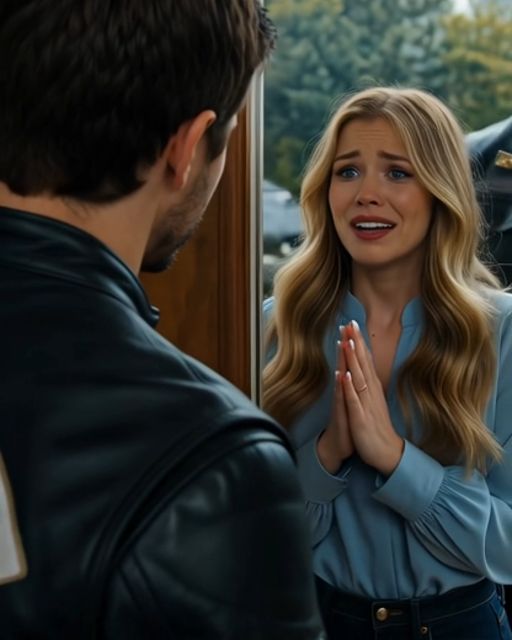
But then I was at his place picking up some parts, and I heard her voice through the door. Quiet. Pleading. “I’m sorry, I’m sorry, I won’t – “
The sound that followed made my blood stop.
I stood there frozen. My hand on the doorknob. My hero was inside that apartment, and suddenly I understood why Lia always parked her car facing the exit. Why she never stayed for the after-parties. Why her hands shook when she poured drinks.
The club had rules. Strict ones. You didn’t snitch. You didn’t question a brother. You sure as hell didn’t get involved in a patched member’s personal business—especially not when you were just a prospect.
But I also knew what I’d heard.
I had two choices: walk away and keep the patch I’d worked three years to earn, or knock on that door and lose everything I’d built with these men.
I’ve already decided what I’m going to do. I just needed proof.
My hand fell from the doorknob. I backed away slowly, my boots silent on the concrete walkway.
My heart was a jackhammer against my ribs.
Knocking on that door would have been stupid. It would have been my word against his, a prospect against a club legend.
I knew exactly how that would end for me. And for her, it would have been so much worse.
I got on my bike, my hands shaking so badly I could barely turn the key. The engine roared to life, a familiar comfort that felt alien now.
I rode for hours, the highway a blur of taillights. I wasn’t running from the problem. I was running towards a solution.
Proof had to be absolute. Undeniable. Something they couldn’t ignore or explain away.
It had to be a recording.
The next day, I spent sixty dollars on a tiny listening device at a spy shop downtown. It was no bigger than a quarter, with a magnetic back and a twelve-hour battery.
The guy behind the counter had a greasy ponytail and didn’t ask any questions. I was grateful for that.
Now I just needed a reason to get back inside Marco’s apartment. A real reason, not just picking up parts.
My chance came two days later at the clubhouse. Marco was holding court by the bar, bragging about a new chrome exhaust he’d installed.
I walked up, trying to keep my hands from sweating. “Hey, Marco. That reminds me, you still got that wobble in your coffee table?”
He looked down at me, annoyed by the interruption. “Yeah. What about it?”
“I’ve got some wood glue and a clamp at my place,” I said, trying to sound helpful, like the perfect prospect. “Could fix it for you in ten minutes. Solid as a rock.”
He stared at me for a long second. Then he grunted, a sound that meant yes. “Fine. Come by tomorrow afternoon. Lia will be there.”
My stomach turned. That was exactly what I was afraid of.
And it was exactly what I needed.
I showed up the next day at two o’clock sharp, a toolbox in my hand. The little device was tucked into my front jeans pocket, cold against my skin.
Lia opened the door. She looked tired. There was a faint purple smudge under her left eye, expertly covered with makeup.
It only made me more certain.
“He’s in the shower,” she said, her voice barely a whisper. She didn’t meet my eyes.
“No problem,” I said, keeping my own voice level. “He said I could fix the table.”
She just nodded and retreated to the kitchen, keeping her back to me. The apartment was small, and the silence was heavy, filled with things I couldn’t see.
The coffee table was in the living room. I knelt, pretending to inspect the wobbly leg. My heart was pounding so hard I was sure she could hear it.
I pulled out my tools with one hand, and with the other, I slipped the bug from my pocket. My fingers were clumsy.
I tipped the table on its side. The leg was loose, just like Marco had said. A perfect excuse.
While I fumbled with the wood glue, I reached under the table’s center support beam. My fingers found a flat, hidden surface.
I pressed the device into place. The magnet clicked softly.
It was done.
I spent another ten minutes making a show of fixing the leg, tightening a clamp, wiping away imaginary glue. The whole time, my mind was screaming.
“All set,” I finally announced to the silent apartment.
Lia appeared in the kitchen doorway. “Thank you,” she mouthed.
I just nodded and got out of there as fast as I could.
Back in my tiny apartment, I pulled out my phone and connected to the device’s audio feed. All I could hear was the faint sound of the television.
I waited.
An hour later, I heard the shower turn off. I heard Marco’s heavy footsteps.
Then I heard his voice, dripping with false charm. “Hey, babe. Prospect fix the table?”
“Yes,” Lia said. Her voice was small.
“Good. Grab me a beer.”
I listened for the next two hours. It was a masterclass in psychological torture. The way he belittled her, criticized the way she cooked, the way she cleaned, the way she breathed.
Every word was a small cut, designed to make her feel worthless.
Then, things got quiet. I thought maybe they’d gone out.
I was wrong.
I heard a glass break. Lia’s gasp.
“Clumsy, aren’t you?” Marco snarled. His voice was different now. The charm was gone, replaced by pure ice.
“I’m sorry,” she whispered. “It slipped.”
“Everything slips with you,” he said. “Your hands, your mouth, your mind.”
I heard a thud. A muffled cry.
My whole body went rigid. I was listening to my hero, the man I looked up to, destroying someone.
I squeezed my eyes shut, forcing myself to keep listening. This was the proof. This was why I was doing it.
But what came next was something I never expected.
After a few minutes of terrifying silence, I heard Marco on the phone. His voice was low, conspiratorial.
“Yeah, the shipment is in,” he said. “Same spot as last time. No, the club doesn’t know. What they don’t know won’t hurt ’em.”
There was a pause.
“It’s fentanyl,” Marco continued, and the word hit me like a physical blow. “Pressed pills. Looks like oxy. The money’s too good to pass up, man. These old-timers are stuck in the past. This is the future.”
My blood ran cold.
The Iron Wolves had one, unbreakable rule that trumped all others. No hard drugs. Period.
We ran security, we had our brawls, we weren’t angels. But we didn’t poison the streets. Pops, the club President, had lost his own nephew to an overdose years ago.
For Marco to be dealing fentanyl behind the club’s back… it wasn’t just breaking a rule. It was the ultimate betrayal.
He wasn’t just a monster to Lia. He was a cancer in my club.
I suddenly had more than proof of abuse. I had proof of treason.
I saved the recordings, my hands shaking again, but this time with a grim purpose. This was bigger than Marco and me. This was about the soul of the club.
I knew I couldn’t just play this for a room full of patched members. Marco had friends, guys who were loyal to him. I had to go to the top.
I had to talk to Pops.
Pops was in his late sixties, with a gray beard down to his chest and hands like leather anvils. He founded the Iron Wolves forty years ago. His word was law.
Requesting a private meeting with the President as a prospect was unheard of. It was a massive risk.
I sent him a simple text: “Pops, I need to talk to you. It’s about the club. Urgent and private.”
I didn’t expect a reply for hours, if at all. My phone buzzed thirty seconds later.
“My garage. One hour. Come alone.”
An hour later, I was standing in front of his tidy suburban house, a place that looked nothing like the home of a biker club president. The garage was his sanctuary.
He was sitting on a stool, polishing a piece of chrome. The Sergeant-at-Arms, a quiet, intimidating man named Stitch, stood by the door.
I was being flanked.
“You got guts, prospect,” Pops said, not looking up from his work. “This had better be worth my time.”
My throat was dry. “It is,” I managed to say. “It’s about Marco.”
Pops stopped polishing. He set the chrome down with deliberate care. He finally looked at me, and his eyes were like chips of steel.
“Go on.”
I took a deep breath. “I respect this club. I respect the brotherhood. But there’s a line. And Marco crossed it.”
Stitch shifted his weight, and the leather of his cut creaked. I was a dead man if I messed this up.
“I have a recording,” I said, pulling out my phone. “You need to hear it.”
Pops just nodded. “Play it.”
I played the first part. The part with Lia. The sound of the slap, her quiet sobs. The whole garage was silent except for the recording.
When it was over, Pops didn’t say anything for a long time. He just stared at the concrete floor. Stitch’s face was unreadable, carved from stone.
I thought I’d failed. I thought they were going to tell me it was his business, not ours.
“Is that all?” Pops asked, his voice dangerously quiet.
“No,” I said. “That’s not all.”
Then I played the second recording. The one about the fentanyl.
As Marco’s voice filled the garage, talking about the shipment and deceiving the club, I saw a change in Pops’ eyes. The quiet contemplation turned into a cold, hard fire.
Stitch took a step forward, his knuckles white.
When the recording finished, Pops stood up. He walked over to me and put a heavy hand on my shoulder. I braced for a blow.
Instead, he squeezed it, a gesture of grim approval.
“We’ve been watching him,” Pops said, his voice a low rumble. “Suspected something for months. The new bike, the cash he was throwing around. He was getting sloppy, arrogant.”
He looked at Stitch, who gave a slight nod.
“We knew he was hurting that girl, too,” Pops continued, his gaze returning to me. “We saw the signs. But you don’t accuse a brother of that without ironclad proof. It would tear the club apart.”
I was stunned. They knew?
“We have our own rules, kid,” Stitch said, speaking for the first time. His voice was gravel. “Older than the bylaws. We don’t abide a man who raises his hand to a woman. And we sure as hell don’t abide a rat poisoning our own backyard.”
It was a test. The whole thing had been a test I didn’t even know I was taking. They weren’t just watching Marco; they were watching to see if anyone in the club, even a prospect, had the integrity to stand up.
“You did the right thing,” Pops said. “You came to us. You protected the family. You proved your loyalty wasn’t just to a patch, but to what that patch is supposed to mean.”
A wave of relief so powerful it almost buckled my knees washed over me.
“What happens now?” I asked.
Pops smiled, but it was a chilling, predatory thing.
“Now,” he said, “we go to church.”
“Church” was mandatory. Every patched member, every prospect. The clubhouse doors were locked. No one in, no one out.
Marco was there, laughing and drinking a beer, completely oblivious. He even clapped me on the back as I walked in. I felt sick.
Pops stood at the head of the long wooden table. He let the room fall silent.
“We got a problem,” Pops began. “We got a sickness in this family.”
He started by talking about the club’s history. About brotherhood. About trust.
Then he turned his eyes on Marco.
“Marco,” he said, his voice flat. “Some of us are concerned you’ve been doing business that isn’t club-sanctioned.”
Marco scoffed. “What are you talking about, Pops? I live and breathe for this club.”
“Is that right?” Pops said. “Tell me about your new business, then. The one involving the pressed pills.”
The color drained from Marco’s face. He looked around the room, trying to find a friendly face, but every eye was on him. Cold. Accusing.
“I don’t know what you’re talking about,” he stammered.
“No?” Pops said. He pulled out a small Bluetooth speaker and set it on the table.
Then he played the recording.
Marco’s own voice, bragging about the fentanyl deal, echoed through the dead-silent clubhouse. The betrayal hung in the air, thick and suffocating.
When it ended, the room erupted. The men Marco had called brothers were on their feet, shouting, their faces masks of rage.
Pops held up a hand, and the room fell silent again.
“There’s more,” Pops said, his voice filled with disgust. He looked directly at Marco. “There’s the matter of how you treat your woman.”
He played the second recording.
Lia’s pleading voice. The sound of the impact. Her muffled cry.
The anger in the room transformed into something deeper. Something colder. It was a room full of hard men, men who had seen and done things. But this was different. This was a violation of a sacred trust.
Marco tried to speak, to defend himself. “She’s my old lady! It’s my business!”
Stitch was on him in a flash, slamming him back into his chair. “You don’t have an old lady,” Stitch snarled in his face. “And you don’t have any business. Not here.”
The vote was unanimous. It wasn’t even a vote; it was a declaration.
They took his cut, his vest with the Iron Wolves patch he’d worn for a decade. They used a knife to meticulously cut the stitching, peeling the logo off the leather.
They stripped him of his identity. He was nobody.
They marched him outside, threw him onto the gravel of the parking lot, and told him to never show his face in town again. His bike, they said, now belonged to the club.
He was left with nothing but the clothes on his back and the shame of his actions.
The next day, I didn’t know where I stood. I had broken the code to uphold the code. I expected to be cast out, too, albeit more gently.
Instead, Pops’ wife, a kind woman named Eleanor, went to Marco’s apartment with two other members’ wives. They helped Lia pack her things.
They moved her into a small, clean apartment the club kept for emergencies. Stitch and a few other guys went over her car, fixed the brakes, changed the oil, and filled the tank with gas, all for free.
They didn’t just remove the poison. They started to heal the wound.
That night, at another church meeting, Pops called me to the front of the room.
“This prospect,” he announced, his voice booming with pride, “showed us what a real Wolf is. He risked everything, not for glory, but for what was right. He protected the family from a threat both outside and in.”
Stitch stepped forward. He was holding a leather cut. It was a new one, but the main patch on the back was old, weathered.
It was the patch they had cut from Marco’s vest.
“We’re not giving you a new patch,” Pops said. “We’re giving you this one. To turn something ugly into something strong. To replace the bad with the good.”
He handed me the vest. I was a full member of the Iron Wolves.
I had set out to join a club to ride with my hero. In the end, I had to take him down to find out what being a hero really meant.
It isn’t about the legend you build or the stories people tell. It’s not about being the toughest guy in the room.
It’s about what you do when you see an injustice, especially when the easiest thing to do is to look away. It’s about protecting those who can’t protect themselves.
A few weeks later, I saw Lia at a coffee shop. She was talking with Eleanor, and she was smiling.
It was a real smile, bright and easy, not the tight, practiced one I remembered. When she saw me, she gave me a small, grateful nod.
That nod was worth more than any patch. It was the real reward.
My brotherhood wasn’t what I thought it would be. It was better. It was a family, flawed and fierce, that in the end, chose to do the right thing.
And I finally felt like I was home.