The line at First National moved like molasses. I was third from the teller, checking my phone, when the front doors slammed open.
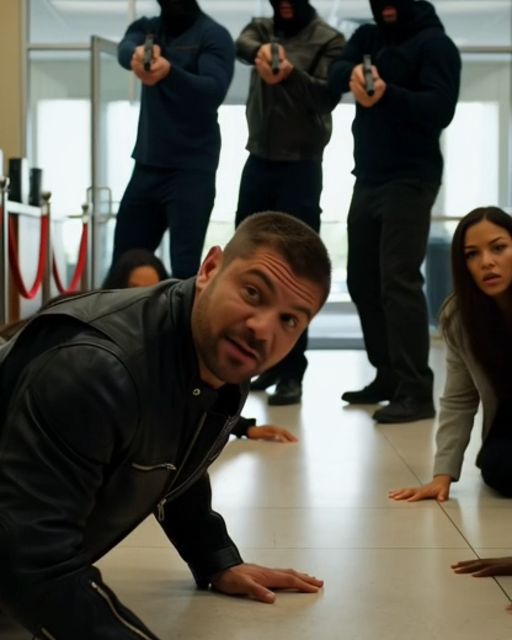
Three men. Masks. Guns.
“EVERYBODY DOWN. PHONES IN THE BAG. NOW.”
I hit the floor with everyone else, heart pounding. But my hands moved fast. I’d already pulled up Vince’s number – my road captain, my brother for twelve years – and fired off a text.
911. First National on Birch. Robbery in progress. I’m inside.
Sent.
The bag came to me. I dropped my phone in, face-down, praying he’d see it in time.
That’s when I noticed the boots.
Steel-toe Harley Davidsons. Custom silver buckles. I’d been with Tank when he bought those at the rally in Sturgis.
My stomach dropped.
I looked at the second guy. The way he held his shoulders. The tattoo peeking out from under his sleeve—a crow with a knife through it. Our crew’s mark.
No.
The third robber barked orders at the tellers. His voice was muffled, but I knew that cadence. I’d heard it a thousand times over engine noise.
Vince.
The man I’d just texted for help was currently pointing a gun at a pregnant woman in the corner.
I couldn’t breathe.
Tank’s eyes swept the room and stopped on me. Even through the ski mask, I saw the moment he recognized me. His whole body went rigid.
He leaned over and whispered something to Vince.
Vince turned.
Slowly.
The bag with all our phones was in his left hand. I watched him reach in and pull out mine. The screen was still lit.
He read the message.
Then he looked directly at me.
The gun in his right hand shifted.
I’d known these men for over a decade. Bled with them. Buried brothers with them.
And now one of them was walking toward me, my own phone in his hand, asking a question I couldn’t answer:
“Who else did you tell?”
His voice was a low growl, distorted by the mask, but it was him. It was Vince.
My mind was a blank, screaming mess. I just stared at him, lying on the cold linoleum floor, the smell of fear and cheap cleaner filling my nose.
“Answer me, Sam.”
Hearing my name from his lips in that moment was like a punch to the gut. It made it real.
“No one,” I croaked out, my throat tight. “Just you. I thought… I thought you could help.”
Vince stood over me, the gun still aimed in my direction, but not directly at me. It was a silent, terrifying question mark.
He looked down at my phone, then back at me. I could feel the eyes of every other hostage burning into my back. They thought I was one of them. They had no idea.
Then, something shifted. Vince lowered the phone. With a sudden, violent motion, he threw it against the marble pillar behind the teller counter. It shattered into a dozen pieces.
“Stay down,” he hissed, his voice just for me. “Don’t be a hero.”
He turned away and went back to the robbery. Tank and the third man, who I now recognized as Grizz by his massive frame, were already stuffing cash into duffel bags.
My betrayal had been seen, judged, and dismissed in less than ten seconds. And I was left with a new kind of terror. I wasn’t just a hostage anymore.
I was a witness. A complication.
I pressed my face against the floor, trying to make myself smaller, invisible. I listened to the sounds. The quiet sobbing of a woman nearby. The frantic rustling of cash. The calm, authoritative commands from Vince.
They were professionals. It was unnerving. This wasn’t some smash-and-grab. It was calculated. Every move had a purpose. They weren’t yelling or causing chaos. They were in control.
It felt like it lasted an eternity, but it must have only been a few minutes.
“Time!” Vince called out.
Tank and Grizz zipped up the bags. They moved toward the door, their movements fluid and practiced.
Vince was the last one to back out. Before he disappeared, his masked face turned and found me one last time. He gave a slight, almost imperceptible nod.
I didn’t know what it meant. Was it a threat? A promise? An apology?
Then they were gone.
The silence they left behind was louder than the robbery itself. For a few seconds, nobody moved. Then one person started to cry, and it was like a dam breaking.
The wail of sirens grew closer.
The police arrived, then paramedics. The bank was a whirlwind of uniforms and flashing lights. We were herded into a corner, wrapped in shock blankets we didn’t need, and told to wait to give our statements.
My heart was a jackhammer against my ribs. I had to lie to the police. I had to lie about my brothers.
An officer with a tired face and a notepad knelt in front of me. “Son, are you okay? Did you see anything?”
I swallowed hard, forcing myself to look him in the eye.
“It happened so fast,” I said, my voice shaky. I didn’t have to fake the fear. “They were wearing masks. Big guys. Professional.”
“Did you recognize anything about them? Voices? Tattoos?”
The crow with the knife burned in my mind’s eye. “No, sir. Nothing. Their voices were muffled.”
He scribbled on his pad. “What about your phone? I see it over there, smashed.”
This was the moment. The lie had to be perfect.
“One of them saw me send a text before they got to me,” I explained, the words tasting like ash. “He grabbed my phone, read it, and then destroyed it.”
“Who did you text?” the officer asked, his pen poised.
“My boss,” I lied. “To tell him I’d be late.”
It was a weak lie, but it was all I had. I was just another victim. Another terrified civilian.
The officer nodded, his expression sympathetic. He had no reason to doubt me. Why would he?
He moved on to the next person, and I let out a breath I didn’t realize I’d been holding for an hour.
I’d done it. I’d protected them.
And I had never felt more alone in my entire life.
They let us go after a few hours. I walked out of the bank into the late afternoon sun, feeling like I’d aged a decade. The world felt different, fragile.
I went home to my small apartment over a garage. The place was usually my sanctuary, filled with the smell of leather and motor oil. Now it felt like a cage.
I sat in the dark, replaying every second. Vince’s voice. Tank’s boots. The shattered pieces of my phone.
Why?
Our crew, the Black Crows, we weren’t saints. We bent the law, sure. But we had a code. We didn’t hurt innocent people. We didn’t pull jobs like this. We were a brotherhood, a family for guys who didn’t have one. We looked out for our own.
Robbing a bank wasn’t just illegal. It was a betrayal of everything we stood for.
Days turned into a week. I watched the news. The police had no leads. The descriptions were generic. The execution was too clean.
I didn’t hear from any of them. I didn’t dare try to make contact. Every time my phone buzzed, my stomach clenched, expecting a call from either the police or Vince.
I was living in a gray space between two worlds, belonging to neither.
Then, one night, a week and a half after the robbery, my burner phone chirped. It was a number I didn’t recognize.
A single text message.
“Workshop. Midnight. Come alone.”
There was no question who it was from.
The old workshop was twenty miles out of town, a derelict corrugated iron building at the end of a dirt road. It was where we came to fix our bikes, drink beer, and escape the world. It was our church.
Pulling up, I saw a single bike parked in the shadows. Vince’s custom chopper.
I cut my engine and walked toward the door. It was slightly ajar.
My hand was shaking as I pushed it open.
The place was lit by a single bare bulb hanging from a wire. Vince was sitting on an upturned crate, a duffel bag at his feet. Tank and Grizz were standing behind him, their faces grim.
No one said a word as I walked in. The air was thick enough to choke on.
I stopped about ten feet from them. “Vince,” I said, my voice hoarse.
“Sam,” he replied, his tone flat. He gestured to another crate. “Sit down.”
I sat. The silence stretched on. I could hear the wind whistling through a crack in the wall.
“You got guts, showing up here,” Grizz rumbled from the corner.
“He’s here because he’s one of us,” Tank said, his voice quiet but firm. He wouldn’t meet my eyes.
Vince finally looked up at me. His face was etched with exhaustion.
“You want to know why,” he said. It wasn’t a question.
I just nodded.
Vince sighed, a heavy, tired sound. He reached down and unzipped the duffel bag. It was full of cash. Stacks and stacks of it.
“This isn’t for us,” he said, kicking the bag lightly. “It’s not for new bikes or a better clubhouse. It’s for Maya.”
Tank’s daughter.
I stared at him, confused. Maya was Tank’s whole world. A sweet little girl with pigtails who loved to sit on her dad’s bike and pretend to ride. She was eight years old.
“What about Maya?” I asked.
Tank was the one who answered. He finally looked at me, and his eyes were hollowed out, filled with a pain so deep it stole my breath.
“She’s sick, Sam,” he said, his voice breaking. “She has a neuroblastoma. A rare kind. Aggressive.”
My blood ran cold.
“The doctors here… they gave her six months,” Tank continued, wiping at his eyes with the back of a hand. “They said there’s nothing more they can do.”
“But there is,” Vince cut in, his voice hard as steel. “There’s an experimental treatment. A clinic in Mexico. The success rate is high. But it’s not approved here. Insurance won’t touch it.”
He paused, letting the words sink in.
“The cost is a quarter of a million dollars. Cash. Upfront.”
Suddenly, the world tilted on its axis. The robbery. The masks. The money. It all snapped into a horrifying, heartbreaking focus.
“We tried everything,” Vince said. “We pooled all our money. Sold what we could. Took out loans. It wasn’t enough. Tank went to the bank—that bank—for a business loan against his auto shop. They turned him down flat.”
The First National Bank on Birch. The same bank they had robbed.
It wasn’t a random target. It was personal. It was revenge.
“So you took it,” I whispered, the realization dawning on me.
“We took what was ours,” Vince corrected me. “What that bank owed a little girl. We have a code, Sam. We look after our own. No matter what.”
I looked at Tank, a mountain of a man, now looking so broken and small. I thought of Maya, her bright laugh echoing in my memory.
The betrayal I had felt curdled into a deep, profound understanding. They hadn’t broken our code. They had honored it in the most extreme way possible.
“What you did in there,” Vince said, his eyes locking onto mine, “texting me… that was you following your gut. Doing what any citizen would do. I get it. Smashing your phone was the only thing I could think of to protect you.”
He leaned forward, his expression intense.
“But now we’re in it. And you’re in it, too. Your text is on record. The cops will eventually look at call logs. They’ll see a message was sent from the bank to my number right as the robbery started. They’ll come asking me questions. And they’ll come asking you why you texted a known biker instead of 911.”
He was right. I hadn’t thought that far ahead. I was tied to this, whether I wanted to be or not.
“Tank and his family need to disappear,” Vince continued, laying out the plan. “They need to get to Mexico. But he can’t be seen moving this kind of cash. He’s already a person of interest because the bank knew he was desperate.”
“They need a ghost,” Grizz added from the shadows. “Someone clean. Someone who was just a victim in the bank that day.”
They were all looking at me.
They weren’t asking me to be an accomplice. They were asking me to be a brother.
The choice wasn’t a choice at all. How could I say no? How could I look at Tank, my friend who’d once taken a pool cue to the back for me, and tell him I wouldn’t help save his little girl?
“What do you need me to do?” I asked.
A wave of relief washed over the room. For the first time that night, Tank managed a weak smile.
The next two weeks were the most stressful of my life. I was their man on the inside. I met with the detectives twice, playing the part of the traumatized hostage. I fed them small, useless details I “remembered,” sending them down rabbit holes and away from the Crows.
My main job was moving the money. In small, untraceable amounts, I helped convert the cash into a more portable form, wiring it piece by piece to a contact Vince had south of the border.
The final piece of the puzzle was getting Tank, his wife, and Maya out of the country. We couldn’t risk them driving.
We used the club’s network. A favor called in from a charter in Texas. A private plane owned by a “sympathetic” businessman.
The night they left, we met at a small, private airstrip an hour out of town. The air was cold and smelled of rain.
Tank pulled me into a hug that nearly cracked my ribs.
“I don’t know how to thank you, Sam,” he whispered, his voice thick with emotion.
“Just get her better,” I said, clapping him on the back. “That’s all the thanks I need.”
I knelt down in front of Maya. She was pale and thin, a little wool hat covering her head, but her eyes were still bright. She handed me a drawing she’d made. It was a lumpy-looking motorcycle with a stick figure on it. She’d written “Sam” at the top.
I folded it carefully and put it in my jacket pocket. “You be brave, little bird,” I told her.
She gave me a small smile.
I watched them board the tiny plane. As it taxied down the runway and lifted into the dark sky, I felt a strange mix of fear and hope.
We had broken every law in the book. But maybe, just maybe, we had done the right thing.
Months crawled by. The police investigation into the robbery went cold, just as Vince predicted. Life returned to a semblance of normal, but nothing was ever really the same. The club was quieter. The space Tank left was a constant, aching void.
I never knew if they made it. If the treatment worked. The silence was its own kind of torture.
Then, six months after they disappeared, a postcard arrived in my mailbox. It had no return address and a Mexican stamp.
The front was a picture of a bright, sunny beach.
I flipped it over. It wasn’t a picture. It was a photograph, taped to the cardboard.
It was Maya. She was standing on the sand, her hair growing back in soft brown curls, a huge smile on her face. She looked healthy. Happy.
Below the photo, there were only six words written in Tank’s familiar scrawl.
“She’s in remission. Thank you, brother.”
I stood there in my driveway, the postcard trembling in my hand, and I cried. I cried for the fear, for the lies, for the brother I missed, and for the little girl who was going to live.
Looking back, I know what we did was wrong in the eyes of the law. We became the very criminals people assumed we were. But the law doesn’t have a heart. It doesn’t understand desperation. It doesn’t make exceptions for a child’s life.
Sometimes, the only code that matters is the one you write yourself. It’s the one that tells you to stand by your family, to fight for them when no one else will. We broke the law to uphold our own code, and it was the most right thing I have ever done. Right and wrong are just words, but a life saved? That’s real. That’s forever.