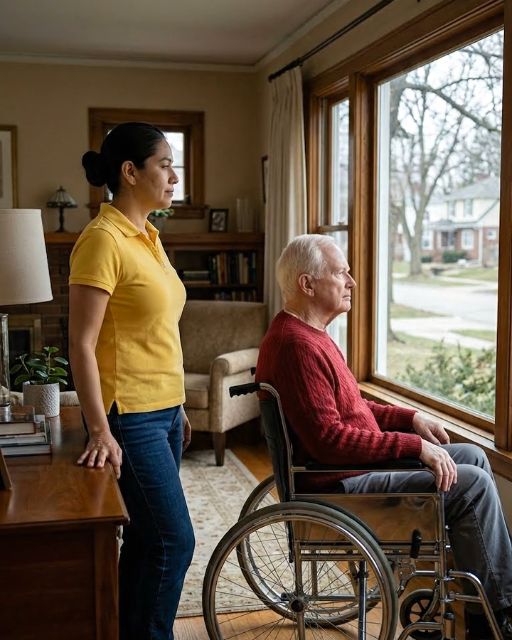

I’m a home nurse and cared for an elderly patient for 10 years. Her children never visited, even when she begged. When she passed, I was devastated. At the funeral, her daughter stormed up and hissed, “You manipulated my mother!” I was confused. But the next day I found a thick, cream-colored envelope tucked inside my mailbox, addressed to me in Mrs. Gable’s shaky but elegant cursive.
I sat on my porch steps, my hands trembling as I tore the seal. Inside was a single key and a letter that explained everything I hadn’t seen coming during those long decade-long afternoons of tea and quiet conversation. Mrs. Gable hadn’t just left me her gratitude; she had left me the deed to the small cottage she owned on the coast, a place she’d mentioned only once as her “sanctuary.”
The daughter, Beatrice, had clearly seen a draft of the will, which explained her venomous outburst at the funeral. I felt a knot of guilt tightening in my chest, even though I knew I had done nothing but my job with a little extra love. For ten years, I was the one who changed her linens, listened to her stories about the Great War, and held her hand when the nights got too long and the house too quiet.
Her children, Beatrice and her brother Julian, were always “too busy” with their corporate lives in the city to catch a flight or even stay on the phone for more than five minutes. I remember Mrs. Gable sitting by the window every Sunday, wearing her best pearl earrings, hoping the driveway would finally play host to a car that wasn’t mine. It never happened, and eventually, she stopped asking me to check the calendar for holiday dates.
The letter in my hand whispered a different story than the one Beatrice had shouted at the cemetery. “My dear Sarah,” it began, “you were the daughter I should have raised, the one who understood that time is the only currency that actually matters.” She wrote about how she knew her children were only waiting for her to pass so they could settle her debts and claim her substantial estate.
What they didn’t know was that Mrs. Gable had been much craftier with her finances than they ever gave her credit for. They assumed she was a frail old woman losing her grip on reality, but she was sharp as a tack until her very last breath. She had spent the last five years quietly liquidating certain assets and moving them into a trust they couldn’t touch.
I drove out to the coastal cottage the following weekend, mostly to escape the hounding phone calls from Beatrice’s lawyers. The house was nestled on a cliffside, overlooking a grey, churning Atlantic that seemed to match my somber mood. It was small, weathered by salt and time, but it felt more like a home than the sterile mansion Mrs. Gable had died in.
When I stepped inside, the air smelled of dried lavender and old books, exactly like her. On the kitchen table sat another note, weighted down by a heavy, antique silver compass. “Look beneath the floorboards where the light hits at noon,” the note instructed in that familiar, spindly handwriting.
I waited, watching the sun crawl across the hardwood floor until it illuminated a slightly loose plank near the hearth. Prying it up was easier than I expected, revealing a small metal lockbox that looked like it belonged in a pirate movie. I used the small key from the first envelope, and the lid creaked open to reveal stacks of letters, but not a dime of money.
These weren’t just any letters; they were unopened envelopes addressed to Beatrice and Julian, dating back twenty years. Every single one was returned to sender, marked “refused” or “moved, no forwarding address.” It hit me then that Mrs. Gable hadn’t been the one who cut ties; her children had systematically erased her from their lives long ago.
But as I sifted through the bottom of the box, I found a legal document that turned my stomach. It was a loan agreement, showing that Mrs. Gable had actually been the silent benefactor who kept Beatrice’s failing boutique hotel afloat for three years. Beatrice didn’t even know it was her mother’s money; she thought she had secured a private investment from a nameless firm.
The twist was that the “nameless firm” was a shell company Mrs. Gable had created to help her daughter without bruising her ego. If Beatrice had been kinder, the debt would have been forgiven upon her mother’s death. Instead, because of a specific clause Mrs. Gable inserted, the debt was now owed to the estate’s primary beneficiary: me.
I spent a long time staring at the ocean that evening, grappling with the power I now held over the woman who had insulted me in front of a grieving crowd. I could literally take Beatrice’s business away with a single phone call to the executors. It felt like a karmic hammer, heavy and ready to drop, but it also felt incredibly sad.
A few days later, Beatrice called me, her voice no longer hissing but brittle and desperate. She had found out about the trust and the debt, and she realized that her entire lifestyle was hanging by a thread I held. “Please,” she sobbed over the phone, “that hotel is everything I have, I didn’t know she was the one behind the funding.”
I invited her to the cottage, the one she didn’t even know her mother owned. When she arrived, she looked haggard, the polished veneer of the city woman completely stripped away by anxiety. We sat in the kitchen, and I pushed the box of returned letters toward her without saying a word.
She opened them one by one, her face turning a ghostly shade of white as she read her mother’s words from a decade ago. Mrs. Gable hadn’t been begging for money or even for help; she had been writing to tell them she loved them and that she forgave them for being busy. The letters were filled with recipes, advice on gardening, and gentle jokes that Beatrice had never bothered to receive.
“I thought she was just an obstacle,” Beatrice whispered, clutching a letter from five years ago. “I thought she was just a reminder of a childhood I wanted to forget.” I told her then about the Sunday afternoons by the window and the way her mother never once spoke a harsh word about her children to me.
I told her that I wasn’t going to call in the debt, but I wasn’t going to give her the money either. Instead, I proposed that we turn the cottage into a foundation for elderly people who had no families to visit them. I wanted to use the funds from the trust to pay for home nurses who would do more than just medical checks—they would be companions.
Beatrice looked at me with a mixture of confusion and profound relief. She asked why I would do that after how she had treated me at the funeral. I told her that Mrs. Gable didn’t spend ten years teaching me how to be a nurse; she spent ten years teaching me how to be a human being.
The transformation in Beatrice didn’t happen overnight, but it did happen. She started coming to the cottage on weekends, not to manage the business, but to help paint the walls and plant the lavender garden her mother had always wanted. We worked side by side, two women connected by a lady who was far wiser than either of us realized.
Julian eventually surfaced too, though he was harder to reach than his sister. When he saw the letters, he didn’t cry like Beatrice did; he just sat in silence for three hours, staring at the sea. He ended up donating a portion of his own savings to the foundation, perhaps as a way to settle a debt that wasn’t financial.
The “Gable Sanctuary” opened its doors a year later, a small, cozy place where no one ever had to sit by a window alone on a Sunday. I stayed on as the director, making sure that every patient felt like they were the most important person in the room. It wasn’t about the grand inheritance or the coastal property; it was about the dignity of being seen.
Beatrice became one of our most dedicated volunteers, surprisingly enough. She found that talking to the residents helped her heal the holes in her own heart. She often told them stories about her mother, finally claiming the relationship she had spent her adult life running away from.
One afternoon, I found Beatrice sitting with an elderly man who reminded me a bit of a male version of Mrs. Gable. She was listening to him talk about his days as a carpenter, her phone tucked away in her bag, completely forgotten. I realized then that the “manipulation” she had accused me of was actually just the mirror she was afraid to look into.
Mrs. Gable had known exactly what she was doing when she left that key in my mailbox. She knew that giving the money directly to her children would have only fueled their shallow lives. By giving it to me, she forced them to confront the person who had actually stood in their place for ten years.
It was a lesson in the true meaning of family. Family isn’t just about the blood that runs through your veins; it’s about the people who show up when the world gets dark. It’s about the person who knows how you take your tea and which old stories make you smile even when you’ve told them a thousand times.
The cottage still stands on the cliff, a beacon for those who feel forgotten by a fast-moving world. Every time I walk through the front door, I feel Mrs. Gable’s presence in the warmth of the wood and the sound of the waves. She managed to take care of her children even after she was gone, just not in the way they expected.
The most rewarding part wasn’t the house or the financial security it provided me. It was seeing a daughter finally fall in love with the memory of a mother she never took the time to know. It was seeing the cycle of neglect break and turn into something beautiful and productive.
I often think about that moment at the funeral when I felt so small and accused. I’m glad I didn’t snap back or let bitterness take root in my own soul. If I had reacted with anger, I might have never opened that mailbox with an open heart.
Life has a funny way of balancing the scales if you give it enough time and a little bit of grace. Mrs. Gable taught me that patience is more than just a skill for a nurse; it’s a way of living. You wait for the sun to hit the floorboards, and you wait for people to find their way home.
In the end, we are all just caregivers in one way or another. Whether we are looking after a patient, a business, or a memory, what matters is the quality of our attention. I’m just grateful I got to spend ten years learning from the best teacher I ever had.
The Gable Sanctuary continues to grow, and sometimes, when the wind blows just right, I can almost hear her laughing. She’d be happy to know the tea is always hot and the driveway is always full of cars. No one sits by the window waiting anymore because someone is always there sitting right next to them.
This journey taught me that true wealth isn’t found in a bank account or a deed. It’s found in the quiet moments of connection that most people are too busy to notice. It’s in the holding of a hand and the listening to a story that has been told a hundred times before.
Kindness is a seed that sometimes takes a decade to bloom, but when it does, it can cover an entire coastline. Never underestimate the power of simply being there for someone when everyone else has walked away. Your presence might be the greatest inheritance they ever receive, and it might just change your life too.
If this story touched your heart, please like and share it with someone who might need a reminder that they are not alone. Let’s spread the message that time and love are the most precious gifts we can give. We never know whose life we might be changing just by showing up.