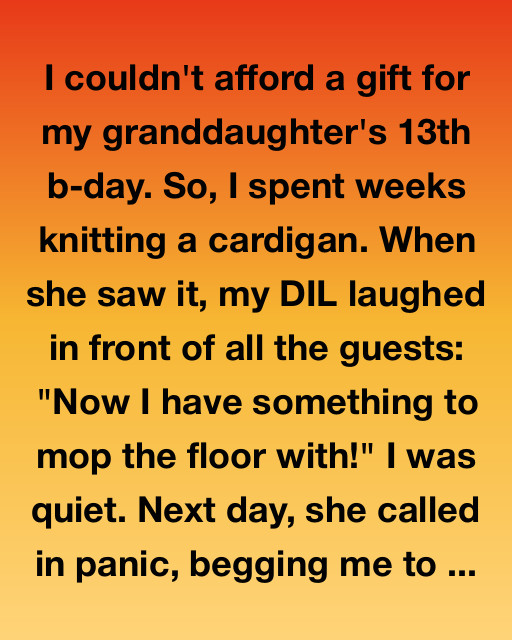
I couldn’t afford a gift for my granddaughter’s 13th b-day. So, I spent weeks knitting a cardigan. When she saw it, my DIL laughed in front of all the guests: “Now I have something to mop the floor with!” I was quiet. Next day, she called in panic, begging me to come over immediately because something terrible had happened.
My hands were still shaking from the humiliation of the previous evening. I had sat in my small, one-bedroom apartment for hours, staring at the leftover balls of yarn. To Brenda, my daughter-in-law, that cardigan was just a pile of cheap wool. To me, it was thirty nights of skipped sleep and a way to tell my granddaughter, Maya, that I loved her more than my empty bank account could say.
Brenda had always been a woman who valued labels and price tags above all else. She came from a family that measured success by the shine of their floor tiles and the brand of their handbags. My son, Silas, worked two jobs just to keep up with the lifestyle she demanded for their suburban home. I never complained, even when they forgot my birthday or “lost” the invitations to family dinners.
When Brenda’s voice crackled through the phone the next morning, she didn’t sound like her usual arrogant self. She sounded small, terrified, and completely out of options. “Evelyn, please, you have to come,” she sobbed into the receiver. “It’s about the party, it’s about the house, it’s everything!”
I didn’t want to go, especially after she had mocked my hard work in front of thirty people. But Maya was my world, and if something was wrong at that house, I couldn’t just sit in my rocking chair and ignore it. I put on my old coat, tucked my knitting bag under my arm just in case I needed to keep my hands busy, and caught the bus.
When I arrived, the driveway was cluttered with expensive cars, but the house felt cold and frantic. Brenda met me at the door, her makeup smeared and her expensive silk blouse stained with something dark and sticky. She didn’t even say hello; she just grabbed my arm and pulled me toward the kitchen.
“Look at this!” she wailed, pointing to the center of the living room floor. Spread out across the white marble were dozens of expensive designer dresses, sweaters, and even a few suede coats. They were all covered in a strange, thick, blue residue that looked like a mixture of paint and heavy grease.
Apparently, Maya’s friends had stayed over for a slumber party, and one of them had brought a “science kit” that went horribly wrong. A bottle of industrial-strength pigment had leaked inside a bag, and in their excitement, the girls had tracked it everywhere. Brenda had tried to clean it with a harsh chemical she found in the garage, but that only made the stain spread and set into the fabric of her most prized possessions.
“I have a charity gala tonight, and half of these clothes aren’t even mine—I borrowed them from my mother and my sisters!” Brenda screamed. “The dry cleaner said they’re ruined, and the professional cleaners won’t be here until tomorrow!” I looked at the mess and then looked at Brenda, who was staring at me with a desperate, wild look in her eyes.
“Why did you call me, Brenda?” I asked quietly, keeping my voice steady despite the chaos. “You told everyone yesterday that my knitting was only good for mopping floors.” She turned bright red, the memory of her cruelty finally catching up to her in the face of her own disaster.
“I saw what you did with that old rug last year,” she stammered, referring to a time I had saved a vintage tapestry using a specific vinegar soak and a hand-knotted technique. “You know how to handle fibers, Evelyn. Please, if you save these clothes, I’ll… I’ll do anything.”
I walked over to the pile of ruined luxury and knelt down, feeling the texture of the damaged silk. It was a mess, but I knew exactly what to do. I didn’t do it for her, though; I did it because I saw Maya standing in the hallway, looking ashamed of her mother and sad about the broken atmosphere of her birthday weekend.
I spent the next six hours in that laundry room, using every trick I had learned over sixty years of being a homemaker. I used cold salt baths, lemon zest, and a very specific gentle scrubbing motion that only someone who spends their life working with yarn would understand. Brenda watched from the doorway, silent for once, as I meticulously pulled the pigment out of the delicate threads.
As I worked, I realized something important about the items Brenda valued so much. They were beautiful, yes, but they were fragile and easily destroyed by a single mistake. My cardigan, the one she had laughed at, was made of sturdy wool meant to survive winters and hugs and years of wear.
By five o’clock in the evening, the “ruined” clothes were hanging on the line, smelling of lavender and fresh air, the stains completely gone. Brenda was speechless as she touched a silk scarf that had been a muddy blue just hours before. She looked at me, then looked down at her feet, finally realizing that the “useless” skills of an old woman had saved her reputation.
“Thank you,” she whispered, and for the first time in ten years, I actually believed she meant it. But the real twist was yet to come, and it didn’t involve the clothes or the cleaning at all. As I was packing up my things to leave, Silas came home early and found us in the kitchen.
He looked at the clean clothes, then at his wife’s humbled face, and then at the knitting bag I was holding. “Mom,” he said, his voice thick with emotion, “I need to show you something in Maya’s room.” I followed him up the stairs, wondering if the girls had made another mess I needed to scrub away.
When we opened Maya’s door, I saw my granddaughter sitting on her bed, but she wasn’t wearing her new designer jeans or the expensive sneakers her parents had bought her. She was wearing the lumpy, slightly uneven, hand-knitted grey cardigan I had given her the night before. She had tucked a small silk flower into the lapel, and she was looking at herself in the mirror with a wide, genuine smile.
“It’s the only thing that feels like you, Grandma,” Maya said, jumping up to give me a squeeze. “All the other gifts are just stuff from a store, but this feels like a hug I can wear to school.” I felt tears prickling my eyes as I realized that while the mother saw a mop, the daughter saw a treasure.
Brenda stood in the doorway, watching her daughter cherish the very thing she had mocked so publicly. The silence in the room was heavy, but it wasn’t uncomfortable anymore; it was the kind of silence that happens when someone finally sees the truth. Brenda walked over to the closet and pulled out the expensive leather jacket she had bought for Maya’s birthday.
“Maya,” Brenda said softly, “I think Grandma’s gift is actually much better than mine.” She turned to me and took my rough, dish-soaped hands in her manicured ones. “I was a fool yesterday, Evelyn. I thought money bought quality, but it only buys things. You’ve given us something that can’t be replaced.”
Then came the part I never expected, the moment that felt like a true reward for all those years of being the “poor” relative. Brenda went to her desk and pulled out a small, dusty wooden box that I recognized from years ago. It belonged to her own grandmother, a woman she rarely spoke about because she had been a simple seamstress from the countryside.
“I’ve been keeping this hidden because I was ashamed of where I came from,” Brenda admitted, opening the box to reveal old patterns and high-quality knitting needles. “I wanted everyone to think I was born into wealth, so I pushed you away to hide my own roots.” She handed me a set of beautiful, hand-carved rosewood needles that were worth more than any designer bag.
“I want you to teach me, Evelyn,” she said, her voice cracking. “I want to learn how to make something that my daughter will want to keep forever.” I looked at Silas, who was beaming with pride at his wife’s change of heart, and then at Maya, who was already picking out a blue yarn for her next sweater.
We spent the rest of the evening not at a gala, but in the living room, with yarn sprawled across the marble floor. I showed Brenda how to cast on, watching her struggle with the simple movements that I could do in my sleep. It was a slow process, and her first few rows were a disaster, but we laughed together for the first time in a decade.
The karmic beauty of it all was that Brenda’s obsession with appearances had led her to the brink of social ruin, only for her to be saved by the very “lowly” craft she despised. By trying to mop the floor with my pride, she had accidentally cleared the path for a real relationship to begin. My son didn’t have to choose between his mother and his wife anymore, and my granddaughter had a family that finally understood what “value” really meant.
As weeks went by, the news of my “miracle cleaning” and my knitting skills spread through Brenda’s social circle. Suddenly, all those wealthy women who used to ignore me were calling, asking if I could repair their heirlooms or teach them how to knit. I started a small business from my apartment, not because I needed the money, but because I loved seeing people appreciate the work of human hands.
Brenda became my best student, and though she never became a master knitter, she became a much better mother and daughter-in-law. She stopped looking at the price tags and started looking at the effort people put into their lives. Every time she sees that grey cardigan on Maya, she gives me a little nod of respect, a silent apology that we both understand.
I learned that you should never let someone else’s lack of vision dim your own light. If you provide value from a place of love, it will eventually be recognized, even by those who are blinded by glitter and gold. True wealth isn’t what you have in your bank account; it’s the skills you carry in your hands and the love you store in your heart.
I still knit every single day, but now I don’t do it in the dark to save on electricity. I do it in the sun, surrounded by my family, teaching the next generation that a handmade life is the most beautiful one of all. It took a ruined party and a bottle of blue pigment to show us the way, but I wouldn’t trade that journey for anything.
Maya still wears that cardigan, even though she’s outgrowing it now. She says it’s her lucky charm, the thing that reminds her that her grandmother’s love is stronger than any stain or any mean word. And whenever I see her in it, I remember that sometimes, the things that people want to use to mop the floor are actually the things that keep our souls clean.
This story is a reminder to always cherish the elders in your life and the traditions they carry. Love is often found in the simplest gestures, and character is revealed when the “expensive” things in life fall apart. Don’t be afraid to be yourself, even when the world tells you that you aren’t enough.
The best gifts aren’t bought with a credit card; they are crafted with patience and given with a pure heart. If you believe that family and kindness are more important than status, then you already possess the greatest wealth imaginable. Never underestimate the power of a grandmother’s hands or the strength of a knitted thread.
Life has a funny way of bringing us back to what matters most when we lose our way. Sometimes you have to hit the bottom—or have your designer wardrobe ruined—to realize what’s truly standing right in front of you. Keep your heart open, keep your needles moving, and never let anyone tell you that your work is “just a mop.”
If this story touched your heart or reminded you of your own grandmother, please LIKE this post and SHARE it with your friends and family! Let’s spread a little bit of warmth and remind everyone that the best things in life are truly handmade.